
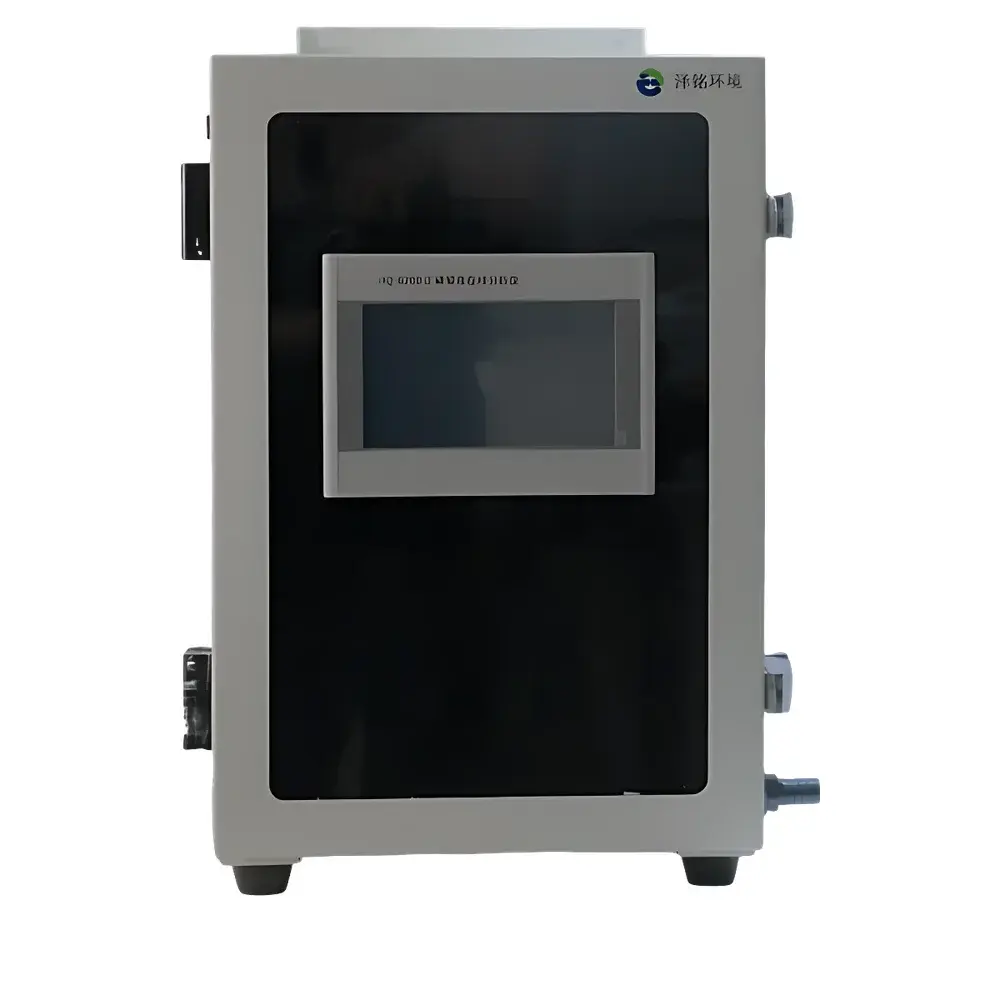
Zming HQ-6200 Online Orthophosphate Analyzer
| Brand | Zming Environmental Technology Co., Ltd. |
|---|---|
| Origin | Shanghai, China |
| Model | HQ-6200 |
| Instrument Type | Online Analyzer |
| Measurement Principle | High-Performance Colorimetry (Molybdenum Blue Method) |
| Detection Range | 0.05–5 mg/L PO₄–P and 0.5–50 mg/L PO₄–P (dual-range auto-switching) |
| Detection Limit | 0.02 mg/L PO₄–P |
| Sample Cycle Time | ≤5 minutes (from aspiration to result output) |
| Reagent Consumption | <10 µL per measurement |
| Operating Mode | Programmable single-shot, continuous, periodic, or event-triggered measurement |
| Cleaning System | Integrated automated ultrasonic + air-pulse cleaning module |
| Compliance | Designed to support ISO 15586, ASTM D515-18, and EPA Method 365.1 workflows |
| Software Interface | RS485/Modbus RTU, optional Ethernet/IP and OPC UA |
| Enclosure Rating | IP65 |
Overview
The Zming HQ-6200 Online Orthophosphate Analyzer is a fully automated, microfluidic-based water quality monitoring instrument engineered for high-precision, low-maintenance orthophosphate (PO₄–P) quantification in real time. It operates on the standardized molybdenum blue colorimetric principle—where orthophosphate reacts with ammonium molybdate and ascorbic acid under acidic conditions to form a phosphomolybdenum blue complex, whose absorbance at 880 nm is linearly proportional to concentration. This method is internationally recognized in regulatory frameworks including EPA Method 365.1, ISO 15586, and ASTM D515-18. The HQ-6200 integrates proprietary microfluidic flow cells, temperature-stabilized optical detection, and adaptive range switching to deliver robust performance across diverse matrices—from ultra-low-concentration environmental surface waters to high-salinity industrial cooling loops. Its compact architecture and minimal reagent demand (<10 µL per analysis) reflect a systems-level optimization for long-term unattended operation in distributed monitoring networks.
Key Features
- Microfluidic platform enabling precise metering, mixing, and reaction control—reducing carryover and improving inter-run reproducibility.
- Dual-range auto-switching capability (0.05–5 mg/L and 0.5–50 mg/L PO₄–P), eliminating manual range selection and minimizing operator intervention.
- Sub-5-minute total cycle time: includes sample aspiration, filtration (optional inline 5-µm filter), digestion (if required for hydrolysable phosphate), color development, photometric measurement, and data reporting.
- Automated maintenance system combining ultrasonic transducer activation and pulsed compressed air to prevent biofilm formation and nozzle clogging—reducing scheduled cleaning intervals by up to 70% versus conventional analyzers.
- Modular hardware design with hot-swappable reagent cartridges, optical cell, and peristaltic pump heads—supporting field-level replacement without calibration recalibration.
- Embedded temperature compensation (±0.1°C resolution) and LED-based photometry with drift-corrected dual-beam optics to ensure stability under ambient fluctuations.
Sample Compatibility & Compliance
The HQ-6200 is validated for use with raw influent, clarified effluent, boiler feedwater, cooling tower blowdown, agricultural runoff, and lacustrine samples—with turbidity tolerance up to 100 NTU (with optional integrated filtration). It complies with functional requirements of GLP and GMP-aligned monitoring programs, offering configurable audit trails, user access levels, and electronic signature support for 21 CFR Part 11 readiness. All wetted materials meet USP Class VI and FDA-compliant polymer standards (e.g., PTFE, PEEK, borosilicate glass). Data output conforms to WQ-XML and WaterML 2.0 schemas, facilitating integration into SCADA, EMS, and cloud-based water intelligence platforms.
Software & Data Management
The embedded firmware supports local configuration via web interface (HTTPS-enabled) or terminal CLI. Remote management is enabled through Modbus RTU (RS485), with optional upgrades to Modbus TCP, EtherNet/IP, or OPC UA for enterprise-level interoperability. Data logging includes raw absorbance values, temperature logs, reagent usage counters, diagnostic flags (e.g., “low reagent,” “flow fault,” “optical drift alert”), and QC check results. Internal storage retains ≥12 months of 15-minute interval data (expandable via microSD). Firmware updates are delivered via signed OTA packages with SHA-256 verification to ensure integrity and traceability.
Applications
- Industrial process control: Real-time monitoring of orthophosphate in boiler feedwater (to prevent scale formation) and cooling water (for corrosion inhibition optimization) in power plants, petrochemical refineries, and steel mills.
- Wastewater treatment: Closed-loop feedback for biological phosphorus removal (Bio-P) and chemical precipitation dosing control in tertiary treatment stages.
- Environmental compliance: Continuous monitoring of eutrophication-sensitive water bodies—including rivers, reservoirs, and estuaries—aligned with EU WFD and US Clean Water Act reporting thresholds.
- Agricultural water stewardship: Tracking phosphate leaching from irrigation return flows and aquaculture discharge to support nutrient management plans (NMPs).
- Research-grade deployment: High-temporal-resolution nutrient flux studies in mesocosms, limnological observatories, and climate change impact assessments.
FAQ
What digestion protocol does the HQ-6200 use for total phosphorus conversion?
The HQ-6200 is configured for orthophosphate only; total phosphorus measurement requires external persulfate digestion upstream. An optional inline UV/persulfate digester module (HQ-DIG-PS) is available as an add-on.
Can the analyzer operate without a central reagent supply system?
Yes—it uses self-contained, pre-filled reagent cartridges (6-month shelf life under ambient storage) with RFID-tracked lot serialization and expiration monitoring.
Is remote calibration verification supported?
Yes—via programmable standard addition sequences using certified reference materials (CRMs) traceable to NIST SRM 3139a, with automatic slope/intercept validation reports.
How is interference from arsenate or silicate mitigated?
The optical path employs spectral deconvolution algorithms trained on multi-analyte interference libraries; additionally, a dedicated silicate compensation channel (810 nm) is activated when silicate >1 mg/L SiO₂ is detected.
What cybersecurity measures are implemented in the firmware?
Role-based authentication (RBAC), TLS 1.2 encryption for web sessions, disabled default credentials, and configurable password policies compliant with IEC 62443-3-3 SL1.







