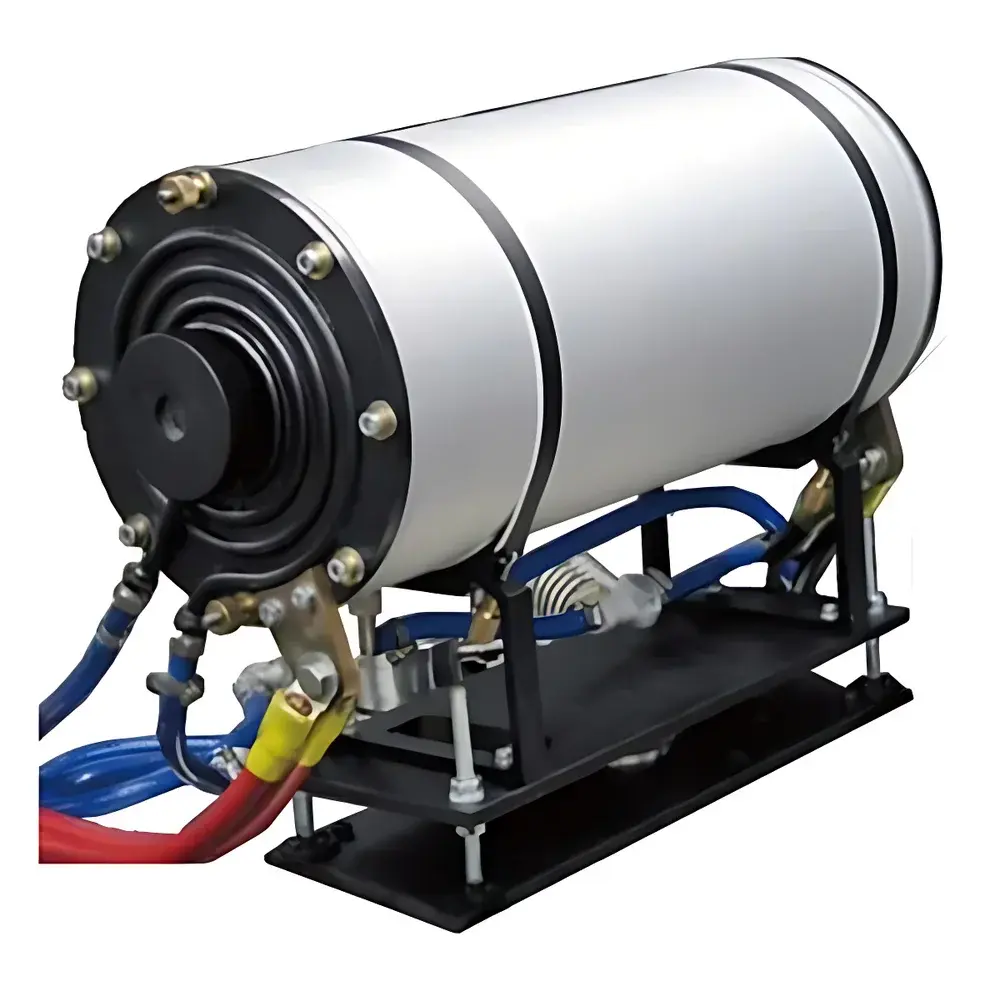
VNIIOFI BB3500M High-Temperature Pyrolytic Graphite Blackbody Furnace
| Brand | VNIIOFI |
|---|---|
| Origin | Russia |
| Model | BB3500M |
| Temperature Range | 1500 K – 3500 K |
| Emissivity | 0.9995 ± 0.0005 (350 nm – 2500 nm) |
| Cavity Bore Diameter | 38 mm |
| Aperture Diameter | 25 mm (unwindowed) or with removable fused silica viewport |
| Max. Current | 800 A |
| Max. Voltage | 30 V |
| Cooling Water Flow Rate | 25 L/min at 15 °C |
| Operating Atmosphere | Argon or vacuum |
| Main Gas Flow | 3 L/min |
| Shield Gas Flow | 0.4 L/min |
| Cavity Lifetime | 700 h at 2800 K, 150 h at 3200 K |
| Dimensions (L × Ø) | 700 mm × 260 mm |
| Orientation | Vertical or horizontal mounting |
| Temperature Resolution | 0.01 °C |
| Ramp Time (to max temp) | 2 h |
| Cool-down Time | 2 h |
Overview
The VNIIOFI BB3500M is a high-temperature, pyrolytic graphite blackbody furnace engineered for primary radiometric calibration and thermodynamic temperature realization in national metrology institutes and accredited calibration laboratories. Operating on the principle of thermal radiation equilibrium within a highly emissive, isothermal cavity, the BB3500M serves as a primary standard source for spectral radiance, spectral irradiance, and radiation thermometry across the UV–VIS–IR spectrum (350 nm to 2500 nm). Its cavity—fabricated from ultra-pure, low-outgassing pyrolytic graphite—achieves an exceptionally stable and uniform temperature distribution under controlled inert (argon) or vacuum conditions. With a nominal operating range spanning 1500 K to 3500 K, the BB3500M supports key applications including the realization of high-temperature fixed points (HTFPs), such as the Co–C (1324.3 K), Pt–C (1738.0 K), and Re–C (2747.8 K) eutectics, and functions as a reference source for optical pyrometer calibration per ISO/IEC 17025 and ASTM E2758.
Key Features
- Pyrolytic graphite cavity construction ensures exceptional thermal stability, minimal outgassing, and long-term structural integrity at temperatures up to 3500 K
- Measured spectral emissivity of 0.9995 ± 0.0005 over 350 nm–2500 nm, validated against cavity radiation theory and traceable to national standards
- 38 mm internal cavity bore and 25 mm unobstructed aperture enable high radiant flux output while maintaining near-Lambertian emission characteristics
- Modular viewport option: removable fused silica window rated for continuous operation up to 1200 °C, facilitating in-situ alignment and spectral transmission verification
- Dual-gas delivery system: main purge (3 L/min Ar) maintains cavity purity; auxiliary shield gas (0.4 L/min Ar) isolates the aperture region from ambient oxidation and convection disturbances
- Water-cooled outer jacket with precisely regulated flow (25 L/min at 15 °C inlet) enables thermal management during extended dwell cycles at peak temperatures
- Flexible mounting configuration supports both vertical and horizontal orientation, accommodating integration into custom optical benches or fixed-point cell assemblies
Sample Compatibility & Compliance
The BB3500M is designed exclusively for use with solid-state, non-reactive calibration targets and does not accommodate liquid or volatile samples. It complies with the physical principles outlined in CIPM Recommendation 2 (2022) on high-temperature radiation thermometry and satisfies the cavity design criteria specified in ISO 18434-1:2008 (Condition monitoring — Thermography — Part 1: General procedures). Its performance is routinely verified against the International Temperature Scale of 1990 (ITS-90) extrapolation protocols and supports traceability to the SI kelvin via radiometric methods. The furnace meets mechanical and electrical safety requirements per IEC 61010-1:2010 for laboratory equipment and is compatible with GLP-compliant audit trails when operated with certified data acquisition systems.
Software & Data Management
While the BB3500M operates via external programmable power supplies and independent temperature controllers (e.g., Eurotherm 3508 or equivalent), its integration into automated calibration workflows is supported through analog/digital I/O interfaces (0–10 V, 4–20 mA, RS-485 Modbus RTU). Users may log cavity temperature, cooling water inlet/outlet temperatures, gas flow rates, and power parameters using third-party SCADA or LabVIEW-based platforms. All measurement data—including ramp profiles, dwell stability (±0.05 K over 30 min at 3200 K), and emissivity-corrected radiance values—can be exported in CSV or HDF5 format. When paired with NIST-traceable transfer standards and validated radiometric software (e.g., NPL’s RadCal or PTB’s IRAS), the system supports full uncertainty budgeting compliant with GUM (JCGM 100:2008) and FDA 21 CFR Part 11–ready electronic records when hosted on validated infrastructure.
Applications
- Primary calibration of spectral radiance standards for satellite Earth observation sensors (e.g., VIIRS, SLSTR)
- Realization and validation of high-temperature fixed points (HTFPs) in accordance with CCT-WG3 guidelines
- Reference source for absolute spectral responsivity calibration of FTIR spectroradiometers and imaging radiometers
- Characterization and verification of optical pyrometers, infrared thermometers, and multiwavelength thermometry systems
- Support of thermodynamic temperature scale dissemination in NMIs and designated institutes (e.g., NIST, PTB, NIM, KRISS)
- Research-grade studies of high-temperature material emissivity, cavity radiation modeling, and non-contact thermometry uncertainty analysis
FAQ
What is the recommended operating atmosphere for long-term cavity stability?
Argon at ≥99.999% purity is strongly recommended; vacuum operation is permissible but requires additional leak-integrity verification and increases thermal drift risk above 3000 K.
Can the BB3500M be used for routine industrial calibrations outside NMIs?
Yes—when operated under documented SOPs, with periodic intercomparisons against higher-tier standards, and with full uncertainty evaluation per ISO/IEC 17025, it qualifies for accredited secondary calibration services.
Is the 0.01 °C temperature resolution achievable across the full 1500–3500 K range?
Resolution refers to controller setpoint granularity; actual temperature stability at 3500 K is ±0.2 K over 10-minute intervals, verified by dual-wavelength pyrometry.
Does the furnace include built-in radiation measurement capability?
No—the BB3500M is a passive blackbody source only; radiometric characterization requires external calibrated detectors, monochromators, and reference standards.
What maintenance intervals are advised for optimal cavity lifetime?
Cavity inspection and cleaning (via ultrasonic argon purge) are recommended after every 100 h of cumulative operation above 3000 K; full system recalibration is required annually or after 500 h of total runtime.