
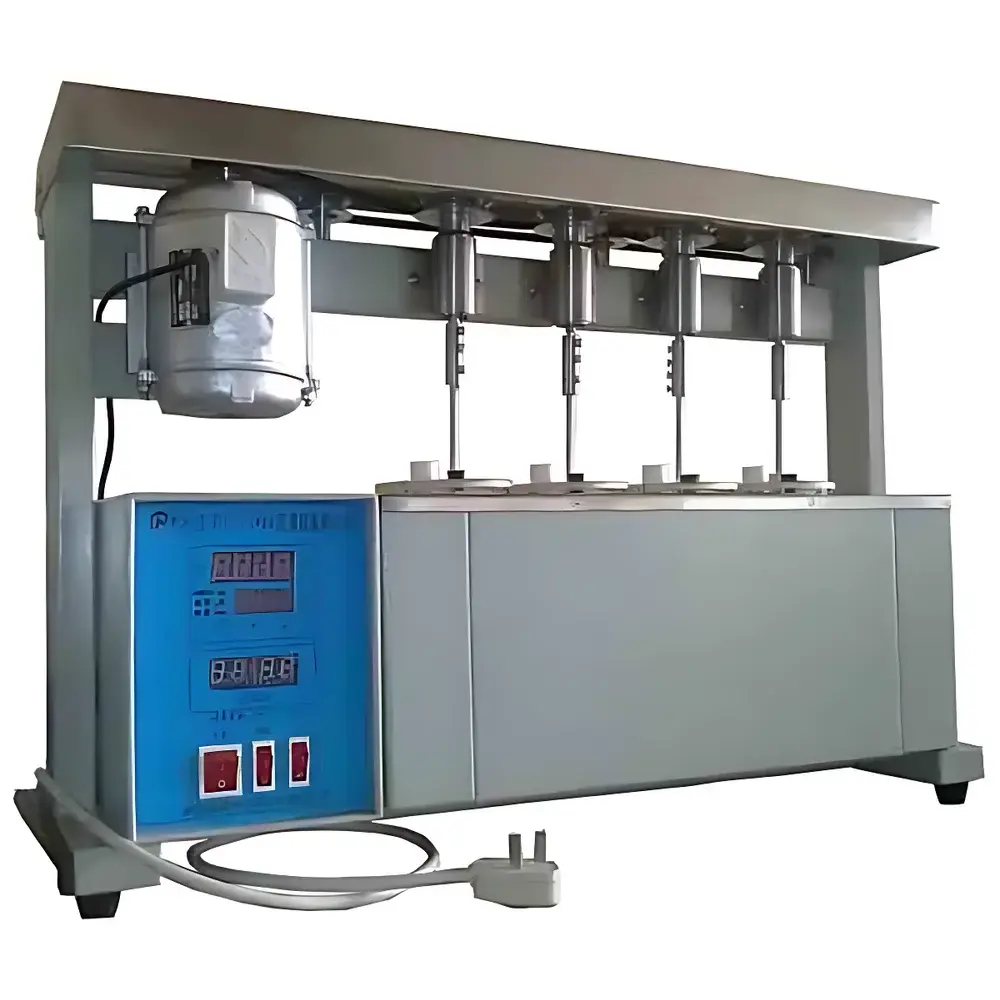
PULUODY PLD-11143B Petroleum Product Rust Prevention Tester (Liquid-Phase Corrosion Test Apparatus per GB/T 11143)
| Brand | PULUODY |
|---|---|
| Model | PLD-11143B |
| Origin | Shaanxi, China |
| Manufacturer Type | Direct Manufacturer |
| Power Supply | AC 220 V ±10%, 50 Hz |
| Temperature Control Range | 0–100 °C |
| Temperature Accuracy | ±1.0 °C |
| Temperature Display | Digital |
| Timing Range | 1 min – 24 h |
| Time Display | Digital |
| Main Heating Power | 600 W / 220 V |
| Auxiliary Heating Power | 1000 W / 220 V |
| Stirrer Speed | 1000 ±50 rpm |
| Test Stations | 4 |
| Ambient Operating Temperature | ~25 °C |
| Relative Humidity | ≤85% |
| Rust Specimen Polishing Motor | AC 220 V ±20 V, 90 W, 1750 ±50 rpm |
| Construction | Stainless Steel Water Bath Chamber, Precision Electromechanical Drive System, Dual-Zone Thermal Regulation |
Overview
The PULUODY PLD-11143B Petroleum Product Rust Prevention Tester is a dedicated benchtop instrument engineered for quantitative evaluation of the rust-inhibiting performance of inhibited mineral oils—particularly turbine oils—under controlled aqueous contamination conditions. It operates in strict conformance with the methodology defined in GB/T 11143–1989 (equivalent in principle to ASTM D665 and ISO 7120), which specifies the liquid-phase rust test procedure involving immersion of polished ferrous specimens (typically ASTM A229 steel rods) in an oil–water emulsion under regulated temperature, agitation, and exposure duration. The core measurement principle relies on visual and microscopic assessment of surface oxidation following standardized exposure, enabling objective classification of rust severity (e.g., “no rust”, “light rust”, “moderate rust”, or “heavy rust”) per the standard’s rating scale. This apparatus does not provide electrochemical or gravimetric corrosion rate data; rather, it delivers pass/fail or comparative ranking outcomes essential for quality control, formulation validation, and batch release testing in lubricant manufacturing and power generation maintenance laboratories.
Key Features
- Four independent test stations housed within a single stainless steel water bath chamber, enabling parallel evaluation of multiple samples or replicates under identical thermal and mechanical conditions.
- Dual-zone heating architecture: primary 600 W immersion heater for precise bath temperature regulation, supplemented by a 1000 W auxiliary heater to ensure rapid thermal equilibration and stability across the full 0–100 °C range.
- High-reproducibility mechanical agitation system featuring a digitally regulated stirrer operating at 1000 ±50 rpm, delivering consistent shear-induced emulsification critical to simulating real-world water-oil interaction dynamics.
- Integrated digital PID temperature controller with ±1.0 °C accuracy and real-time display, coupled with a programmable digital timer supporting exposure durations from 1 minute to 24 hours—fully compliant with GB/T 11143 timing requirements.
- Dedicated rust specimen polishing unit included: AC-powered motor (90 W, 1750 ±50 rpm) with precision-machined chuck for standardized surface preparation of ASTM A229 steel rods prior to immersion.
- Robust industrial-grade construction using corrosion-resistant 304 stainless steel for all wetted components, ensuring long-term reliability in humid, saline-prone laboratory environments.
Sample Compatibility & Compliance
The PLD-11143B is validated for use with inhibited mineral-based lubricants—including steam turbine oils, hydraulic fluids, circulating system oils, and other petroleum-derived products where water ingress poses a risk of ferrous component corrosion. It accommodates test specimens conforming to ASTM A229 (hard-drawn spring steel rods, 12.7 mm diameter × 76 mm length) and supports evaluation of both light and heavy oils, including those denser than water. The instrument fulfills all mechanical, thermal, and operational specifications mandated by GB/T 11143–1989. While not certified to ISO/IEC 17025, its design aligns with GLP-aligned laboratory practice when operated with documented SOPs, calibrated thermometers (traceable to NIST or equivalent national standards), and routine verification of stirrer speed and timer accuracy. Data generated supports compliance reporting for OEM specifications (e.g., GEK 32568, Siemens TLV 9013) and internal QC protocols governing rust inhibitor efficacy.
Software & Data Management
The PLD-11143B operates as a standalone hardware platform without embedded firmware or proprietary software. All control functions—including temperature setpoint, soak time, and agitation initiation—are executed via front-panel digital interfaces with tactile feedback. Users maintain complete traceability through manual logbooks or LIMS-integrated electronic records. For audit readiness, laboratories are advised to document calibration history of external reference thermometers, verify stirrer RPM using a non-contact tachometer prior to each test series, and retain photographic evidence of specimen surfaces pre- and post-test. The instrument supports 21 CFR Part 11 compliance when integrated into a validated electronic record system that enforces user authentication, audit trails, and electronic signatures for test reports.
Applications
- Quality assurance of turbine oils during production and after field service to verify retention of rust-inhibiting additives.
- Comparative screening of alternative rust inhibitors or additive packages during lubricant reformulation.
- Root-cause analysis of field failures attributed to rust formation in steam turbines, hydroelectric generators, or industrial gearboxes.
- Supporting ISO 4406 particle count and ASTM D892 foam tests in comprehensive lubricant health assessments.
- Educational use in petroleum engineering curricula for demonstrating water-induced corrosion mechanisms in hydrocarbon systems.
FAQ
What standards does the PLD-11143B comply with?
It is designed and verified per GB/T 11143–1989, with functional equivalence to ASTM D665 Method A (turbine oil) and ISO 7120. It does not replace electrochemical corrosion testers such as ASTM G5/G102 systems.
Can the instrument test synthetic lubricants?
Yes—provided the base fluid is compatible with ASTM A229 steel and forms a stable emulsion with distilled water under agitation. Validation per ASTM D665 Annex A is recommended for non-mineral formulations.
Is calibration certification provided with the unit?
No factory calibration certificate is included; however, the unit ships with a metrology-ready interface for third-party calibration of temperature sensors and timer circuits using accredited labs.
What maintenance is required for long-term operation?
Monthly cleaning of the stainless steel bath with deionized water and periodic inspection of heater terminals and stirrer coupling integrity are sufficient. No scheduled lubrication or firmware updates are necessary.
How are rust ratings determined?
Per GB/T 11143, ratings rely on visual comparison of specimen surfaces against standardized photographic references after careful rinsing and drying—no automated image analysis is performed by the instrument itself.





