
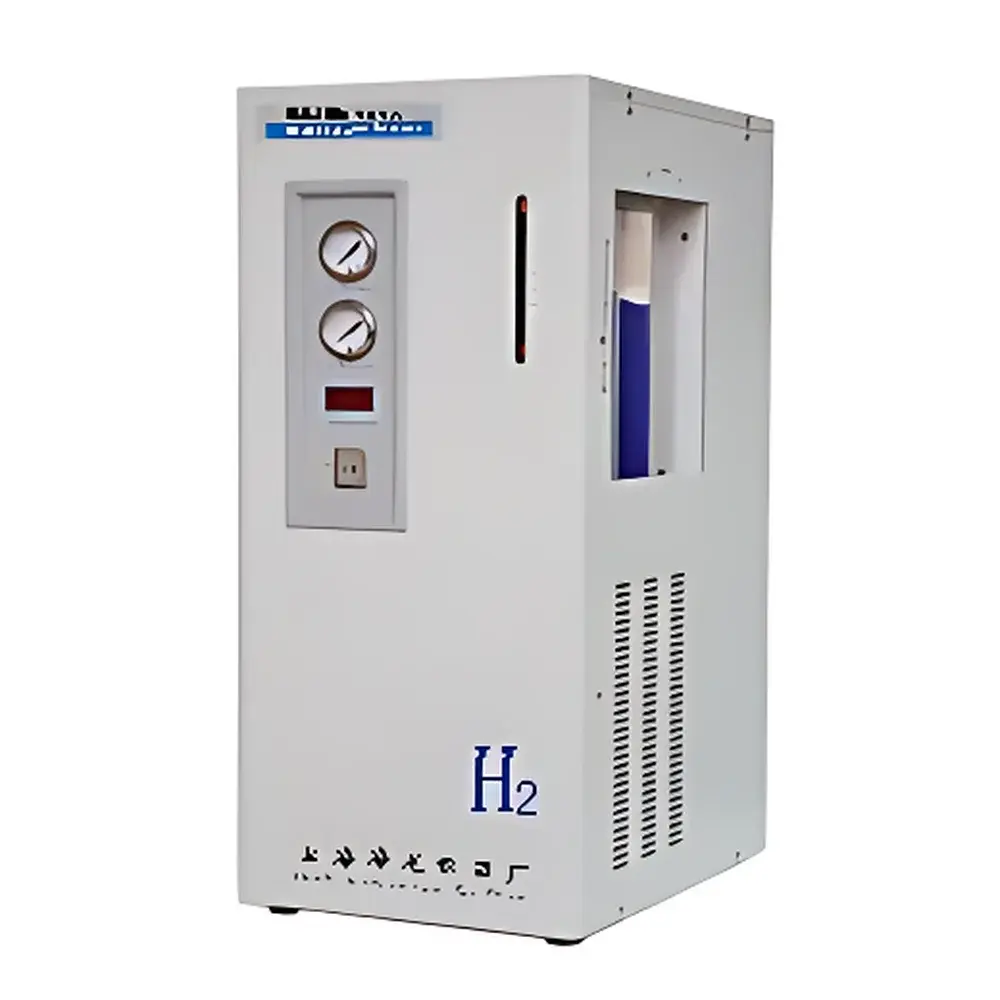
Hydrogen Generator HLH-700II
| Origin | Shanghai, China |
|---|---|
| Manufacturer Type | Authorized Distributor |
| Model | HLH-700II |
| Pricing | Available Upon Request |
| Hydrogen Purity | >99.999% |
| Flow Rate | 0–700 mL/min |
| Output Pressure | 0–0.4 MPa (Factory Set at 0.3 MPa) |
| Max Power Consumption | 250 W |
| Operating Environment | 10–40 °C, RH ≤85%, Non-corrosive, Low-dust Ambient |
Overview
The HLH-700II Hydrogen Generator is a high-purity, membrane-based electrolytic hydrogen source engineered for continuous, on-demand supply in analytical laboratories—particularly as a carrier and fuel gas for gas chromatography (GC), GC–MS, and other hydrogen-dependent instrumentation. It employs alkaline water electrolysis (AWE) with a stainless-steel barrel-type electrolyzer cell featuring imported noble-metal catalysts to maximize current efficiency and long-term stability. Unlike cylinder-based supply, the HLH-700II eliminates high-pressure storage risks, reduces logistical overhead, and delivers consistent hydrogen at precisely controlled flow and pressure without purity degradation over time. Its design conforms to core safety principles defined in IEC 61010-1 (Safety Requirements for Electrical Equipment for Measurement, Control, and Laboratory Use) and integrates fail-safe mechanisms essential for unattended operation in regulated environments.
Key Features
- Electrolyzer Architecture: Barrel-shaped electrolytic cell with electrochemically polished 316L stainless-steel electrodes and proprietary platinum-group catalysts; optimized thermal mass and passive heat dissipation ensure stable cell temperature during extended operation.
- Gas Purity & Conditioning: Dual-stage purification system comprising catalytic deoxygenation followed by molecular sieve drying; achieves ≥99.999% H2 purity (residual O2 <0.1 ppm, H2O <1 ppm), compliant with ASTM D1946 and ISO 8573-1 Class 1 compressed air quality equivalency for trace-gas analysis.
- Intelligent Pressure & Flow Management: Closed-loop digital pressure regulation with real-time flow tracking; maintains setpoint accuracy within ±2% across the full 0–700 mL/min range; factory preset output pressure of 0.3 MPa, adjustable up to 0.4 MPa.
- Anti-Backflow Protection: Patented mechanical liquid-trap valve combined with hydrophobic membrane separation prevents electrolyte carryover under all operating conditions—including power interruption or sudden downstream pressure drop.
- Low-Maintenance Operation: Single initial KOH charge (20% w/w aqueous solution); only deionized or distilled water replenishment required during routine use; no periodic catalyst replacement or membrane servicing over typical service life.
Sample Compatibility & Compliance
The HLH-700II is compatible with all GC systems requiring ultra-high-purity hydrogen, including flame ionization detectors (FID), thermal conductivity detectors (TCD), and pulsed discharge helium ionization detectors (PDD). Its gas output meets stringent requirements for pharmaceutical QC (USP <621>), environmental testing (EPA Method 8260/8270), and petrochemical analysis (ASTM D3588). The unit complies with CE marking directives (2014/30/EU EMC, 2014/35/EU LVD), RoHS 2011/65/EU, and supports GLP/GMP documentation workflows via optional audit-trail-enabled firmware (available upon request).
Software & Data Management
While the HLH-700II operates as a standalone analog-controlled generator, it includes a standardized 0–5 V DC analog output signal proportional to actual flow rate, enabling integration into centralized lab monitoring systems (e.g., LabVantage, Thermo Fisher SampleManager). Optional RS-485 Modbus RTU interface (HLH-700II-Comm Kit) allows remote status polling (operational state, pressure fault, low-water alarm), event logging, and configuration lockout—facilitating 21 CFR Part 11-compliant electronic recordkeeping when paired with validated SCADA platforms.
Applications
- Carrier gas for capillary GC and GC–MS in clinical toxicology and forensic labs
- Fuel gas for FID in environmental VOC monitoring and stack emission testing
- Reductant gas in hydride generation atomic absorption spectroscopy (HG-AAS)
- Blank gas in residual solvent analysis per ICH Q2(R2) validation protocols
- On-site hydrogen supply for portable FTIR and Raman spectrometers requiring field-deployable gas sources
FAQ
What is the expected service life of the electrolyzer cell?
Under normal operating conditions (ambient temperature 20–25 °C, daily usage ≤12 h), the electrolyzer cell maintains ≥95% nominal flow efficiency for ≥3 years—covered under extended warranty.
Can the HLH-700II supply multiple GC instruments simultaneously?
Yes; with proper manifold design and pressure-drop calculation, it supports up to three standard FID-equipped GC systems (total demand ≤600 mL/min) while maintaining purity and pressure stability.
Is deionized water sufficient for electrolyte top-up, or is distilled water mandatory?
Distilled water is required; deionized water may contain dissolved CO2 or trace cations that accelerate carbonate precipitation in the electrolyte, reducing cell efficiency over time.
Does the unit require ventilation or external exhaust?
No forced ventilation is needed; however, installation must comply with local codes for hydrogen-generating equipment—minimum 0.5 m clearance from ignition sources and adequate room air exchange (≥6 air changes/hour) per NFPA 55 guidelines.
How is calibration verified for regulatory submissions?
Calibration is performed using NIST-traceable flow meters and certified gas analyzers (e.g., Agilent 7890B with TCD + GC–MS confirmation); certificate of conformance and calibration report are provided with each unit shipment.



