
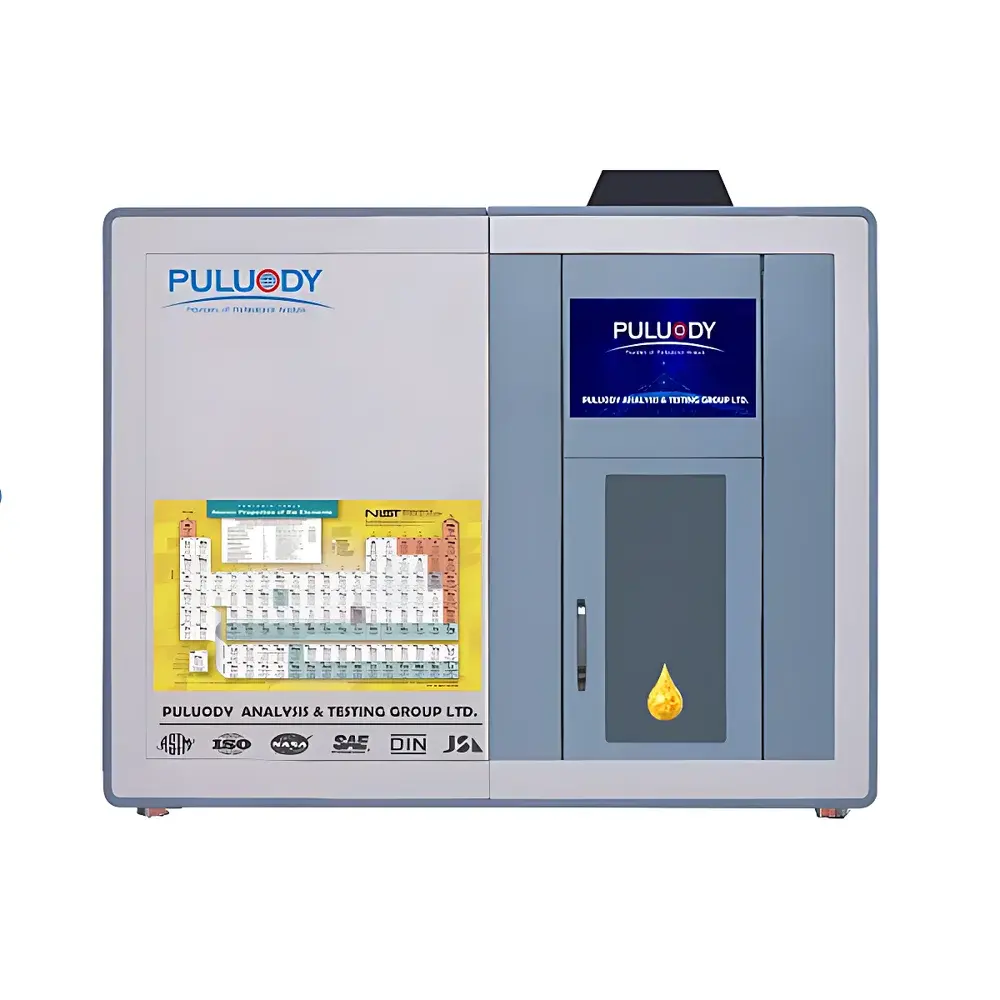
PULUODY P-ICP-II Rotating Disc Electrode Atomic Emission Spectrometer (RDE-AES) for Oil Analysis
| Brand | PULUODY |
|---|---|
| Model | P-ICP-II |
| Origin | Shaanxi, China |
| Detection Principle | Rotating Disc Electrode Atomic Emission Spectrometry (RDE-AES) |
| Spectral Range | 190–800 nm |
| Optical Resolution | ≤0.015 nm |
| RF Generator Frequency | 27.12 MHz (stability ≤0.05%) |
| RF Power Output | 800–1600 W (stability ≤0.2%) |
| Grating Density | 2400 lines/mm |
| Grating Area | 80 × 110 mm |
| Sample Volume Required | >1 mL |
| Operating Temperature | 20–45 °C |
| Operating Humidity | 0–90% RH (non-condensing) |
| Elemental Detection Capability | ≥61 elements |
| Detection Limit | down to 1 ppb (µg/L) for most metals |
| Linear Dynamic Range | 5 orders of magnitude |
| Analysis Speed | ≥4 elements per minute |
| Precision (RSD) | ≤1.5% |
| Stability (RSD) | ≤2.0% |
| Accuracy | ±3% (method-dependent) |
| Compliance Standards | ASTM D6595, ASTM D6728, NB/SH/T 0865, SN/T 1652, DL/T 1550, JJF (Defense) 1752018 |
Overview
The PULUODY P-ICP-II Rotating Disc Electrode Atomic Emission Spectrometer (RDE-AES) is a dedicated elemental analysis system engineered for rapid, multi-element quantification in lubricants, hydraulic fluids, insulating oils, turbine oils, fuels, and other non-aqueous liquid matrices. It operates on the principle of rotating disc electrode excitation—where a graphite disc electrode is immersed in the oil sample, rotated at high speed, and subjected to radiofrequency (RF) plasma discharge. This process atomizes and excites metal species present in the sample, generating element-specific atomic emission spectra in the UV-Vis range (190–800 nm). The spectrometer captures these emissions using a high-resolution optical system (≤0.015 nm resolution) with a 2400 lines/mm grating and advanced photodetector architecture. Unlike inductively coupled plasma (ICP-OES) systems requiring acid digestion or dilution, the P-ICP-II enables direct, minimally prepared analysis of neat oils—reducing sample preparation time, contamination risk, and operator dependency while maintaining trace-level sensitivity.
Key Features
- Direct oil analysis without digestion or dilution—preserves native elemental speciation integrity and eliminates matrix-induced calibration drift.
- Simultaneous multi-element detection capability covering ≥61 elements—including wear metals (Fe, Cu, Al, Cr, Pb), contaminants (Si, Na, B, Ca), and additive elements (Ba, Zn, P, Mg, Mo).
- Sub-ppb detection limits (1 µg/L) for key analytes such as Fe, Cu, and Cr—enabling early-stage wear monitoring in critical machinery.
- Wide linear dynamic range (>5 orders of magnitude) supports concurrent quantification of both trace wear particles and high-concentration additives within a single run.
- High-throughput operation: ≥4 elements quantified per minute with automated spectral acquisition and integrated background correction algorithms.
- Robust RF plasma source (27.12 MHz, 800–1600 W) ensures stable excitation across varying oil viscosities and conductivities.
- Seventh-generation PULUODY spectral detector optimized for low-noise signal capture and long-term photometric stability under industrial laboratory conditions.
Sample Compatibility & Compliance
The P-ICP-II is validated for use with mineral and synthetic lubricants, transformer oils (IEC 60296), turbine oils (ASTM D4378), diesel and jet fuels (ASTM D975, D1655), antifreeze solutions, and hydrocarbon-based hydraulic fluids. It meets the methodological requirements of multiple international and industry-specific standards: ASTM D6595 (wear metals in used oils), ASTM D6728 (fuel contaminants), NB/SH/T 0865 (Chinese national standard for RDE-AES in lubricant analysis), SN/T 1652 (import/export fuel testing), DL/T 1550 (copper/iron in transformer oil), and JJF (Defense) 1752018 (calibration protocol for oil emission spectrometers). All measurement procedures support GLP-compliant data integrity through audit-trail-enabled software logging, electronic signature validation, and full traceability of calibration curves, instrument parameters, and raw spectral files.
Software & Data Management
PICP-V2.1 analytical software provides a modular, standards-integrated platform for method development, spectral processing, quantitative reporting, and trend analytics. It includes over 10,000 reference spectral lines for qualitative verification and interference correction. The software supports full quantitative analysis (calibration curve fitting, internal standardization, matrix-matched standards), semi-quantitative screening, and post-acquisition reprocessing—including peak deconvolution, baseline subtraction, and multivariate outlier detection. Reporting templates comply with ISO/IEC 17025 documentation requirements and allow user-defined fields (e.g., method ID, analyst ID, instrument serial number, uncertainty estimation). Export formats include PDF, XLSX, CSV, and TXT; all reports embed raw intensity values, wavelength assignments, RSD calculations, and confidence intervals. For regulated environments, optional 21 CFR Part 11 compliance modules provide role-based access control, electronic signatures, and immutable audit trails.
Applications
The P-ICP-II serves as a core diagnostic tool in predictive maintenance programs across aerospace (engine oil health monitoring), power generation (transformer and turbine oil surveillance), marine propulsion (lube oil degradation tracking), rail transport (gearbox condition assessment), and heavy equipment manufacturing (hydraulic system contamination control). It enables quantitative trending of wear metal accumulation (e.g., Fe/Cr ratio for bearing vs. gear wear differentiation), contaminant ingress (Si/Al for dust ingestion, Na/K for coolant leakage), and additive depletion (Zn/P/Mg for anti-wear and detergent package monitoring). When integrated into enterprise CMMS or SAP PM systems via API, it supports automated alerting upon deviation from statistically derived alarm thresholds—facilitating root-cause analysis and evidence-based maintenance scheduling.
FAQ
What types of oil samples can be analyzed without pretreatment?
Neat lubricating oils, hydraulic fluids, transformer oils, turbine oils, diesel and aviation fuels, glycol-based coolants, and ester-based synthetics—provided viscosity remains below 500 cP and water content is <0.1% v/v.
Is acid digestion required before analysis?
No. The RDE-AES technique analyzes undiluted, unacidified oil samples directly—eliminating digestion-related errors, cross-contamination, and labor-intensive preparation steps.
How is calibration performed and maintained?
Calibration uses certified oil-based reference standards (e.g., NIST SRM 2720a, Conostan OMA series) traceable to SI units. Multi-point calibration curves are stored with expiration dates, and daily performance checks verify drift against QC standards per ASTM D6595 Section 9.
Can the system detect non-metallic elements such as boron or phosphorus?
Yes. The 190–800 nm spectral coverage includes strong emission lines for B (249.77 nm), P (253.56 nm), S (180.73 nm), and Cl (134.72 nm), enabling quantification at sub-ppb levels when using appropriate internal standards.
What regulatory documentation is provided for GMP/GLP audits?
Factory-issued IQ/OQ protocols, calibration certificates traceable to NIST/PTB, software validation summary (including 21 CFR Part 11 readiness report), and full electronic record retention logs meeting ALCOA+ principles (Attributable, Legible, Contemporaneous, Original, Accurate, Complete, Consistent, Enduring, Available).





