
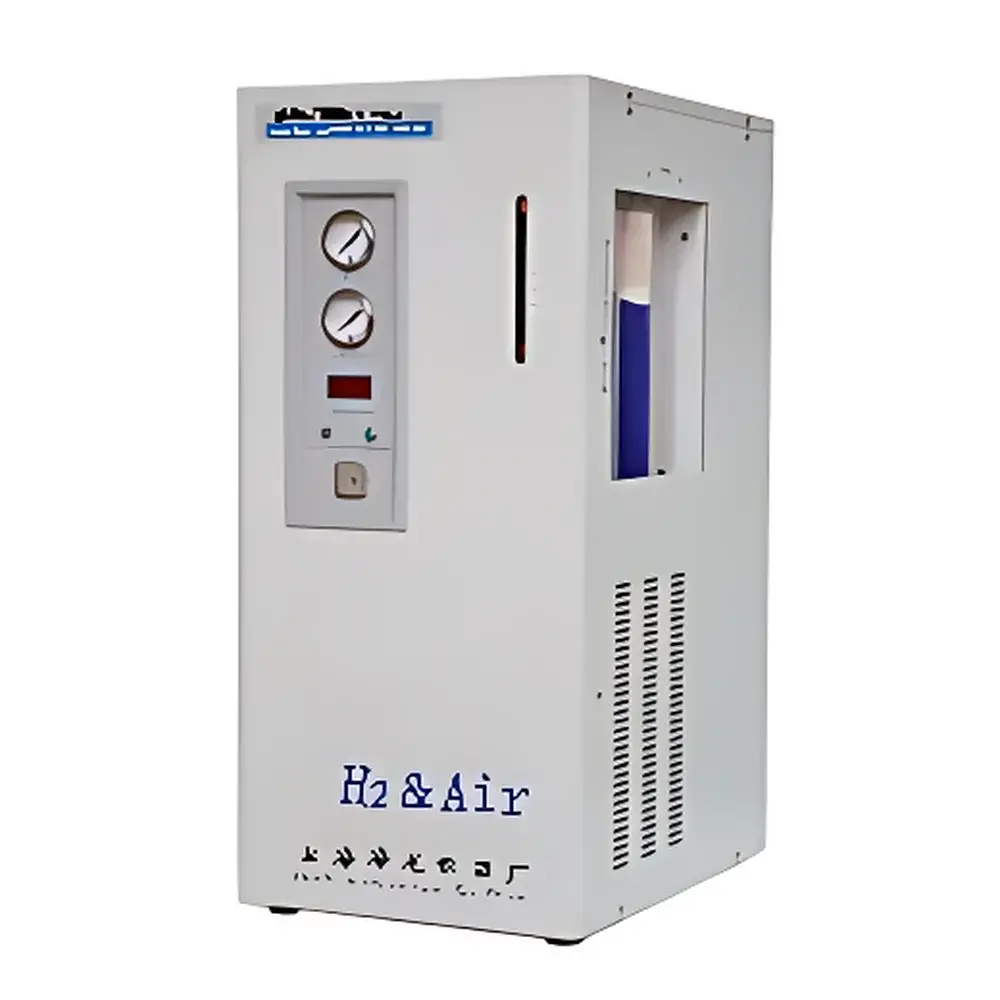
Hailong HLHA-500G Hydrogen-Air Integrated Gas Generator
| Brand | Hailong |
|---|---|
| Origin | Shanghai, China |
| Model | HLHA-500G |
| Hydrogen Purity | 99.999% |
| Hydrogen Flow Rate | 0–500 mL/min |
| Hydrogen Output Pressure | 0–0.4 MPa (factory-set at 0.3 MPa) |
| Air Flow Rate | 0–5000 mL/min |
| Air Output Pressure | 0–0.5 MPa |
| Air Hydrocarbon Content (Output) | <0.1 ppm |
| Air Hydrocarbon Content (Input Tolerance) | <100 ppm |
| Max. Power Consumption | 350 W |
| Pressure Stability | <0.0001 MPa |
| Operating Temperature | 0–40 °C |
| Operating Humidity | <85% RH |
| Warranty | 1-year full unit, 3-year electrolyzer |
Overview
The Hailong HLHA-500G Hydrogen-Air Integrated Gas Generator is an engineered solution for laboratories requiring continuous, on-demand supply of high-purity hydrogen and clean compressed air—primarily for gas chromatography (GC) detectors such as Flame Ionization Detectors (FID), Thermal Conductivity Detectors (TCD), and Electron Capture Detectors (ECD). Unlike conventional cylinder-based systems, this integrated generator employs alkaline water electrolysis for hydrogen production and a brushless, oil-free diaphragm compressor for air generation—eliminating hydrocarbon contamination at the source. The system operates on the principle of controlled electrochemical decomposition of deionized water in a cylindrical alkaline electrolyzer, where hydrogen gas is generated at the cathode and oxygen is safely vented. Simultaneously, ambient air undergoes three-stage filtration (particulate, activated carbon, and coalescing) followed by dual-stage pressure regulation to deliver ultra-low hydrocarbon (<0.1 ppm) air compliant with ASTM D6299 and ISO 8573-1 Class 1 requirements for GC carrier and detector gases.
Key Features
- Cylindrical alkaline electrolyzer architecture with automatic anti-alkaline-backflow design—prevents electrolyte migration into gas lines and extends service life beyond 6,000 operational hours.
- Stainless steel integrated gas storage tank with auto-condensate drainage, reducing manual maintenance and ensuring consistent gas delivery under variable demand.
- Dual independent gas conditioning paths: hydrogen stream passes through triple-stage desiccant and particle filtration; air stream features three-stage purification (pre-filter, activated carbon, and final sub-micron coalescing filter) plus two-stage pressure stabilization.
- Over-pressure protection circuitry integrated into both hydrogen and air pneumatic circuits—meets IEC 61000-6-2 EMC immunity standards and complies with CE machinery directive 2006/42/EC.
- Low thermal load design: maximum power draw of 350 W enables operation in standard laboratory electrical circuits without dedicated line conditioning.
- Pressure stability of <0.0001 MPa ensures baseline integrity during long-duration GC runs—critical for quantitative analysis per USP and EP 2.2.46 method validation protocols.
Sample Compatibility & Compliance
The HLHA-500G is compatible with all major GC platforms requiring hydrogen fuel (e.g., Agilent 7890/8890, Thermo Fisher ISQ, Shimadzu GC-2030) and clean air for FID make-up or detector support. Its output specifications align with key regulatory and industry benchmarks: hydrogen purity (99.999%) satisfies ASTM D7622 and ISO 8573-1:2010 Class 1.1.1 for gaseous fuels; air hydrocarbon content meets EPA Method 8260D and EU Pharmacopoeia 2.2.27 requirements for residual solvent analysis. The unit is designed for GLP-compliant environments—audit-ready with timestamped runtime logs, pressure event records, and no external software dependencies for basic operation.
Software & Data Management
The HLHA-500G operates via embedded microcontroller logic with local LED status interface—no PC connection required for routine use. Optional RS-232 or analog 4–20 mA outputs enable integration into centralized lab monitoring systems (e.g., LabVantage, STARLIMS) for real-time pressure, flow, and temperature telemetry. All operational data—including electrolyzer runtime, cumulative gas volume, and fault codes—are stored in non-volatile memory with retention exceeding 10 years. While not FDA 21 CFR Part 11–certified out-of-the-box, the system supports electronic signature workflows when deployed with validated third-party LIMS interfaces meeting ALCOA+ data integrity principles.
Applications
- Routine GC-FID analysis of environmental water and soil extracts (EPA 502.2, 524.2)
- Pharmaceutical residual solvent testing per ICH Q2(R2) and USP
- Food safety screening for volatile organic compounds (VOCs) including ethanol, acetaldehyde, and benzene
- Petrochemical hydrocarbon profiling using simulated distillation (ASTM D2887)
- Research-grade hydrogen supply for catalytic reaction studies requiring inert, moisture-controlled atmospheres
FAQ
What type of water is required for the electrolyzer?
Deionized water with resistivity ≥1 MΩ·cm and silica content <50 ppb is mandatory. Tap or distilled water will cause rapid electrode fouling and void warranty.
Can the unit operate continuously for 24/7 applications?
Yes—the electrolyzer and compressor are rated for indefinite duty cycle under ambient conditions ≤35 °C and <70% RH. Thermal shutdown activates at 45 °C internal cabinet temperature.
Is periodic maintenance required?
Yes: desiccant cartridges require replacement every 6 months (or after 3,000 L of hydrogen produced); air filters every 12 months; electrolyte top-up every 24 months under normal use.
Does the generator support remote monitoring?
Standard model includes analog 0–5 VDC output for pressure and flow; optional RS-232 module enables Modbus RTU communication for SCADA integration.
How does the over-pressure protection function?
Dual redundant mechanical relief valves (hydrogen: 0.45 MPa setpoint; air: 0.55 MPa) activate independently of control electronics—ensuring fail-safe operation even during power loss.



