
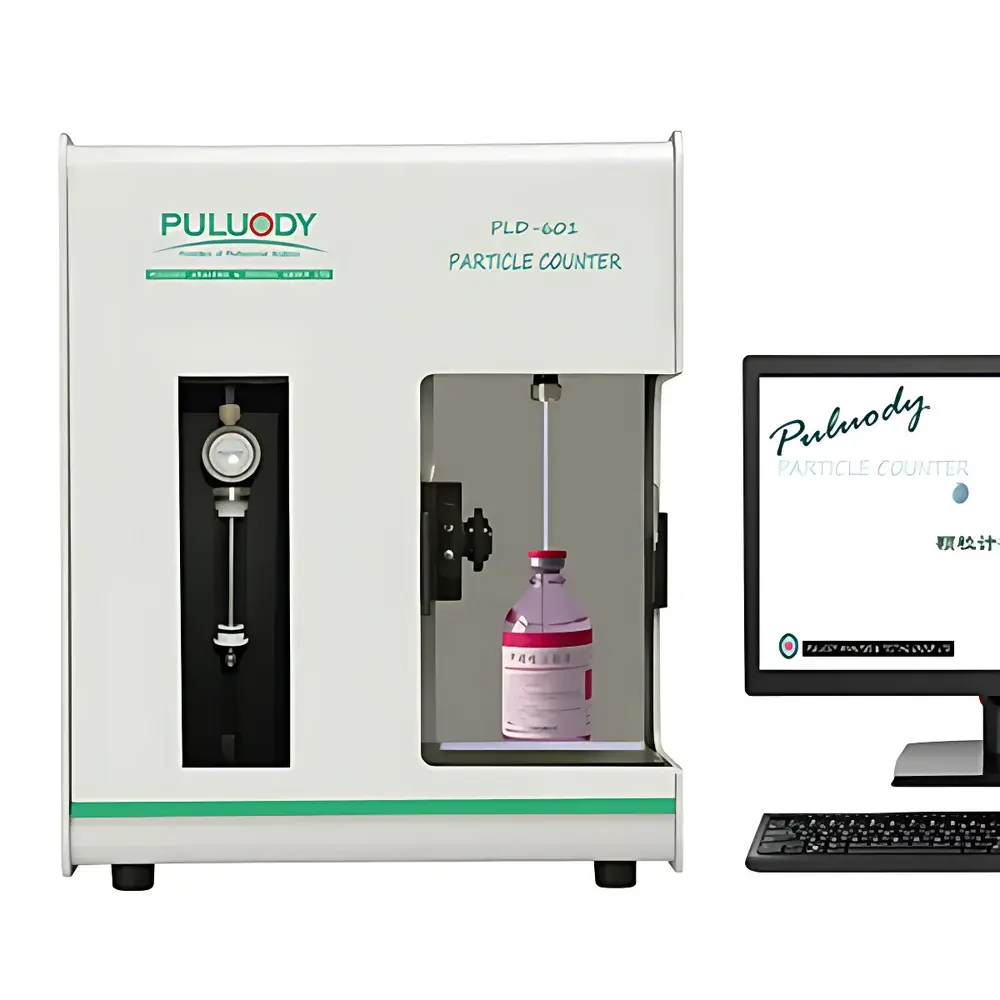
PULUODY PLD-601-Y Optical Particle Counter for Insoluble Particulate Matter in Ophthalmic Brushes and Parenteral Preparations
| Brand | PULUODY |
|---|---|
| Origin | Shaanxi, China |
| Manufacturer Type | Authorized Distributor |
| Product Category | Domestic |
| Model | PLD-601-Y |
| Instrument Type | Optical Particle Counter (Light Obscuration Principle) |
| Detection Range | 1–450 µm (extendable to 0.03–3000 µm with optional configuration) |
| Sensor | 8th-Generation Dual-Laser Narrow-Beam Particle Sensor |
| Flow Control | Precision Metering Plunger Pump + Ultra-Precise Electromagnetic Flow Control System |
| Sampling Rate | 5–150 mL/min |
| Cleaning Flow Rate | 5–500 mL/min |
| Temperature Range (Fluid) | 0–80 °C |
| Ambient Operating Temperature | −15–50 °C |
| Channel Resolution | 1000 adjustable channels (down to 0.01 µm resolution) |
| Accuracy | ±5% typical (per ChP 2020 & USP <788>) |
| Coincidence Limit | ≤2.5% error at 1000 particles/mL |
| Resolution Compliance | >95% (ChP), <10% (USP/ISO 21501) |
| Calibration Standards | JJG 1061, ISO 21501, NIST-traceable latex spheres |
| Software | V8.9 Integrated Analysis Suite (PC & touchscreen), 5-level user permission, audit trail, electronic signature, 21 CFR Part 11 compliance |
| Regulatory Alignment | ChP 2015/2020 <0903>, USP <788>/<789>/<797>, EP 10.0/9.0, BP 2019, JP 17, WHO IntPh IV, YBB00272004-2015, GB/T 11446.9-2013, ISO 4406, ISO 11171, NAS 1638, MIL-STD-1246C |
Overview
The PULUODY PLD-601-Y Optical Particle Counter is a regulatory-grade instrument engineered for quantitative detection and sizing of insoluble particulate matter in ophthalmic delivery systems—including eye brush applicators—and parenteral pharmaceutical preparations. It operates on the light obscuration (LO) principle, where particles suspended in liquid media pass through a precisely collimated dual-laser sensing zone, generating transient signal pulses proportional to their cross-sectional area. This eighth-generation sensor architecture employs narrow-beam dual-wavelength laser diodes to minimize Mie scattering artifacts and improve discrimination of submicron contaminants—critical for ophthalmic safety assessment per USP and ChP 2020 . The system integrates a high-fidelity plunger pump and electromagnetic flow regulator to maintain volumetric accuracy within ±1% across variable viscosities and temperatures (0–80 °C fluid range), ensuring reproducible sample aspiration and compliance with pharmacopoeial sampling volume requirements (e.g., 25 mL minimum for injectables per USP ). Designed for GxP environments, it meets stringent data integrity criteria under FDA 21 CFR Part 11 and supports full traceability from raw pulse acquisition to final particle count report.
Key Features
- 8th-generation dual-laser narrow-beam optical sensor with real-time pulse shape analysis for improved particle classification fidelity
- Dual-stage precision flow control: metering plunger pump (±1% volumetric accuracy) + closed-loop electromagnetic flow modulation
- 1000-channel high-resolution detection capability (0.01 µm minimal bin width), configurable for pharmacopoeial thresholds (e.g., ≥10 µm, ≥25 µm per ChP/USP) or custom size bands (e.g., 4–70 µm(c))
- V8.9 analytical software suite with five-tier role-based access control, automated audit trail generation, electronic signatures, and encrypted data backup/recovery
- Compliance-ready architecture supporting 21 CFR Part 11, ALCOA+ principles, and GLP/GMP documentation workflows
- Touchscreen interface with bilingual (English/Chinese) operation, integrated thermal printer, and optional wireless keyboard/mouse support
- Full validation support: calibrated per JJG 1061, ISO 21501, and NIST-traceable reference materials; certified by NW National Metrology Center and Defense Science & Technology Commission Level-1 Particle Metrology Station No. 116
Sample Compatibility & Compliance
The PLD-601-Y accommodates a broad spectrum of liquid matrices relevant to pharmaceutical quality control and medical device evaluation. Validated applications include ophthalmic solutions (e.g., preservative-free artificial tears), sterile injectables (lyophilized powders reconstituted in WFI), vaccine suspensions, infusion sets, IV tubing, ophthalmic brush applicators, pharmaceutical excipients, purified water (PW), water for injection (WFI), and ultra-pure water (UPW) per ASTM D5127 and ISO 3696. It satisfies mandatory testing protocols outlined in ChP 2020 , USP , , and , EP 10.0, BP 2019, JP 17, and WHO International Pharmacopoeia IV. For medical devices, it quantifies particulate shedding from silicone-tipped eye brushes and evaluates filter efficiency of terminal sterilizing filters (e.g., 0.22 µm PVDF membranes) per YBB00272004-2015 and GB 8368. All test methods are preloaded into the software with auto-applicable pass/fail logic aligned with specified limits.
Software & Data Management
The V8.9 software platform provides end-to-end data lifecycle management compliant with ICH GCP, FDA guidance on computerized systems, and EU Annex 11. Each measurement session generates immutable metadata including operator ID, timestamp, instrument serial number, calibration status, environmental logs (temperature/humidity), and full raw pulse stream archives. Audit trails record all user actions—including parameter edits, result deletions, and report exports—with time-stamped digital signatures. Data export options include CSV, PDF (with embedded digital signature), XML (for LIMS integration), and SQL-compatible dumps. Backups are AES-256 encrypted and stored locally or on network drives; recovery preserves full chain-of-custody integrity. Optional cloud sync enables remote QA review and centralized fleet monitoring across multi-site facilities.
Applications
- Pharmaceutical QC labs: Routine batch release testing of injectables, ophthalmics, vaccines, and active pharmaceutical ingredients (APIs)
- Medical device manufacturers: Particulate shedding assessment of ophthalmic brushes, contact lens cases, and infusion components
- Water system validation: Monitoring of PW, WFI, and UPW in cleanroom utilities per ISO 14644-1 and EU GMP Annex 1
- Semiconductor fabs: Slurry cleanliness verification (CMP slurries) and wafer rinse water qualification
- Chemical & cosmetics R&D: Stability profiling of nanoemulsions, pigment dispersions, and surfactant formulations
- Filter performance testing: Quantitative determination of beta-ratio and retention efficiency per ISO 16889
FAQ
Does the PLD-601-Y comply with FDA 21 CFR Part 11 requirements for electronic records and signatures?
Yes—the system implements role-based authentication, time-stamped audit trails, electronic signatures with biometric or token-based verification, and immutable data archiving per Part 11 Subpart B.
Can the instrument be validated for use in GMP-regulated environments?
Yes—full IQ/OQ/PQ documentation templates are provided, and calibration is traceable to national standards (NW Metrology Center, NIM). Third-party certification services are available via PULUODY’s authorized metrology partners.
What particle size standards are supported for calibration?
Calibration is performed using NIST-traceable polystyrene latex (PSL) spheres per ISO 21501-4, or certified reference materials compliant with JJG 1061 and USP . Custom calibrants (e.g., silica, metal oxides) may be qualified upon request.
Is method transfer between instruments possible?
Yes—V8.9 supports standardized method export/import (.pmm files), enabling identical test configurations across multiple PLD-601-Y units in global manufacturing networks.
How is carryover minimized during high-concentration sample analysis?
The system features programmable high-flow cleaning cycles (up to 500 mL/min), integrated ultrasonic bath priming, and real-time blank verification before each run to ensure residual contamination remains below 0.1% of previous sample count.



