
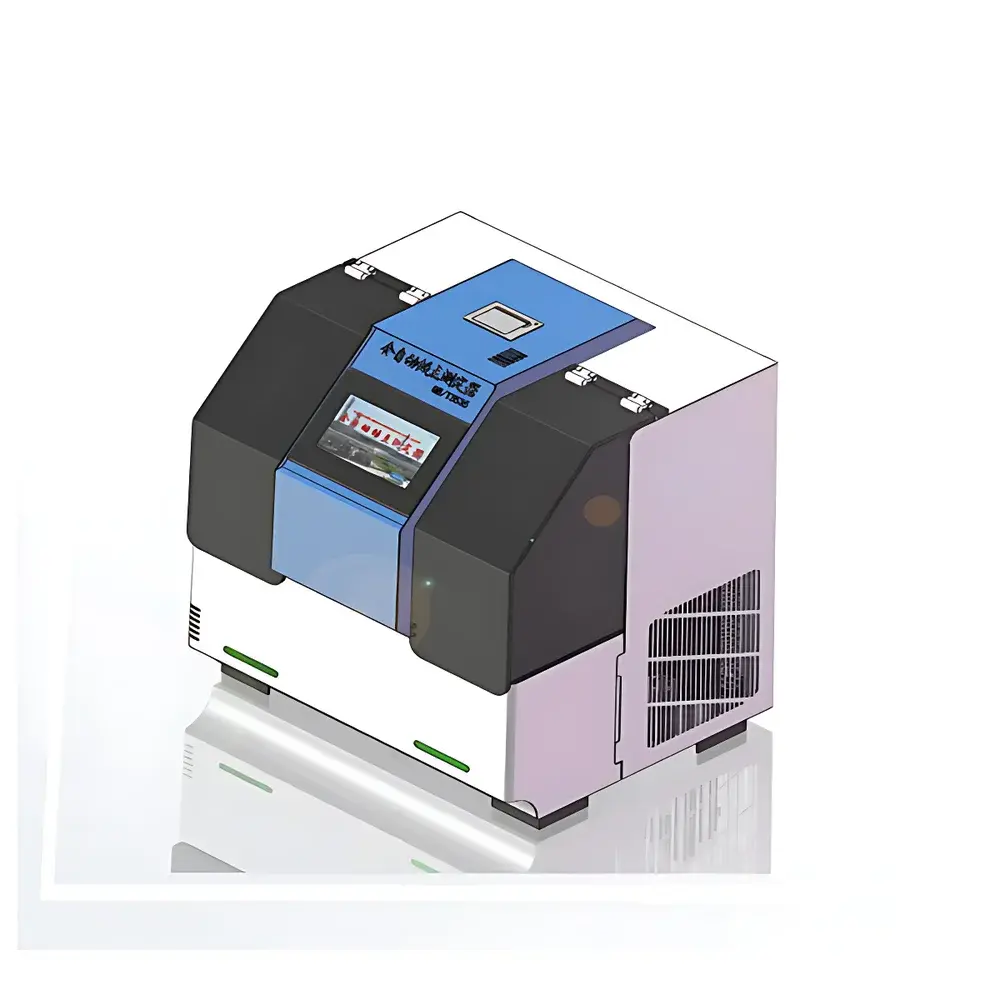
Automatic Petroleum Oil Pour Point and Cloud Point Tester PLD-3535E by PULUODY
| Brand | PULUODY |
|---|---|
| Model | PLD-3535E |
| Origin | Shaanxi, China |
| Instrument Type | Benchtop Automatic Pour/Cloud Point Analyzer |
| Standards Compliance | ASTM D5950-14, GB/T 3535 |
| Temperature Control Range | +50 °C to –70 °C |
| Control Accuracy | ±0.1 °C |
| Detection Method | Optical Liquid Surface Detection |
| Test Interval | 2 °C, 3 °C or User-Defined |
| Tilt Angles | 45° and 90° (Motorized Mechanical Actuation) |
| Dual Independent Bath Positions | 2 |
| Sample Volume | 10 mL per test |
| Test Duration | <10 s per measurement step |
| Repeatability | ±0.2% (of reading) |
| Power Supply | AC 200 V ±10%, 50 Hz |
| Power Consumption | 2000 W |
| Operating Environment | 5–35 °C, <85% RH |
| Display | 7″ Touchscreen LCD |
| Output | Panel-Mount Thermal Printer |
| Cooling System | Miniature Cascade Compressor (Air-Cooled, No External Chiller Required) |
Overview
The PULUODY PLD-3535E Automatic Petroleum Oil Pour Point and Cloud Point Tester is a benchtop analytical instrument engineered for precise, repeatable determination of pour point and cloud point in liquid petroleum products—including diesel fuels, lubricating oils, base stocks, and residual fuel blends—according to internationally recognized standard test methods. It operates on the principle of automated mechanical tilting combined with high-sensitivity optical detection of liquid mobility cessation (pour point) or wax crystal formation onset (cloud point). Unlike manual or semi-automated systems, the PLD-3535E implements fully programmable thermal ramping and endpoint recognition without operator intervention, minimizing subjectivity and enhancing inter-laboratory reproducibility. Its dual-bath architecture enables concurrent testing of two independent samples under identical thermal conditions—a critical capability for method validation, QC batch comparison, or reference material verification. The system integrates a miniature cascade compressor refrigeration unit, eliminating dependence on external cooling water supplies and ensuring stable low-temperature performance down to –70 °C.
Key Features
- Two independently controlled test baths with motorized 45° and 90° tilt actuation, enabling side-by-side comparative analysis under identical thermal profiles.
- Optical liquid surface detection system with real-time imaging feedback—designed to identify subtle changes in fluid meniscus stability during cooling, delivering higher endpoint resolution than traditional visual or capillary-based methods.
- Precision temperature control within ±0.1 °C across the full operating range (–70 °C to +50 °C), achieved via closed-loop PID regulation and high-stability platinum resistance thermometers (PRTs).
- Programmable test interval selection (2 °C, 3 °C, or user-defined steps), supporting both ASTM D5950-14 and GB/T 3535 protocols without hardware modification.
- Integrated 7-inch capacitive touchscreen interface with intuitive graphical workflow navigation, parameter logging, and real-time cooling curve visualization.
- Air-cooled miniature cascade compressor refrigeration—no external chiller, no water connections, reduced facility infrastructure dependency, and lower maintenance overhead.
- Thermal printer embedded in front panel for immediate hardcopy output of test reports including sample ID, date/time stamp, final endpoint temperature, and system diagnostic flags.
Sample Compatibility & Compliance
The PLD-3535E is validated for use with a broad spectrum of petroleum-derived liquids, including but not limited to: middle distillate fuels (EN 590, ASTM D975), engine lubricants (API Group I–III base oils), marine residual fuels (ISO 8217), and blended biofuels containing FAME or HVO components. It conforms strictly to ASTM D5950-14 “Standard Test Method for Pour Point of Petroleum Products (Automatic Tilt Method)” and Chinese national standard GB/T 3535 “Petroleum Products — Determination of Pour Point”. All internal calibration routines, thermal ramp logic, and endpoint decision algorithms are traceable to NIST-traceable reference standards. The instrument’s firmware supports audit-ready data integrity features—including electronic signatures, time-stamped event logs, and immutable result storage—making it suitable for laboratories operating under GLP, ISO/IEC 17025, or internal QA/QC frameworks requiring documented procedural consistency.
Software & Data Management
The embedded microprocessor-based control software provides complete automation from sample loading to report generation. Each test sequence records ambient temperature, bath temperature history, tilt timing, optical signal amplitude, and final endpoint classification. Data are stored locally in non-volatile memory with timestamped file naming (e.g., PP_20240517_142236.csv) and exportable via USB to standard spreadsheet formats. Optional PC connectivity (via RS232 or USB-to-serial adapter) enables integration with LIMS platforms or centralized QA databases. The system supports configurable pass/fail criteria based on specification limits, automatic flagging of out-of-tolerance results, and generation of summary statistics (mean, SD, CV%) across multiple runs. All software updates are delivered as signed firmware packages to ensure version control and regulatory compliance readiness.
Applications
- Quality assurance of finished diesel fuels prior to dispatch, verifying conformance to cold-flow specifications (e.g., EN 14214, ASTM D975).
- Base oil characterization in lubricant formulation labs, where pour point serves as an indicator of paraffin content and additive response.
- Refinery process monitoring—tracking pour point shifts during hydrotreating or dewaxing unit optimization.
- Research into cold-flow improver (CFI) efficacy, using dual-bath capability to evaluate treated vs. untreated samples simultaneously.
- Third-party certification testing for international trade compliance, particularly in markets with stringent low-temperature operability requirements (e.g., Nordic countries, Canadian winter grades).
- Method transfer studies between manual ASTM D97 and automated D5950 workflows, supported by built-in correlation tools and statistical reporting.
FAQ
Does the PLD-3535E comply with ASTM D5950-14 and GB/T 3535?
Yes—the instrument’s mechanical tilt sequence, optical detection threshold logic, and thermal ramp parameters are fully aligned with both standards’ procedural definitions.
Can the system be used for cloud point testing as well as pour point?
Yes—while optimized for pour point per ASTM D5950, its optical detection sensitivity and programmable ramp intervals allow adaptation for cloud point determination when configured with appropriate sample tubes and algorithm thresholds.
Is external cooling water required?
No—the integrated air-cooled cascade compressor eliminates reliance on chilled water circuits, reducing installation complexity and operational costs.
What sample volume is required per test?
10 mL of homogenized, moisture-free sample is required for each test position; tube geometry and fill level are standardized to ensure thermal mass consistency.
How is data integrity ensured for regulated environments?
The system maintains full audit trails—including user login events, parameter changes, test start/stop timestamps, and raw sensor outputs—with write-protected storage and optional electronic signature support for 21 CFR Part 11 alignment.






