
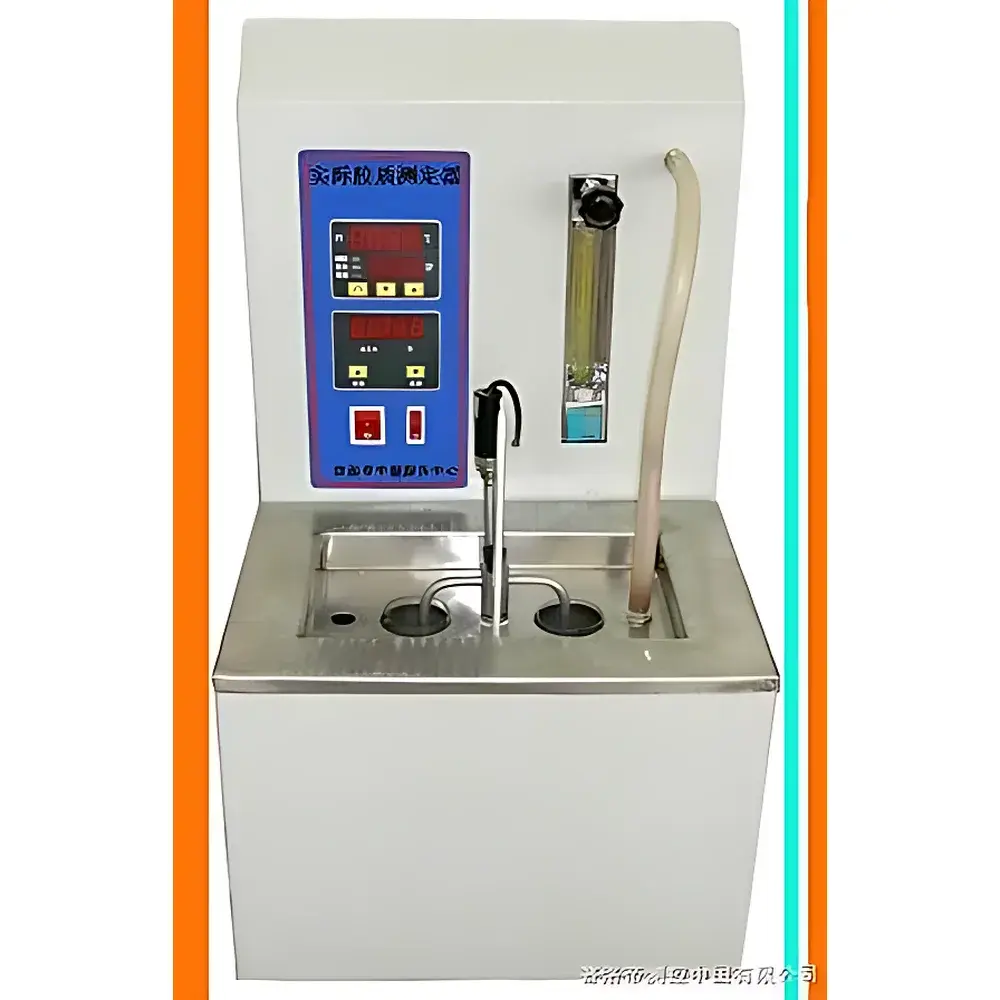
PULUODY PLD-509A Actual Gum Content Tester
| Brand | PULUODY |
|---|---|
| Origin | Shaanxi, China |
| Manufacturer Type | Direct Manufacturer |
| Country of Origin | China |
| Model | PLD-509A |
| Pricing | Available Upon Request |
| T-type Delivery Tube Inner Diameter | 6 mm |
| High-form Beaker Capacity (Nozzle-less) | 100 mL |
| Air Flowmeter Range | 10–88 L/min |
| Heating Element Power | 1800 W |
| Input Voltage | AC 220 V, 50 Hz |
| Temperature Control Range | Ambient to 300 °C |
| Temperature Control Accuracy | ≤ ±2.5 °C |
| Operating Ambient Temperature | –10 °C to +45 °C |
| Maximum Relative Humidity | 85 % RH |
Overview
The PULUODY PLD-509A Actual Gum Content Tester is a precision laboratory instrument engineered for the quantitative determination of actual gum content in aviation gasoline, motor gasoline, and other volatile petroleum distillates—strictly in accordance with the methodology defined in GB/T 509 (equivalent to ASTM D381 and ISO 6246). The instrument operates on the principle of controlled evaporation under standardized airflow and thermal conditions: a fixed volume of fuel sample is evaporated in a pre-weighed, nozzle-less high-form beaker while exposed to a regulated stream of ambient air at elevated temperature. Non-volatile residues—comprising oxidized hydrocarbons, polymerized olefins, and condensation products formed during thermal–oxidative stress—are retained as “actual gum.” This residue is then dried, cooled in a desiccator, and gravimetrically quantified to yield gum content in mg/100 mL, a critical parameter for assessing fuel stability, storage integrity, and engine deposit formation potential.
Key Features
- Compliance-driven design aligned with GB/T 509, ASTM D381, and ISO 6246 test protocols—ensuring regulatory acceptability in quality control laboratories.
- Stable, digitally regulated heating system with 1800 W power output and precise temperature control from ambient up to 300 °C (±2.5 °C accuracy), minimizing thermal drift during extended evaporation cycles.
- Integrated calibrated airflow meter (10–88 L/min range) with fine-tuning capability to maintain consistent air velocity across the sample surface—critical for reproducible oxidative evaporation kinetics.
- Dedicated T-type delivery tube (6 mm inner diameter) and standardized 100 mL nozzle-less high-form beaker geometry ensure uniform sample exposure and adherence to dimensional specifications mandated by the standard.
- Robust stainless-steel chassis and insulated heating chamber provide mechanical stability, thermal safety, and long-term operational reliability in routine QC environments.
- Designed for ambient operation between –10 °C and +45 °C at ≤85 % relative humidity—suitable for installation in general-purpose analytical labs without climate-controlled rooms.
Sample Compatibility & Compliance
The PLD-509A is validated for use with light distillate fuels including aviation turbine fuel (Jet A/A-1), unleaded motor gasoline (RON/MON blends), and naphtha fractions. It is not intended for heavy fuel oils, biodiesel blends above B5, or oxygenated solvents lacking defined volatility profiles per GB/T 509. All test procedures comply with national and international standards governing fuel specification testing. Data generated supports compliance reporting under GB 17930 (Chinese Motor Gasoline Standard), ASTM D4814, and EN 228. The instrument’s construction and calibration traceability support GLP-aligned laboratory practices; optional documentation packages—including calibration certificates and user qualification records—facilitate internal audit readiness.
Software & Data Management
The PLD-509A is a standalone benchtop instrument with no embedded microprocessor or digital interface. All operational parameters—including airflow rate, bath temperature, and evaporation duration—are manually set and monitored via analog gauges and mechanical controls. Gravimetric results are recorded externally using certified analytical balances (e.g., METTLER TOLEDO XSR series) compliant with ISO/IEC 17025. Laboratories integrating the PLD-509A into LIMS or ELN workflows typically log test metadata (sample ID, operator, date/time, environmental conditions) and final gum mass values via structured electronic templates. While the unit itself does not generate electronic audit trails, its manual operation enables full procedural transparency—a requirement under FDA 21 CFR Part 11 when paired with documented SOPs and analyst training records.
Applications
- Quality assurance of refinery-produced gasoline batches prior to distribution.
- Monitoring oxidative stability during fuel aging studies and accelerated storage tests.
- Investigating gum formation mechanisms in reformulated fuels containing ethanol or ether-based oxygenates.
- Supporting root-cause analysis of intake valve deposits (IVD) and carburetor varnish in engine durability testing.
- Verifying conformance to contractual gum limits specified in procurement agreements for military or aviation fuel supply chains.
- Training platform for ASTM D381 methodology in university petroleum engineering laboratories.
FAQ
What standards does the PLD-509A support?
It is fully compliant with GB/T 509, ASTM D381, and ISO 6246 for actual gum determination in light distillate fuels.
Is the instrument suitable for diesel fuel testing?
No—diesel and middle-distillate fuels require different methodologies (e.g., ASTM D2274 for oxidation stability); the PLD-509A is limited to volatile fuels meeting the volatility criteria of GB/T 509.
Does it include a built-in balance or data logger?
No—the PLD-509A is a dedicated evaporation apparatus only; gravimetric analysis requires an external analytical balance and manual data entry.
Can temperature and airflow be independently adjusted during testing?
Yes—both heating bath temperature and airflow rate are independently controllable via front-panel knobs and calibrated flowmeters, enabling method optimization within standard-defined ranges.
What maintenance is required for long-term accuracy?
Routine cleaning of the T-tube and beaker holder, periodic verification of airflow meter calibration against a primary standard, and annual validation of temperature sensor accuracy using NIST-traceable reference thermometers.
Related Products





