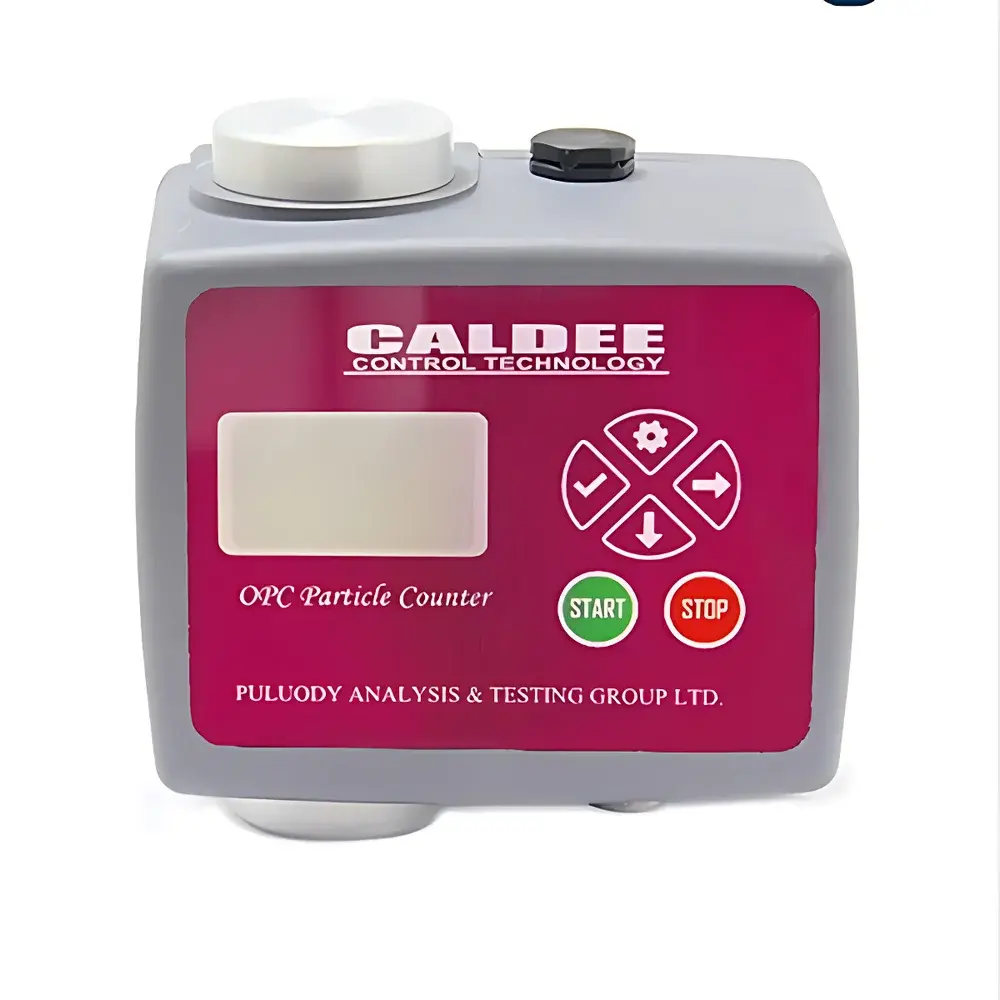
PULUODY OPC-7 Online Particle Counter (Economy Edition)
| Brand | PULUODY |
|---|---|
| Origin | Shaanxi, China |
| Manufacturer Type | Authorized Distributor |
| Country of Origin | China |
| Model | OPC-7 |
| Price | USD 8,100 (FOB) |
| Detection Principle | Dual-Laser Narrow-Beam Light Obscuration |
| Measurement Range | 1–150 µm |
| Channels | 8 |
| Standards Compliance | ISO 4406, NAS 1638, SAE AS4059, ISO 11171, MIL-STD-1246D, GJB 420B, GB/T 14039, GOST 17216 |
| Pressure Rating | 0–1.0 MPa (standard), up to 31.5 MPa (with integrated pressure reducer) |
| Flow Rate | 15–500 mL/min |
| Fluid Temperature Range | −10 °C to +80 °C |
| Viscosity Limit | ≤500 cSt (online mode) |
| Output Interfaces | RS232, RS485, 4–20 mA, 0–5 V (customizable) |
| Power Supply | 9–30 VDC |
| Reporting | Particles per mL + ISO/NAS/GJB contamination code |
| Calibration Support | NIST-traceable reference materials, annual recalibration assistance provided |
Overview
The PULUODY OPC-7 Online Particle Counter (Economy Edition) is an industrial-grade, real-time fluid cleanliness monitoring instrument engineered for continuous in-line analysis of particulate contamination in hydraulic oils, lubricants, turbine fluids, and process liquids. It employs seventh-generation dual-laser narrow-beam light obscuration technology—originally developed by PULUODY Analytical Testing Group (UK)—to deliver high-fidelity particle counting across eight user-configurable size channels (1–150 µm). Unlike benchtop or offline samplers, the OPC-7 integrates directly into pressurized fluid circuits without flow interruption, enabling dynamic wear debris tracking, early-stage filter performance evaluation, and predictive maintenance decision support. Its architecture complies with fundamental metrological requirements for on-site calibration traceability and third-party verification per ISO/IEC 17025 principles. Designed for operational resilience, it operates reliably under ambient temperatures from −10 °C to +80 °C and system pressures up to 31.5 MPa (with optional pressure-reduction module), making it suitable for offshore platforms, mobile hydraulics, and high-pressure test rigs.
Key Features
- Seventh-generation dual-laser optical sensing with optimized beam collimation for improved signal-to-noise ratio and reduced coincidence error at high particle concentrations
- Eight programmable detection thresholds aligned to international particle size binning standards (e.g., ISO 4406:2021 Annex A, NAS 1638 Class Limits)
- Real-time analog and digital outputs: RS232, RS485 Modbus RTU, 4–20 mA current loop, and 0–5 V voltage output—fully configurable for DCS, PLC, or local panel integration
- Ruggedized IP65-rated enclosure with stainless-steel wetted parts; validated for continuous operation in vibration-prone, high-EMI environments
- Onboard contamination grading per 15+ global standards—including ISO 4406, NAS 1638, SAE AS4059, GJB 420B, GOST 17216, and GB/T 14039—with automatic report generation in particles/mL and coded class notation
- Wide-flow adaptability: adjustable sampling rate from 15 to 500 mL/min; compatible with viscosities up to 500 cSt in online configuration
Sample Compatibility & Compliance
The OPC-7 supports direct measurement of mineral oils, synthetic lubricants, phosphate esters, water-glycol fluids, and ultra-pure aqueous solutions (e.g., pharmaceutical water-for-injection prefiltration streams). It meets optical alignment and calibration stability requirements defined in ISO 11171:2016 (Calibration of Liquid-Borne Particle Counters) and ISO 4402:1991 (for legacy calibration protocols). While not certified to IEC 61508 or SIL-2 as a safety instrument, its hardware design incorporates redundant sensor diagnostics and watchdog circuitry to ensure data integrity during extended unattended operation. All firmware and reporting logic are structured to support GLP-compliant audit trails when deployed with external timestamped data loggers. Regulatory alignment includes compatibility with FDA 21 CFR Part 11 requirements for electronic records when paired with validated software clients.
Software & Data Management
The OPC-7 operates with embedded firmware supporting standalone operation—no PC required for basic functionality. Optional PC-based software (PULUODY ParticleView™ v3.x) enables advanced trending, alarm threshold customization, multi-sensor fleet monitoring, and export to CSV, PDF, or XML formats compliant with enterprise LIMS systems. Raw count data is time-stamped with millisecond resolution and stored onboard for up to 30 days (configurable buffer depth). The device logs all parameter changes, calibration events, and alarm triggers with immutable timestamps—supporting retrospective root-cause analysis in failure investigations. Firmware updates are delivered via secure signed binary packages; version history and checksum validation are retained in non-volatile memory.
Applications
- Continuous condition monitoring of hydraulic systems in construction machinery, wind turbine pitch/yaw actuators, and marine propulsion control units
- Filter efficiency validation per ISO 16889 and beta-ratio testing on filter test benches
- Wear debris trend analysis in gearboxes and servo-valve test stands using NAS 1638 or ISO 4406 delta-class tracking
- Contamination control during oil reclamation and offline filtration processes
- Pre-commissioning fluid cleanliness verification for aerospace ground support equipment (per MIL-STD-1246D Level 100)
- Monitoring of turbine lube oil in power generation facilities against ISO 4406 16/13 limits
FAQ
Does the OPC-7 require annual recalibration? How is traceability maintained?
Yes. Annual recalibration is recommended per ISO/IEC 17025 guidance. PULUODY provides NIST-traceable latex sphere reference suspensions (ISO 11171 compliant) and on-site calibration verification kits. Full recalibration services are available through authorized service centers.
Can the OPC-7 be installed upstream of a filter?
Yes—provided differential pressure remains within rated limits and flow conditioning (e.g., straight pipe runs ≥10× diameter) is implemented upstream to minimize turbulence-induced counting artifacts.
Is firmware upgrade supported remotely?
Firmware updates require physical access via USB or serial interface; remote update is not supported for security and integrity reasons.
What is the minimum detectable particle concentration?
The lower limit of quantification (LLOQ) is 100 particles/mL at 4 µm(c), validated per ISO 21501-4:2018 procedures using monodisperse reference materials.
Does the device meet explosion-proof requirements for hazardous areas?
No. The OPC-7 is rated for general industrial use (IP65). For Zone 1/2 applications, it must be housed in an approved purge cabinet or used with intrinsically safe barrier interfaces.