
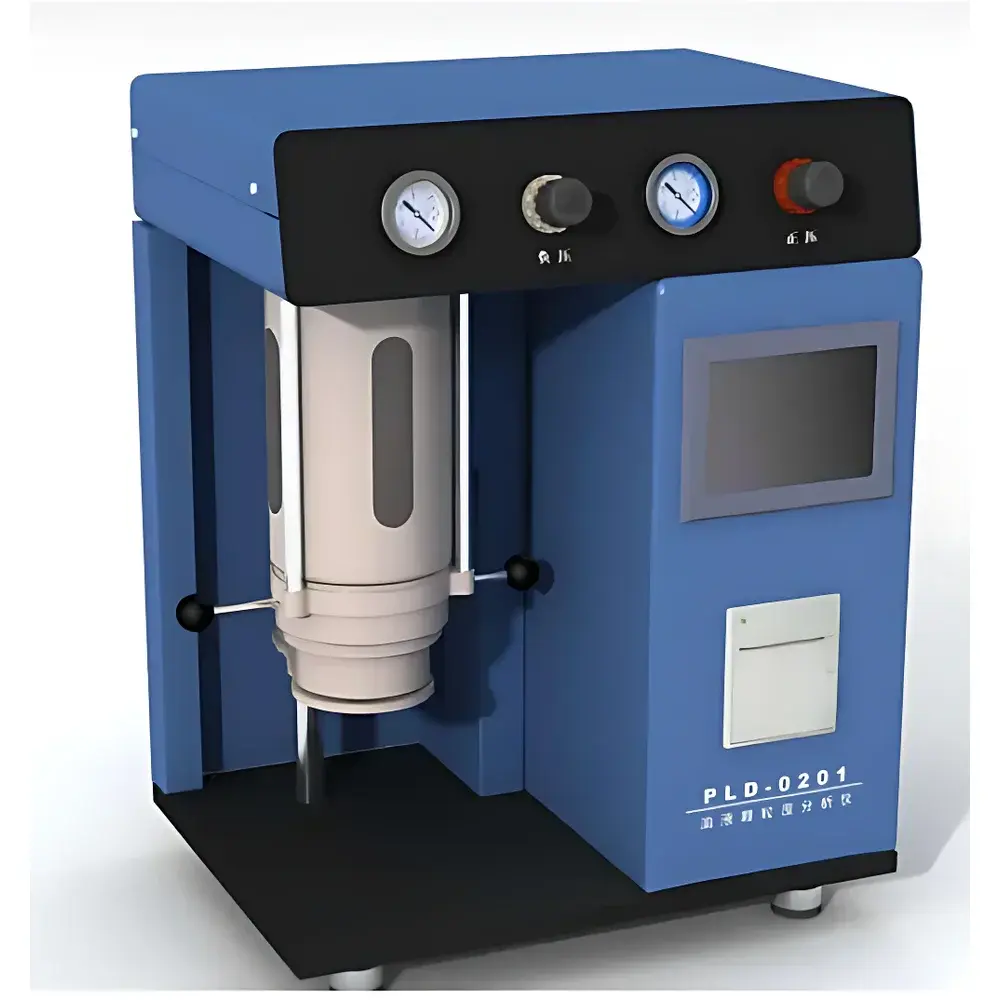
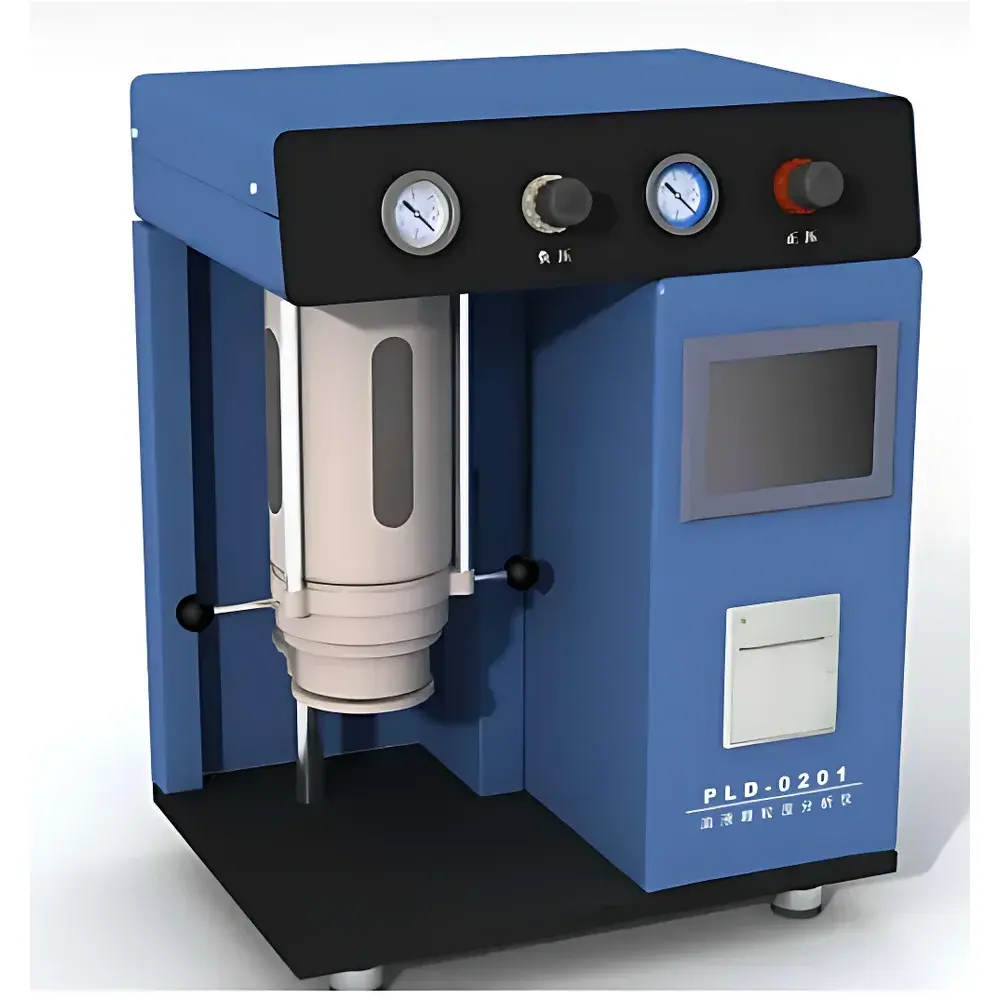
PULUODY PLD-0201 Optical Particle Counter
| Brand | PULUODY |
|---|---|
| Origin | Shaanxi, China |
| Manufacturer Type | Direct Manufacturer |
| Instrument Type | Optical Particle Counter (Light Obscuration Principle) |
| Model | PLD-0201I |
| Measurement Principle | Light Obscuration (LO) per ISO 11171:1999 / ISO 4406:1999 / NAS1638 / GJB420B |
| Laser Sensor | 7th-Generation Narrow-Beam Laser Detector (PCF-7A) |
| Measurement Range | 1–450 µm |
| Sensitivity | 1 µm (per ISO 4402), 4 µm(c) (per ISO 11171 & GB/T 18854) |
| Channels | 8 user-configurable size thresholds |
| Sample Volume Accuracy | ±1% |
| Flow Rate Control | 5–60 mL/min via precision piston pump with electromagnetic flow regulation |
| Pressure Range | –0.06 to 0.7 MPa (dual positive/negative pressure pre-treatment system) |
| Viscosity Handling | up to 350 cSt |
| Max Particle Concentration | 10,000 particles/mL (≤5% coincidence error) |
| Test Duration | Adjustable, default 12.5 s |
| Operating Temp | Ambient to 65 °C |
| Ambient Temp | 0–50 °C |
| Power | 220 V AC, 50 Hz, <80 W |
| Calibration Compliance | GB/T 18854–2002, ISO 11171:1999, JJG 066–95 |
| Data Output | Real-time particle count/size distribution, histogram, ISO 4406 & NAS1638 contamination grade assignment, built-in thermal printer |
| Interface | RS232 serial port |
| Software | P6.4 Analysis Suite (integrated LabPC7 platform) |
| Regulatory Support | GLP-compliant audit trail, FDA 21 CFR Part 11-ready configuration (optional), traceable calibration certificate available from National Defense Science & Technology Industry First-Class Particle Metrology Station (No. 116) |
Overview
The PULUODY PLD-0201 Optical Particle Counter is a laboratory-grade light obscuration (LO) instrument engineered for precise, repeatable quantification of solid particulate contamination in liquid media—primarily hydraulic oils, lubricants, transformer oils, turbine oils, aviation fuels, and polymer solutions. It operates on the standardized principle of light extinction: as particles suspended in a laminar fluid stream pass through a focused laser beam, they attenuate incident light proportionally to their cross-sectional area. The resulting pulse amplitude is converted into equivalent spherical diameter (ESD) values referenced to certified polystyrene latex (PSL) standards per ISO 11171:1999. Designed for compliance with international contamination grading frameworks—including ISO 4406:1999, NAS1638, GJB420B, and GB/T 14039–2002—the PLD-0201 delivers authoritative data for predictive maintenance, fluid life extension, and regulatory conformance across aerospace, power generation, marine, and heavy industrial sectors.
Key Features
- 7th-generation narrow-beam laser detection module (PCF-7A) optimized for signal stability, low noise floor, and high pulse resolution across the 1–450 µm range.
- Precision dual-control fluidics: integrated piston pump + electromagnetic flow regulator ensures constant volumetric delivery (5–60 mL/min) and sample volume accuracy better than ±1%.
- Configurable 8-channel size classification with user-defined threshold settings; supports custom binning for specialized applications such as wear debris analysis or additive monitoring.
- Dual-pressure pre-treatment chamber (–0.06 to 0.7 MPa) enables degassing of volatile samples and controlled aspiration of high-viscosity fluids (up to 350 cSt) without dilution or filtration.
- Integrated industrial touchscreen HMI with dual-input capability (touch + physical keypad); real-time display of count-vs-size histograms, cumulative distributions, and ISO/NAS contamination codes.
- Onboard thermal printer and embedded operating system allow standalone operation—no external PC required for routine testing or report generation.
- RS232 interface supports bidirectional communication with LIMS or enterprise QA/QC databases; full ASCII data export including timestamp, sample ID, channel counts, and calculated grades.
Sample Compatibility & Compliance
The PLD-0201 accepts undiluted, unfiltered samples of mineral oils, synthetic lubricants, insulating fluids, aqueous coolants, and organic solvents. Its optical architecture accommodates refractive index variations typical of hydrocarbon-based and ester-based formulations without recalibration. The instrument conforms to metrological requirements defined in GB/T 18854–2002 (equivalent to ISO 11171:1999), with traceable calibration available from the National Defense Science & Technology Industry First-Class Particle Metrology Station (Station No. 116). Optional certification packages include validation reports aligned with GLP and ISO/IEC 17025:2017. For regulated environments, optional firmware modules support electronic signatures, audit trails, and 21 CFR Part 11–compliant data integrity controls.
Software & Data Management
The P6.4 Analysis Suite—deployed as both integrated firmware and Windows-compatible LabPC7 desktop application—provides comprehensive workflow management. It automates particle localization, shape-assisted classification (via pulse width analysis), and multi-standard grading (ISO 4406, NAS1638, GJB420B). Raw pulse data is stored with metadata (operator ID, calibration date, environmental conditions) and supports retrospective re-analysis. Histograms, trend charts, and statistical summaries (mean, median, mode, standard deviation) are exportable in CSV, PDF, and XML formats. Batch reporting templates comply with internal SOPs and external audit requirements, including automatic inclusion of instrument ID, sensor calibration status, and pass/fail flags against preset cleanliness limits.
Applications
- Aerospace: Hydraulic fluid certification per SAE AS4059E and MIL-STD-1246C; contamination monitoring of jet fuel (JP-5, JP-8) and synthetic lubricants in turbine engines.
- Power Generation: Transformer oil condition assessment per IEC 60429 and ASTM D6786; particulate load tracking in steam turbine control systems.
- Marine & Offshore: Gearbox oil surveillance on propulsion systems; verification of filtration efficiency in closed-loop hydraulic circuits.
- Automotive R&D: Wear particle analysis in engine oil drain samples; validation of filter media performance under dynamic flow conditions.
- Pharmaceutical Manufacturing: Non-viable particulate testing of purified water and WFI per USP , when configured with appropriate sample preparation accessories.
FAQ
What standards does the PLD-0201 natively support for contamination grading?
ISO 4406:1999, NAS1638, GJB420B, and GB/T 14039–2002 are preloaded; additional standards (e.g., SAE AS4059E, DIN 51830) can be imported via configuration file.
Can the instrument analyze viscous samples without dilution?
Yes—its dual-pressure sampling system allows direct aspiration of fluids up to 350 cSt at controlled flow rates, eliminating pre-dilution errors and preserving particle morphology.
Is calibration traceable to national metrology institutes?
Calibration is performed using NIST-traceable PSL standards; formal certification from the National Defense First-Class Particle Metrology Station (No. 116) is available upon request.
Does the system meet FDA 21 CFR Part 11 requirements?
The base configuration supports ALCOA+ data integrity principles; optional Part 11–compliant firmware includes electronic signatures, role-based access control, and immutable audit logs.
How is sensor fouling managed during extended operation?
An automated rinse cycle activates post-analysis using compatible solvents (e.g., isopropanol, filtered heptane); the flow path is validated for residue-free recovery between samples.



