
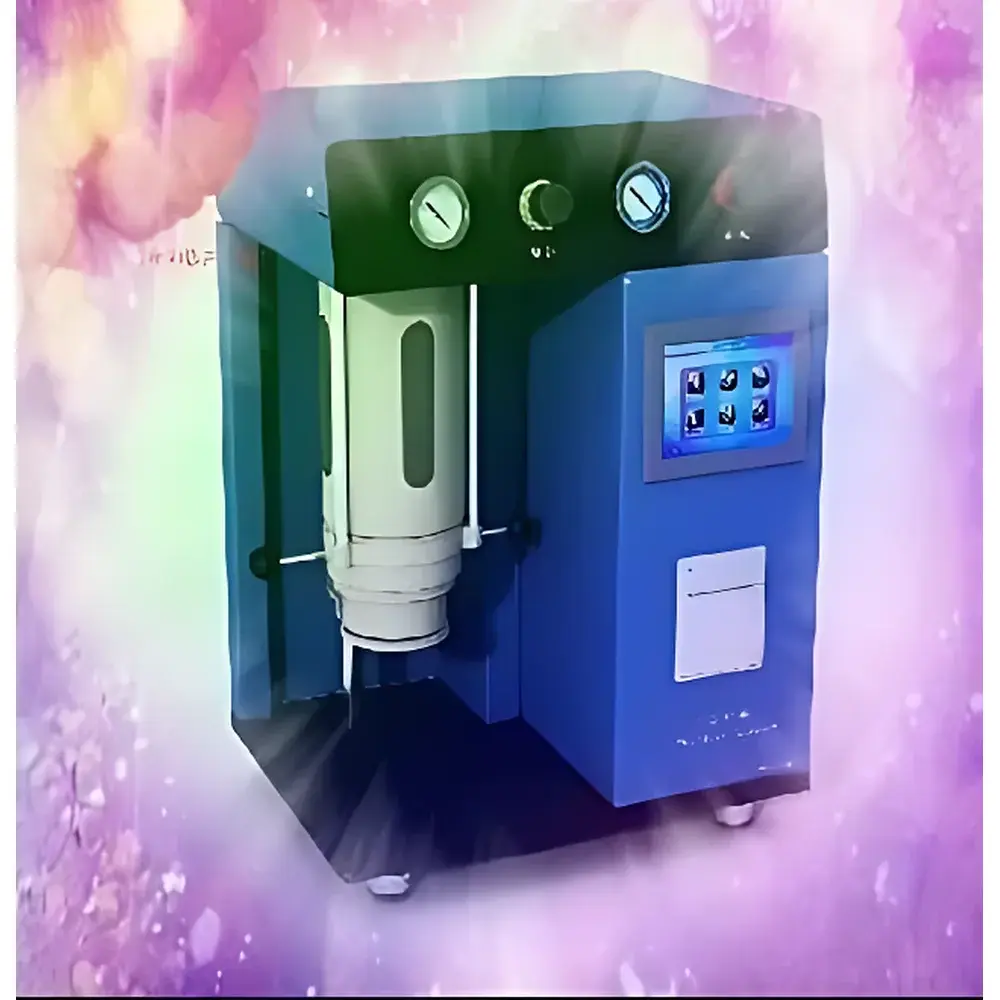
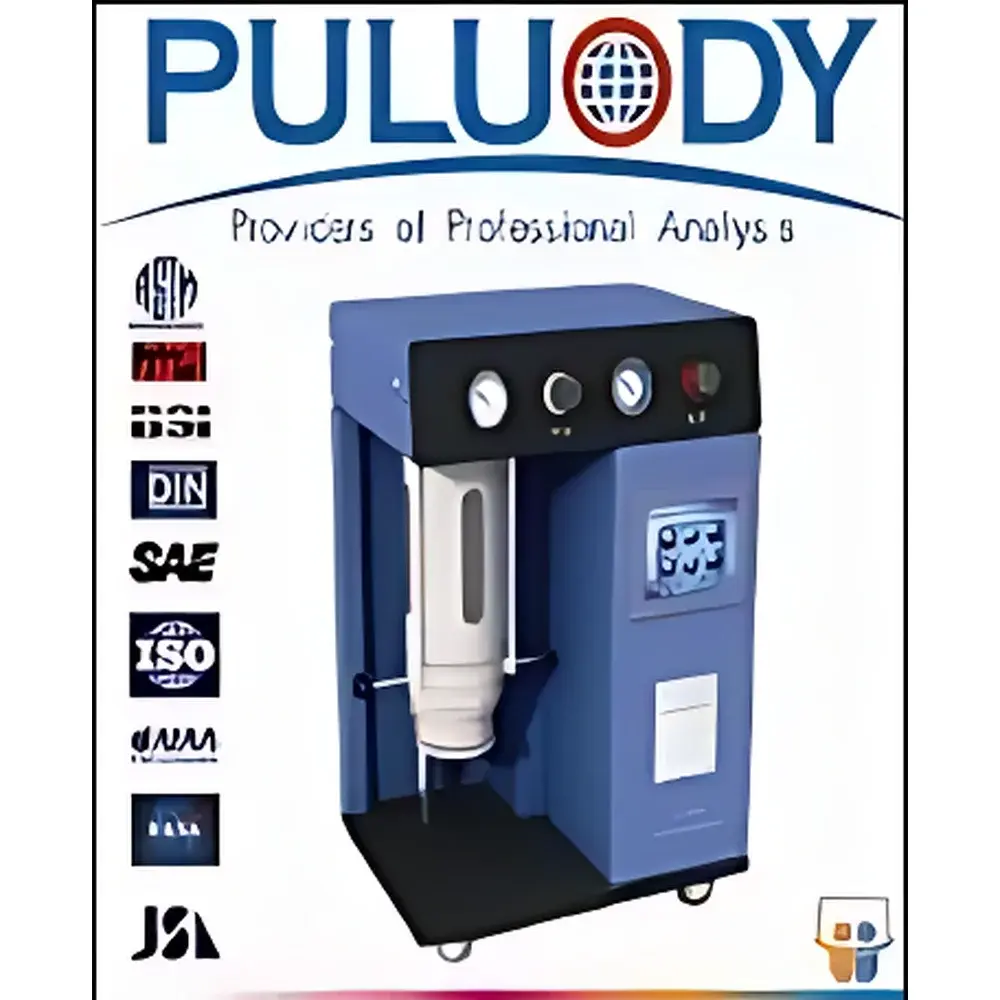

PULUODY PLD-0201L Laser-Based Oil Particle Counter System
| Brand | PULUODY |
|---|---|
| Model | PLD-0201L |
| Measurement Principle | Light Obscuration (LO) / Optical Blockage |
| Detection Range | 1 µm to 450 µm |
| Sensitivity | 1 µm (per ISO 4402) or 4 µm(c) (per ISO 11171 & GB/T 18854) |
| Channel Configuration | 8 user-definable size channels |
| Counting Accuracy | ≤5% coincidence error at 10,000 particles/mL |
| Sample Volume Accuracy | ±1% |
| Flow Control | Precision piston pump with electromagnetic flow regulation (5–60 mL/min) |
| Pressure Range | −0.6 to +0.7 MPa (integrated positive/negative pressure pretreatment) |
| Viscosity Limit | ≤350 cSt (mm²/s) |
| Operating Temperature | Ambient to 65 °C |
| Environmental Temp. | 0–50 °C |
| Power Supply | 220 V AC, 50 Hz, <80 W |
| Compliance Standards | ISO 4406:1999, NAS 1638, GB/T 14039–2002, GB/T 18854–2002 (ISO 11171:1999), JJG 066–95, GJB 380, GJB 420 |
| Data Interface | RS232 serial port |
| Built-in Printer | Yes |
| Calibration Traceability | Certified by AVIC Particle Metrology Test Station (No. 116, National Defense Science & Technology Industry First-Class Particle Metrology Station) |
Overview
The PULUODY PLD-0201L Laser-Based Oil Particle Counter System is an engineered solution for quantitative assessment of solid particulate contamination in liquid media—primarily lubricants, hydraulic fluids, insulating oils, turbine oils, and other industrial process liquids. It operates on the internationally standardized light obscuration (LO) principle, wherein particles suspended in a flowing liquid stream pass through a focused laser beam, generating transient reductions in detected light intensity proportional to particle cross-sectional area. These pulses are converted into digital signals, enabling real-time sizing and counting across eight programmable detection thresholds. The system is designed for high reproducibility in demanding environments where fluid cleanliness directly impacts equipment reliability, service life, and operational safety—especially in aerospace hydraulics, power generation turbines, marine propulsion systems, and precision manufacturing.
Key Features
- Precision piston pump with closed-loop electromagnetic flow control ensures consistent sample delivery at 5–60 mL/min, minimizing shear-induced particle fragmentation and maintaining volumetric accuracy within ±1%.
- Integrated dual-mode pressure conditioning system supports both vacuum-assisted degassing and pressurized aspiration—enabling reliable analysis of viscous oils (up to 350 cSt) and volatile or aerated samples without manual pre-treatment.
- Sixth-generation narrow-beam laser sensor optimized for ISO 11171-compliant calibration, delivering stable signal-to-noise ratio and sub-micron resolution down to 1 µm (per ISO 4402) or 4 µm(c) (per ISO 11171/GB/T 18854).
- Eight fully configurable particle size channels allow flexible reporting aligned with NAS 1638, ISO 4406, GJB 420A, or custom user-defined binning schemes—including dual-scheme backup for comparative analysis.
- Onboard industrial-grade computing platform with capacitive touchscreen interface enables standalone operation: real-time histogram generation, automatic contamination grade assignment, and direct thermal printing of certified reports.
- RS232 interface supports bidirectional communication with external LIMS or QA databases; firmware architecture complies with audit-trail requirements for GLP/GMP-regulated laboratories.
Sample Compatibility & Compliance
The PLD-0201L accommodates a broad spectrum of non-aqueous liquids including mineral and synthetic lubricants, phosphate ester fire-resistant fluids, transformer insulating oils, aviation fuels (Jet A-1, JP-8), water-glycol hydraulic fluids, and polymer solutions. It excludes strongly absorbing or fluorescent media that compromise LO signal fidelity. All measurement protocols adhere to ISO 4406:1999 for coding particle counts per milliliter in two size ranges (≥4 µm(c) and ≥6 µm(c)), and NAS 1638 for ten-class grading based on cumulative counts across five discrete bins (5–15 µm, 15–25 µm, etc.). Instrument calibration follows GB/T 18854–2002 (equivalent to ISO 11171:1999), traceable to reference particle suspensions certified by the AVIC Particle Metrology Test Station (No. 116), China’s national first-class defense metrology facility. Optional certification reports from this accredited body are available upon request for regulatory submission or third-party audit readiness.
Software & Data Management
The embedded P6.4 Analytical Software Suite provides comprehensive data handling capabilities without requiring external PCs. It supports automatic calculation of ISO cleanliness codes, NAS class numbers, and raw particle concentration histograms. All test records include timestamp, operator ID, sample ID, instrument serial number, calibration status, and environmental parameters—ensuring full traceability under FDA 21 CFR Part 11 guidelines when paired with optional electronic signature modules. Data export formats include CSV and PDF; historical datasets are indexed by date, standard, and sample type for rapid retrieval. Firmware updates maintain alignment with evolving international standards such as ISO 4406:2022 and ASTM D7619 revisions.
Applications
This system serves critical roles across multiple sectors: monitoring in-service oil degradation in gas turbine engines (per SAE AS4059); verifying cleanliness of hydraulic fluid prior to commissioning aircraft landing gear systems; certifying transformer oil purity before energization in substations; validating filtration efficiency in offshore drilling mud reclamation loops; and ensuring compliance with OEM specifications for wind turbine gearbox oils (e.g., DIN 51517-3, Shell LAG 046). Its ability to operate unattended during extended sampling cycles makes it suitable for integration into predictive maintenance programs utilizing ISO 4406 trend analysis over time.
FAQ
Does the PLD-0201L require daily recalibration?
No—calibration is performed per GB/T 18854–2002 using NIST-traceable ISO MTD reference particles; routine verification checks are recommended before each shift or after major maintenance.
Can it analyze water-based coolants or glycol solutions?
Yes, provided they are optically transparent and non-corrosive to wetted components (316 stainless steel, sapphire flow cell, fluoropolymer seals).
Is remote diagnostics supported?
Yes, via optional Ethernet module (not included standard) enabling secure SSH access for firmware updates and troubleshooting by PULUODY technical support engineers.
What is the maximum allowable air content in the sample?
The integrated vacuum degassing function handles up to 5% dissolved air; higher levels require offline deaeration per ISO 4021.
How is data integrity maintained during power interruption?
Non-volatile flash memory preserves all active test sessions and calibration logs; system resumes from last valid state upon reboot without data loss.
Related Products



