
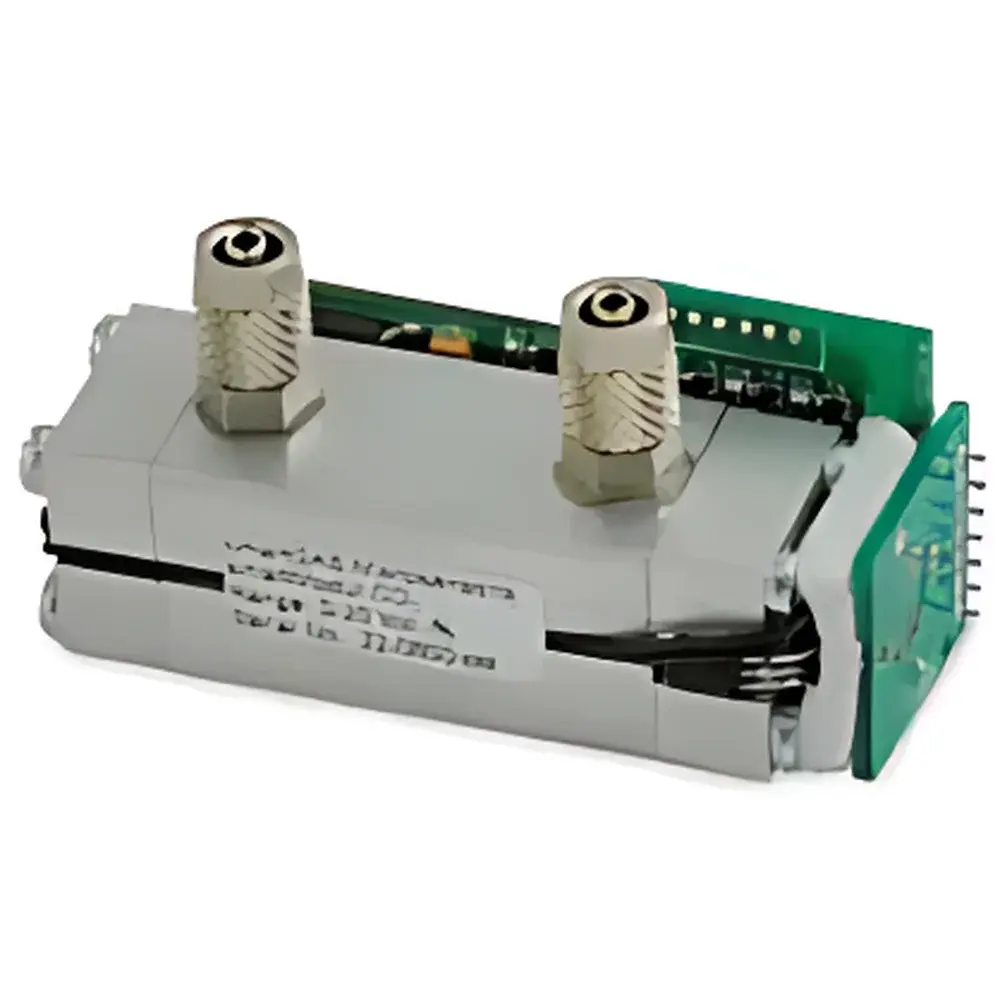
SmartGas SF6 Infrared Gas Sensor (NDIR-Based, Dual-Wavelength, Temperature-Compensated)
| Brand | SmartGas |
|---|---|
| Origin | Germany |
| Model | SM-SF6 / SMC-SF6 / SMF-SF6 / SMP-SF6 |
| Detection Principle | Non-Dispersive Infrared (NDIR) |
| Measurement Range Options | 0–50 ppm (leak detection), 0–1500 ppm (monitoring), 0–3000 ppm (monitoring), 0–100 % vol. (purity analysis) |
| Resolution | 0.1 ppm (low-range), 1 % (high-range) |
| Accuracy | ±1 ppm (0–50 ppm), ±2 % (0–100 % vol.) |
| Cross-Sensitivity | Immune to H₂O, CO₂, ethanol |
| Output | Digital (I²C, UART) and Analog (4–20 mA, 0–10 V) |
| Lifetime | ≥10 years |
| Power Consumption | Low (typ. <150 mW in standby) |
| Operating Temperature | –20 °C to +50 °C |
| Compliance | Designed for IEC 61000-6-3/-4, RoHS, CE |
Overview
The SmartGas SF6 Infrared Gas Sensor is a high-stability, non-dispersive infrared (NDIR) sensing module engineered for continuous, quantitative detection of sulfur hexafluoride (SF₆) in industrial and utility environments. Unlike electrochemical or catalytic bead sensors, this device relies on the fundamental vibrational absorption band of SF₆ near 10.55 µm — a spectral signature unique to the molecule and unshared by common interferents including water vapor (H₂O), carbon dioxide (CO₂), and alcohols. Its dual-wavelength, dual-beam optical architecture incorporates an active measurement channel and a reference channel modulated at the same frequency but tuned to a non-absorbing wavelength. This design inherently compensates for long-term drift caused by LED aging, optical window fouling, detector responsivity shifts, and ambient temperature fluctuations — a critical requirement for unattended operation in substations, GIS enclosures, and SF₆ handling facilities.
Key Features
- Dual-beam NDIR optics with integrated temperature compensation — eliminates baseline drift without periodic zero calibration
- Proven immunity to cross-sensitivity from H₂O, CO₂, CH₄, ethanol, and other common atmospheric gases
- Extended operational lifetime exceeding 10 years under continuous duty — no consumables, no electrolyte replacement
- Multiple form factors: SM-SF6 (basic module), SMC-SF6 (connectable interface), SMF-SF6 (flow-through configuration), SMP-SF6 (premium version with enhanced diagnostics)
- Configurable detection ranges: 0–50 ppm (leak detection), 0–1500 ppm / 0–3000 ppm (continuous monitoring), and 0–100 % vol. (purity verification)
- Simultaneous digital (I²C, UART) and analog (4–20 mA, 0–10 V) outputs — compatible with PLCs, SCADA systems, and embedded controllers
- Low-power design (typ. <150 mW standby) suitable for battery-operated leak detectors and remote monitoring nodes
- Robust mechanical housing rated IP65 — validated for installation in switchgear rooms, transformer vaults, and outdoor GIS bays
Sample Compatibility & Compliance
The sensor operates reliably across dry and humid gas streams without condensation-induced signal attenuation. It requires no sample conditioning (e.g., drying or filtration) for typical indoor or enclosed electrical equipment applications. All variants comply with electromagnetic compatibility standards IEC 61000-6-3 (emission) and IEC 61000-6-4 (immunity), and meet RoHS Directive 2011/65/EU and CE marking requirements. While not intrinsically safe certified out-of-box, the SMF-SF6 and SMP-SF6 modules support integration into ATEX Zone 2 or IECEx Zone 2 compliant systems when installed within appropriately rated enclosures. The sensor’s measurement traceability aligns with ISO 17025–accredited calibration practices using NIST-traceable SF₆ standards.
Software & Data Management
SmartGas provides a standardized firmware interface supporting Modbus RTU over UART and configurable I²C register maps — enabling seamless integration into OEM instrumentation platforms. Each sensor includes factory calibration data stored in onboard EEPROM, including span factor, zero offset, temperature coefficient, and nonlinearity correction coefficients. Optional SmartGas Configuration Studio software allows end-users to perform field verification, adjust alarm thresholds, log real-time concentration trends, and export CSV-formatted datasets for QA/QC reporting. Audit trails and configuration change logs are maintained per GLP/GMP-aligned data integrity principles, though full 21 CFR Part 11 compliance requires host-system-level implementation (e.g., user authentication, electronic signatures, and immutable audit logs).
Applications
- Real-time SF₆ leakage monitoring in gas-insulated switchgear (GIS), circuit breakers, and transformers
- OEM integration into portable and fixed-mount SF₆ leak detectors (0–50 ppm range)
- Continuous purity assessment in SF₆ reclamation units and cylinder filling stations (0–100 % vol.)
- Environmental safety interlocks in high-voltage laboratories and SF₆ handling workshops
- Condition-based maintenance systems for predictive assessment of seal degradation and enclosure integrity
- Compliance monitoring against IEEE C37.122.3 and IEC 62271-4 for SF₆-filled equipment
FAQ
What is the primary advantage of NDIR over electrochemical SF₆ sensors?
NDIR technology offers superior long-term stability, absence of consumables, immunity to poisoning, and inherent resistance to humidity interference — making it suitable for unattended, multi-year deployment in critical power infrastructure.
Can the sensor be calibrated in-field?
Yes — zero calibration is possible using certified nitrogen or clean air; span calibration requires certified SF₆ standard gas (e.g., 20 ppm or 50 ppm in N₂). SmartGas recommends annual verification per ISO 6141.
Is temperature compensation built-in?
Yes — all models include integrated thermistor feedback and algorithmic compensation across –20 °C to +50 °C operating range.
Does the sensor require warm-up time?
Stabilization occurs within 30 seconds after power-on; full specification accuracy is achieved within 2 minutes.
How is cross-sensitivity to CO₂ mitigated?
By selecting a narrow-band optical filter centered precisely at SF₆’s asymmetric stretch absorption peak (10.55 µm), while rejecting adjacent CO₂ bands (>12 µm) and H₂O rotational lines (<8 µm).
Related Products







