
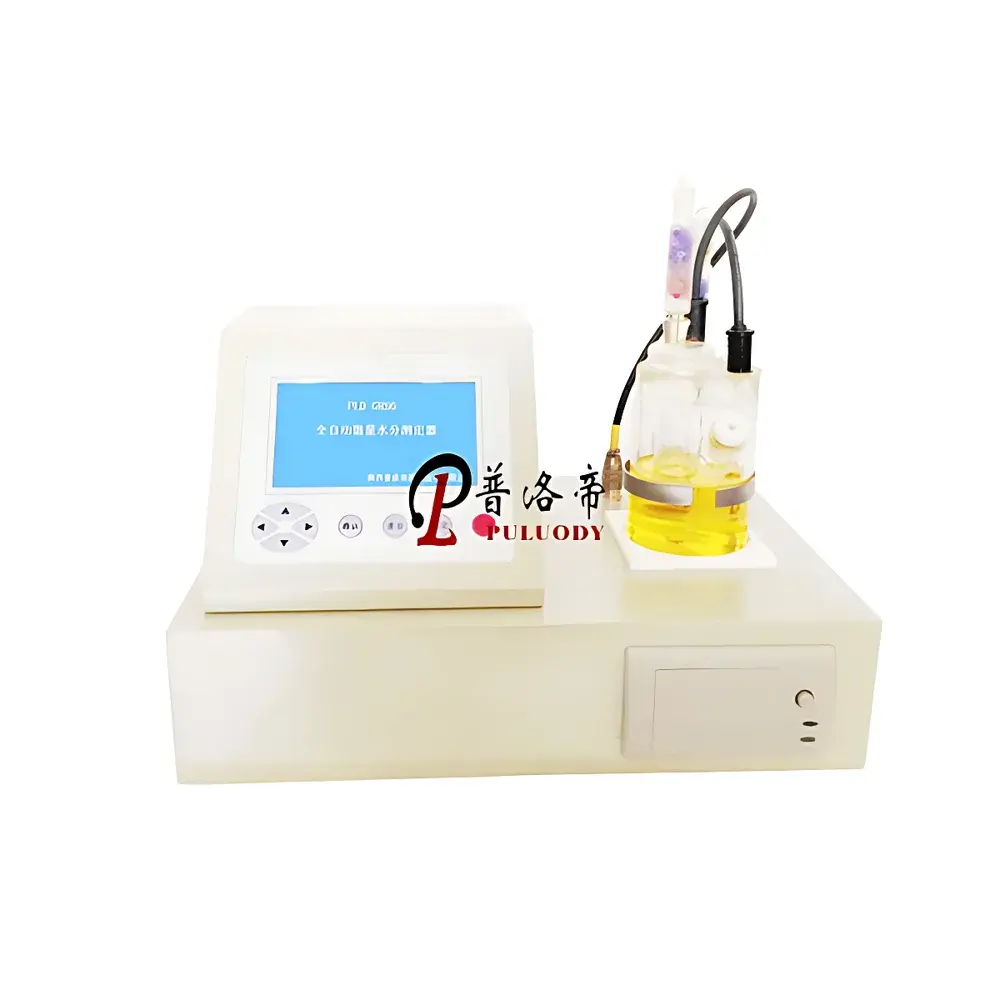
Purifier PLD-GRS6 Fully Automated Micro Coulometric Karl Fischer Moisture Analyzer
| Origin | Shaanxi, China |
|---|---|
| Manufacturer Type | Authorized Distributor |
| Origin Category | Domestic (China) |
| Model | PLD-GRS6 |
| Price | USD 6,700 (FOB) |
| Measurement Principle | Coulometric Karl Fischer Titration |
| Detection Electrodes | Dual Platinum Electrodes |
| Control System | Embedded MCU with Purifier T8.0 Firmware |
| Measurement Range | 1 µg – 500 mg H₂O |
| Sensitivity | 0.1 µg |
| Accuracy | ±5% or ±1 µg (whichever is greater) |
| Sample Types | Liquids, Gases, and Solids (with optional oven adapter) |
| Analysis Time | 2–4 min per test |
| Endpoint Detection | Real-time dual-electrode current monitoring with auto-termination logic |
| Display | 20×2 LCD with date/time, electrolysis rate (µg/s), and cumulative water mass |
| Output | Integrated thermal printer (16-character line, auto-print of parameters & results) |
| Titration Cell Volume | 150 mL |
| Stirring | Built-in magnetic stirrer |
| Power Supply | 220 V ±10%, 50 Hz ±0.5 Hz |
| Power Consumption | 40 W |
| Operating Environment | 10–40 °C, ≤70% RH |
| Compliance Standards | GB/T 7600, GB/T 11133, GB/T 6283, SH/T 0207, SH/T 0246, SH/T 0255 |
Overview
The Purifier PLD-GRS6 Fully Automated Micro Coulometric Karl Fischer Moisture Analyzer is engineered for high-precision, trace-level water quantification in demanding laboratory and industrial quality control environments. It operates on the fundamental electrochemical principle of coulometric Karl Fischer titration—where iodine is generated *in situ* via controlled electrolysis of iodide ions in a reagent-saturated anolyte solution. Water content is stoichiometrically determined by Faraday’s law: one mole of iodine reacts with one mole of water (H₂O + I₂ + SO₂ + 3RN + CH₃OH → 2RN·HI + RN·HSO₄CH₃). Unlike volumetric KF systems, the coulometric mode enables sub-microgram detection without manual reagent dispensing, eliminating volumetric error sources and ensuring exceptional reproducibility for samples containing ≤100 µg H₂O. The PLD-GRS6 is purpose-built for applications requiring strict adherence to Chinese national standards (GB/T and SH/T series) and aligns structurally with international KF instrumentation design conventions—including sealed titration cell architecture, inert gas purging capability (for gas-phase analysis), and thermally stable electrode positioning.
Key Features
- True micro-coulometric detection with 0.1 µg sensitivity—validated per GB/T 7600 and SH/T 0207 protocols for transformer oil and insulating fluids.
- Dual platinum indicator electrodes provide real-time current monitoring for unambiguous endpoint discrimination, minimizing over-titration and drift-related bias.
- Embedded MCU-based control system (Purifier T8.0 firmware) executes automatic baseline correction, blank compensation, and adaptive electrolysis current regulation—ensuring consistent charge delivery across varying sample matrices.
- Integrated magnetic stirring ensures homogeneous reagent-sample interaction within the 150 mL titration cell, critical for viscous or low-conductivity samples (e.g., lubricants, polymer solutions).
- Thermal printer outputs time-stamped reports including date/time stamp, electrolysis rate (µg/s), total water mass (µg), and operator-defined parameters—supporting audit-ready documentation under GLP-aligned workflows.
- Compact benchtop footprint (W × D × H: 320 × 280 × 180 mm) and low power draw (40 W) enable deployment in space-constrained QC labs or mobile testing units.
Sample Compatibility & Compliance
The PLD-GRS6 accommodates liquid samples (petroleum distillates, solvents, pharmaceutical excipients), gaseous streams (via optional gas sampling module with flow-controlled injection), and solid materials (using heated oven coupling—available as accessory). Its measurement range (1 µg–500 mg H₂O) covers critical use cases from ultra-dry solvents (e.g., lithium battery electrolytes) to high-moisture fuels. Instrument validation follows GB/T 11133 for liquid petroleum products and SH/T 0246 for light hydrocarbons—both referencing ASTM D6304 where applicable. While not FDA 21 CFR Part 11–certified out-of-the-box, its deterministic endpoint logic, immutable print logs, and time/date stamping support retrospective data integrity assessment during internal GMP/GLP audits.
Software & Data Management
The embedded T8.0 firmware provides deterministic, non-graphical data handling: all measurements are stored locally in non-volatile memory with timestamp, sample ID (user-entered), and raw electrolysis charge (coulombs). No external PC dependency is required for routine operation. Data export is limited to printed hardcopy; however, the standardized 16-character thermal output format permits OCR-based digitization into LIMS or Excel for trend analysis. Firmware updates are performed via secure USB interface under authorized service protocols—ensuring configuration stability across production shifts.
Applications
- Petrochemical QC: Moisture verification in transformer oils (GB/T 7600), jet fuels (SH/T 0246), and lubricant additives (SH/T 0255).
- Pharmaceutical manufacturing: Residual solvent moisture in APIs and excipients per ICH Q5C guidelines.
- Electronics materials: Quantifying trace H₂O in lithium-ion battery electrolytes and photoresist solvents.
- Environmental testing: Water content in contaminated soil extracts and wastewater treatment chemicals.
- Food & beverage R&D: Moisture profiling in hygroscopic ingredients (e.g., milk powders, starches) where over-drying degrades functionality.
FAQ
What sample types can be analyzed without accessories?
Liquid and gaseous samples—provided they are chemically compatible with Karl Fischer reagents (i.e., no aldehydes, ketones, or strong reducing agents without pre-treatment).
Is the instrument compliant with ISO/IEC 17025 requirements?
While not accredited, its documented repeatability (RSD < 2% at 10 µg level per GB/T 11133), traceable calibration using certified water standards (e.g., 1.00 ± 0.02 mg/mL Hydranal® standard), and printed audit trail support method validation per ISO/IEC 17025 Clause 7.7.
Can the PLD-GRS6 be integrated into a networked lab environment?
No native Ethernet or Wi-Fi interface exists; integration requires post-analysis OCR scanning of printed reports or third-party serial-to-IP bridge hardware.
What maintenance intervals are recommended for the titration cell?
Electrode cleaning with anhydrous methanol every 50–100 analyses; full cell reconditioning (reagent replacement, septum change, electrode polishing) every 3 months under continuous use.
Does the system support user-defined calculation formulas?
No—the firmware applies fixed stoichiometric conversion (10.72 µg H₂O per 1 mC) per Faraday’s constant and KF reaction chemistry; custom factors are not programmable.





