
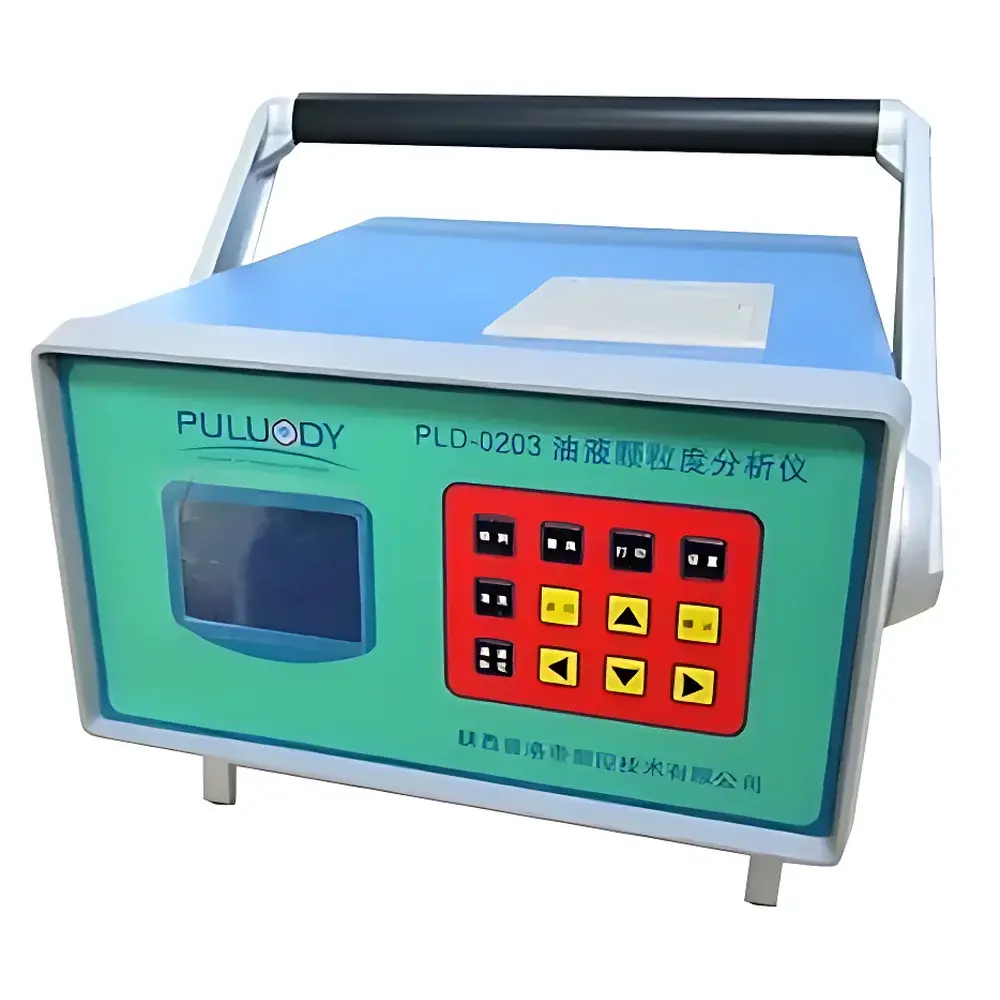
PULUODY PLD-0203 Portable Oil Contamination Analyzer (8-Channel Optical Particle Counter)
| Brand | PULUODY |
|---|---|
| Origin | Shaanxi, China |
| Model | PLD-0203 (8-Channel) |
| Instrument Type | Optical Particle Counter |
| Laser Sensor Generation | 7th-generation dual-laser narrow-beam sensor |
| Measurement Principle | Light Obscuration (LO) |
| Calibration Standards | ISO 11171, ISO 4402, ASTM F658-87 (PSL), GB/T 18854, JJG 1061 |
| Compliant with | ISO 4406:1987/1999, NAS 1638, SAE AS4059F, GJB 420B, DL/T 432, GJB 380, ISO 11500 |
| Particle Size Range | 0.03 µm to 3000 µm (configurable sensor modules) |
| Channel Count | Up to 1000 user-definable size channels (16 active per test) |
| Sensitivity | 1 µm (per ISO 4402) or 4 µm(c) (per ISO 11171 / GB/T 18854) |
| Coincidence Limit | ≤5% error at 10,000 particles/mL |
| Resolution | ≥90% at 60 mL/min |
| Volume Accuracy | ±1% |
| Sample Flow Rate | 5–60 mL/min (test), 5–150 mL/min (cleaning) |
| Viscosity Range | Offline: 0–99 mm²/s |
| Online | 0–500 mm²/s |
| Operating Pressure (Online) | 0–0.6 MPa (standard), 0–31.5 MPa (with pressure regulator) |
| Sample Volume | 1–200 mL (programmable) |
| Temperature Range | Sample: 20–65 °C |
| Ambient | 0–50 °C |
| Power Supply | 220 VAC, 50 Hz, <80 W |
| Data Output | RS232, RS485, USB, 4–20 mA, 0–5 V, MODBUS |
| Storage Capacity | Up to 6000 test records (200 tests × 30 results each) |
| Auto-Cleaning Function | Yes |
| Software | P6.4 Analysis & Testing Suite (Integrated & PC Edition) |
| Compliance Support | FDA 21 CFR Part 11 audit trail (optional configuration), GLP/GMP-ready reporting |
Overview
The PULUODY PLD-0203 Portable Oil Contamination Analyzer is a field-deployable, high-fidelity optical particle counter engineered for quantitative assessment of solid particulate contamination in liquid media—primarily hydraulic fluids, lubricants, aviation fuels, and ultra-pure process liquids. It operates on the light obscuration (LO) principle: as particles suspended in a flowing liquid stream pass through a focused laser beam, they attenuate incident light proportionally to their cross-sectional area. This analog signal is digitized and classified into discrete size bins using real-time pulse-height analysis. Unlike static microscopy or filtration-based methods, LO provides statistically robust, volumetric particle concentration data (particles per milliliter) across sub-micron to millimeter-scale ranges—critical for predictive maintenance, fluid life extension, and mission-critical system integrity assurance.
Key Features
- Modular multi-sensor architecture: Supports up to 14 interchangeable optical detection modules (e.g., 0.03–0.10 µm, 0.1–1.0 µm, 2–750 µm), enabling application-specific configuration without hardware replacement.
- 7th-generation dual-laser narrow-beam sensing: Delivers enhanced signal-to-noise ratio and reduced refractive index dependency, improving accuracy for low-refractive-index particles (e.g., polymer wear debris, water droplets in oil).
- True 1000-channel resolution: Allows arbitrary definition of 16 user-selectable size thresholds per measurement—supporting custom grading schemes beyond standardized norms (e.g., turbine OEM-specific limits).
- Integrated industrial control: Embedded ruggedized IPC or optional external industrial PC ensures deterministic real-time acquisition, eliminating latency-induced counting errors during high-flow sampling.
- Full auto-sequence operation: Includes programmable sample draw, measurement, backflush cleaning, and sensor recalibration—all executed without operator intervention.
- Pressure-rated online capability: With integrated pressure regulation, the unit performs continuous monitoring at line pressures up to 31.5 MPa—validated for aerospace hydraulic systems and high-pressure fuel circuits.
Sample Compatibility & Compliance
The PLD-0203 accommodates a broad chemical matrix: mineral- and synthetic-based oils (including phosphate ester hydraulic fluids), jet fuels (JP-5, JP-8), transformer insulating oils, ultra-pure water (UPW), aggressive solvents (e.g., acetone, IPA), and high-acidity or high-alkalinity process streams. Its wetted path employs chemically inert materials (316L SS, fused silica flow cells, Kalrez® seals) to ensure compatibility with corrosive media. Regulatory alignment includes full traceability to ISO 11171 (calibration), ISO 4402 (historical reference), and national metrological standards (JJG 1061, GB/T 18854). For regulated environments, optional software configurations support FDA 21 CFR Part 11-compliant electronic signatures, audit trails, and role-based access control—meeting GLP and GMP documentation requirements in pharmaceutical and defense applications.
Software & Data Management
The P6.4 Analysis & Testing Suite provides both embedded touchscreen interface and desktop PC integration. It enables real-time visualization of differential and cumulative particle distributions, dynamic histogram overlays, trend analysis across sequential samples, and automated generation of compliance reports per ISO 4406, NAS 1638, or GJB 420B. Raw data export supports CSV, XML, and PDF formats; metadata tagging includes timestamp, operator ID, instrument serial number, calibration certificate ID, and environmental parameters (temperature, pressure). The system logs all critical events—including sensor diagnostics, flow rate deviations, and cleaning cycle completion—for full traceability during internal audits or third-party certification reviews.
Applications
This analyzer serves mission-critical roles across sectors where fluid cleanliness directly impacts reliability and safety: in-flight fuel verification for military aircraft; wear debris trending in naval gas turbine lube systems; particulate clearance validation for semiconductor tool coolant loops; contamination screening of IV solutions and parenteral drug manufacturing fluids; and condition-based maintenance of wind turbine gearboxes and hydroelectric governor oil systems. Its portability enables on-site testing at remote depots, offshore platforms, or production lines—eliminating delays associated with offsite lab submission while maintaining metrological equivalence to accredited reference laboratories.
FAQ
Does the PLD-0203 require sample filtration or dilution prior to analysis?
No. The instrument is designed for direct analysis of undiluted, unfiltered samples—provided viscosity remains within specified limits (≤99 mm²/s offline; ≤500 mm²/s online). Built-in flow conditioning eliminates sedimentation bias and ensures representative sampling.
How is calibration traceability maintained?
Calibration uses NIST-traceable PSL (polystyrene latex) spheres per ASTM F658-87 and is verified against ISO 11171 reference materials. Certificates include uncertainty budgets and are issued by the National Northwest Metrology & Testing Center (civilian) or the Defense Science & Technology Commission’s Level-1 Particle Metrology Station (military).
Can the device operate continuously in hazardous environments?
The base unit meets IP54 ingress protection and operates safely in non-explosive atmospheres. For Zone 1/2 hazardous areas, optional ATEX-certified enclosures and intrinsically safe flow modules are available upon request.
What maintenance intervals are recommended?
Optical windows require quarterly inspection and cleaning with lint-free optics-grade tissue and isopropanol. Annual recalibration and sensor performance validation are advised; full service is performed by PULUODY Authorized Service Centers under ISO/IEC 17025-accredited procedures.
Is remote firmware update supported?
Yes—via secure HTTPS-based OTA (over-the-air) protocol using encrypted firmware packages signed with PULUODY’s private key. Update logs are retained in the system audit trail with timestamp and operator authentication.



