
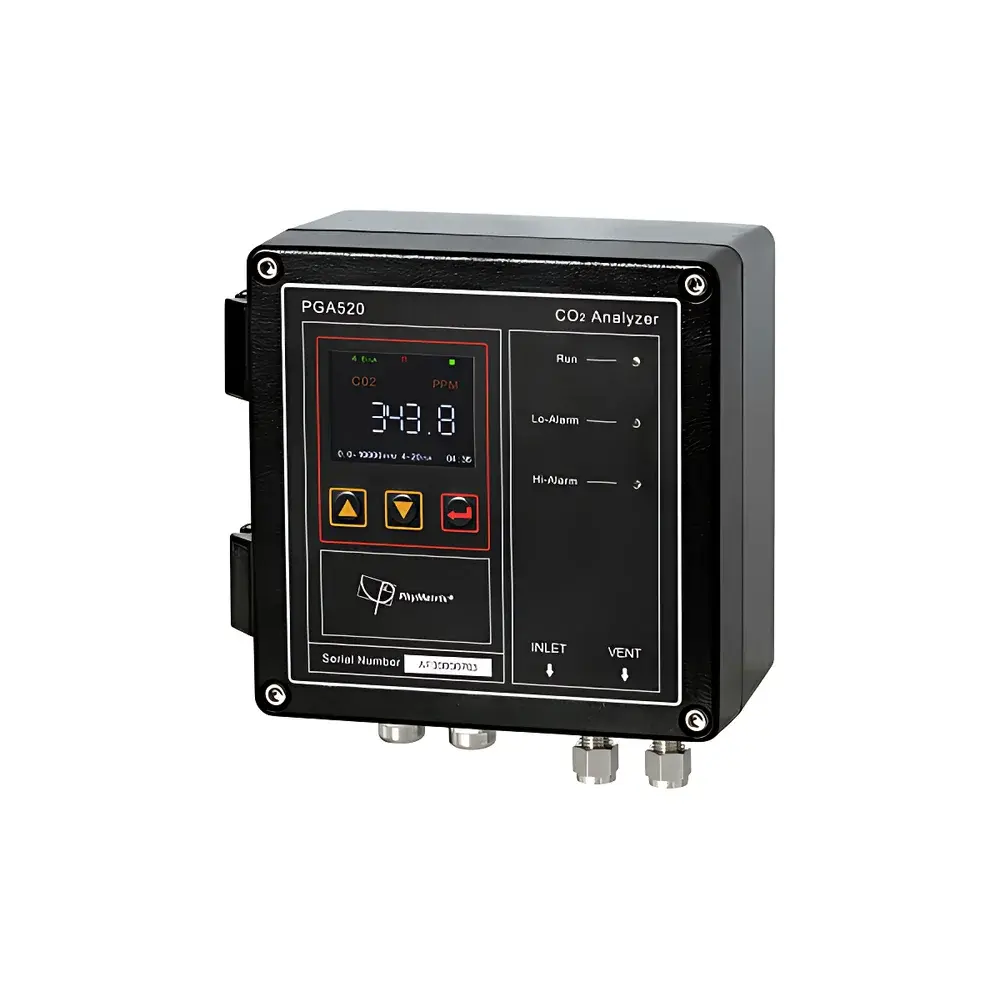
PhyMetrix PGA520 Online Carbon Dioxide (CO₂) Analyzer
| Brand | PhyMetrix |
|---|---|
| Origin | USA |
| Model | PGA520 |
| Instrument Type | Online Analyzer |
| Detection Target | Single-component (CO₂) |
| Repeatability | ≤ ±1% F.S. |
| Resolution | 0.1 ppm or 0.01% |
| Response Time | T90 ≈ 0.15 s (@ 1 SCFH) |
| Linearity Error | ≤ ±2% F.S. (excluding calibration gas uncertainty) |
| Measurement Ranges | 0–5000 ppm, 0–5%, 0–20%, 0–100% CO₂ (field-selectable) |
| Minimum Resolution | 0.01 ppm or 0.01% |
| Warm-up Time | <2 min (to operational readiness) |
| Operating Temperature | 0–40 °C with full-range temperature compensation |
| Power Supply | 110–220 VAC or 12–36 VDC |
| Dimensions | 200 mm (H) × 80 mm (W) × 102 mm (D) |
| Weight | 1.5 kg |
| Inlet/Outlet Fitting | 1/4" compression fitting (male thread) |
| Enclosure Rating | IP67 |
Overview
The PhyMetrix PGA520 Online Carbon Dioxide (CO₂) Analyzer is a compact, field-deployable infrared gas analyzer engineered for continuous, real-time monitoring of carbon dioxide concentration in industrial process streams, environmental ducts, and controlled atmosphere systems. It employs non-dispersive infrared (NDIR) spectroscopy—a physically robust, interference-resistant measurement principle—where CO₂ molecules absorb specific mid-infrared wavelengths (typically centered near 4.26 µm). The instrument integrates an optical detection cell, precision analog signal conditioning, digital signal processing, and embedded firmware within a single sealed enclosure. Unlike extractive sampling systems requiring external pumps or conditioning, the PGA520 features an integrated, low-volume sample chamber optimized for fast gas exchange and minimal dead volume. Its design prioritizes metrological stability under dynamic flow conditions (1 SCFH nominal), making it suitable for applications demanding sub-second response fidelity without compromising long-term baseline integrity.
Key Features
- Monolithic NDIR sensor architecture with factory-calibrated optical path and thermally stabilized detector
- Integrated sample cell with optimized internal geometry—T90 response time ≤ 0.15 seconds at 1 standard cubic foot per hour (SCFH)
- True dual-range electronics supporting four user-selectable measurement spans: 0–5000 ppm, 0–5%, 0–20%, and 0–100% CO₂
- High-resolution display interface: 3.5-inch true-color LCD showing real-time ppm/%, running average, delta deviation, and 4–20 mA output status
- Comprehensive temperature compensation across full operating range (0–40 °C), ensuring ≤ ±2% F.S. linearity and ≤ ±1% F.S. repeatability independent of ambient thermal drift
- Flexible power architecture: compatible with both AC (110–220 V) and DC (12–36 V) inputs—enabling deployment in control cabinets, mobile platforms, or hazardous-area zones with appropriate barrier integration
- IP67-rated aluminum housing with stainless-steel wetted parts and 1/4″ Swagelok-compatible compression fittings for leak-tight process connection
Sample Compatibility & Compliance
The PGA520 is designed for direct in-line or sidestream installation into clean, dry, non-corrosive gas matrices. It accommodates typical industrial process gases including air, nitrogen, argon, and synthetic blends—but requires particulate filtration (<1 µm) and dew point control (<5 °C) upstream if moisture or aerosols are present. The analyzer complies with IEC 61000-6-2 (EMC immunity) and IEC 61000-6-4 (EMC emission) standards. While not intrinsically safe certified out-of-box, its low-power operation and sealed enclosure support integration into Class I, Division 2 (CID2) or ATEX Zone 2 environments when installed behind approved safety barriers. Data integrity protocols align with GLP/GMP documentation requirements, and the device supports audit-ready configuration logging via optional service port access.
Software & Data Management
The PGA520 operates autonomously without external software dependencies. All configuration—including range selection, zero/span calibration triggers, analog output scaling, and alarm thresholds—is performed locally via intuitive on-screen menus. Analog output (4–20 mA, isolated, HART-enabled option available) transmits linearized CO₂ concentration data to DCS, PLC, or SCADA systems. Optional RS-485 Modbus RTU interface enables remote readout of primary measurement, diagnostic flags (e.g., low signal, temperature fault), and calibration history timestamps. Firmware updates are performed via micro-USB service port using PhyMetrix-provided configuration utility—version-controlled and traceable per ISO/IEC 17025 documentation guidelines.
Applications
- Continuous emissions monitoring (CEM) of CO₂ from combustion sources prior to stack release
- Fermentation process control in biopharma and beverage manufacturing
- Controlled atmosphere storage (CAS) and modified atmosphere packaging (MAP) verification
- Indoor air quality (IAQ) monitoring in smart buildings and HVAC optimization loops
- Carbon capture utilization and storage (CCUS) pilot system inlet/outlet concentration profiling
- Calibration transfer verification for reference-grade analyzers in metrology labs
FAQ
What gas interferences affect CO₂ measurement accuracy on the PGA520?
Water vapor and acetylene exhibit overlapping IR absorption bands near 4.26 µm; therefore, the analyzer requires sample drying (dew point <5 °C) and absence of C₂H₂. Methane, CO, and NO₂ do not interfere under standard operating conditions.
Is field calibration possible without specialized equipment?
Yes—zero calibration can be performed using certified zero air (≤0.1 ppm CO₂); span calibration requires traceable CO₂-in-N₂ standard gas at known concentration matching the selected range. Built-in auto-zero function minimizes manual intervention.
Can the PGA520 operate continuously at -10 °C?
No—the specified operating range is 0–40 °C. Below 0 °C, condensation risk increases and optical signal-to-noise ratio degrades; external heated enclosure or sample conditioning is required for sub-zero deployment.
Does the device meet EPA Method 3A or EN 15267 requirements?
The PGA520 is not certified to Method 3A or EN 15267 as a standalone CEMS analyzer; however, it satisfies performance criteria for relative accuracy testing (RAT) and quality assurance when used as a component within a validated system.
How often is recalibration recommended under stable operating conditions?
PhyMetrix recommends quarterly zero/span verification for critical applications; semi-annual full calibration is advised for regulatory reporting contexts where traceability to NIST standards is mandated.







