
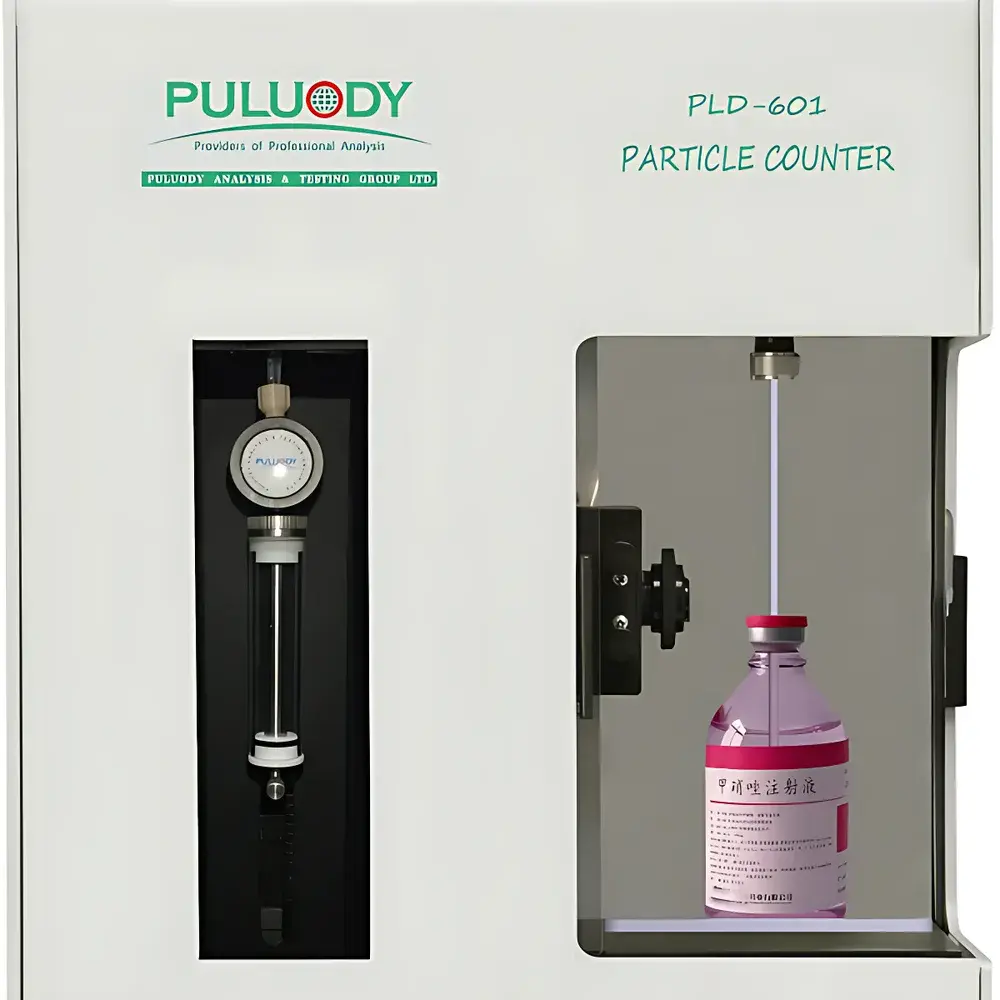
PULUODY PLD-601P Optical Particle Counter for Insoluble Particulate Matter in IV Bags and Bottles
| Brand | PULUODY |
|---|---|
| Model | PLD-601P |
| Instrument Type | Optical Particle Counter (Light Obscuration Method) |
| Detection Principle | Dual-Laser Narrow-Beam Light Obscuration |
| Sensor Generation | 8th-Generation Dual-Laser Sensor |
| Channel Resolution | 1000 Adjustable Channels |
| Particle Size Range | 1–450 µm (optional 0.03–3000 µm) |
| Sampling Flow Rate | 5–150 mL/min |
| Rinse Flow Rate | 5–500 mL/min |
| Sample Temperature Range | 0–80 °C |
| Ambient Operating Temperature | −15–50 °C |
| Accuracy | ±5% typical |
| Sampling Precision | <±1% |
| Coincidence Limit | ≤2.5% at 1000 particles/mL |
| Resolution | >95% (Chinese Pharmacopoeia 2015/2020 calibration), <10% (USP/ISO 21501 calibration) |
| Compliance Standards | ChP 2020 <0903>, USP <788>/<789>/<797>, EP 10.0, BP 2019, JP 17, ISO 21501, ISO 11171, GB/T 11446.9–2013, GB 8368, YBB 00272004–2015 |
| Software | V8.9 Regulatory-Compliant Analysis Suite with FDA 21 CFR Part 11 Support |
| Data Integrity Features | Five-Level User Permission Management, Audit Trail, Electronic Signature, Auto Backup/Restore, Power-Fail Recovery |
| Calibration Traceability | JJG 1061, ISO 21501, NIST-Traceable Latex Standards |
| Metrology Accreditation | National Northwest Metrology & Testing Center (CNAS CALIBRATION LAB) |
| Regulatory Certification | GLP/GMP-Aligned Architecture, Validatable System Design |
Overview
The PULUODY PLD-601P Optical Particle Counter is a regulatory-grade instrument engineered for the quantitative detection and size-resolved enumeration of insoluble particulate matter in parenteral pharmaceuticals and medical devices. It operates on the light obscuration (LO) principle—where particles suspended in liquid interrupt a collimated laser beam, generating voltage pulses proportional to cross-sectional area—and conforms to the core physical measurement paradigm defined in pharmacopoeial standards including ChP 2020 , USP , EP 10.0, and ISO 21501. Designed specifically for sterility-critical environments, the PLD-601P delivers traceable, reproducible particle counts across 1000 user-definable size channels from 1 µm to 450 µm (with extended-range configurations available), supporting both routine QC release testing and advanced filter validation studies such as terminal filter efficiency assessment per USP Annex and ISO 13408-1.
Key Features
- 8th-generation dual-laser narrow-beam sensor architecture enabling simultaneous signal acquisition from orthogonal optical paths—enhancing detection stability and reducing false positives from air bubbles or refractive index artifacts.
- Dual-precision fluidic control system integrating a calibrated piston metering pump and ultra-stable electromagnetic flow regulation, ensuring volumetric accuracy better than ±1% and repeatability under dynamic sampling conditions.
- V8.9 regulatory software suite compliant with FDA 21 CFR Part 11, featuring five-tier role-based access control, immutable audit trail logging, electronic signatures, and automated data backup/restore protocols.
- 1000-channel high-resolution analysis engine supporting customizable binning—from fixed 4-channel setups aligned with USP thresholds (≥10 µm, ≥25 µm) to full-spectrum distribution profiling required by ISO 21501 and ChP 2020 Annexes.
- Thermally stabilized fluid path with programmable temperature control (0–80 °C), enabling consistent measurement of viscous or temperature-sensitive formulations without thermal drift-induced bias.
- Validatable hardware architecture with metrological traceability to national standards: certified by China’s National Northwest Metrology & Testing Center (CNAS-accredited Lab No. 116) and compliant with JJG 1061 verification procedures.
Sample Compatibility & Compliance
The PLD-601P accommodates a broad spectrum of liquid-phase samples relevant to pharmaceutical manufacturing and quality assurance: sterile aqueous solutions (e.g., IV bags, ampoules, ophthalmic preparations), lyophilized powder reconstitutes, vaccine suspensions, injectable excipients, purified water (PW), water for injection (WFI), and ultrapure water (UPW). It supports direct analysis of medical packaging components—including plastic infusion containers, rubber stoppers, and tubing—as specified in YBB 00272004–2015 and GB 8368. The system meets all essential requirements for GMP-regulated environments, including ALCOA+ data integrity principles, and is routinely deployed in laboratories undergoing FDA, EMA, and NMPA inspections. Its firmware and software are preconfigured for automatic compliance reporting against ChP, USP, EP, BP, JP, and WHO International Pharmacopoeia criteria.
Software & Data Management
The embedded V8.9 software platform provides a fully integrated environment for method development, instrument control, real-time visualization, statistical reporting, and long-term archival. All analytical sessions generate timestamped, digitally signed records with complete metadata—including operator ID, environmental parameters, calibration history, and raw pulse data. Audit trails record every user action—including parameter edits, result overrides, and report exports—with hash-verified immutability. Data export options include CSV, PDF, XML, and LIMS-compatible ASTM E1382-compliant formats. The system supports 21 CFR Part 11-compliant electronic signatures via PKI-based certificate integration and includes built-in tools for IQ/OQ/PQ documentation generation and periodic revalidation planning.
Applications
- Pharmaceutical QC: Routine batch release testing of injectables per ChP , USP , and EP 2.9.19; evaluation of particulate load in active pharmaceutical ingredients (APIs) and excipients.
- Filter Validation: Quantitative assessment of retention efficiency for 0.22 µm and 0.45 µm sterilizing-grade filters used in aseptic processing lines.
- Water Systems Monitoring: Continuous or periodic monitoring of PW, WFI, and UPW distribution loops per USP and ISO 14644-1 Class 5/7 requirements.
- Medical Device Testing: Evaluation of extractables and leachables from IV sets, syringes, and infusion pumps per ISO 10993-12 and ISO 14971 risk management frameworks.
- Semiconductor & Electronics: Slurry cleanliness verification in CMP processes and particle contamination screening in ultrapure rinse fluids.
- Industrial Hygiene: Cleanroom fluid handling validation, lubricant purity certification, and formulation stability studies in cosmetics and food-grade emulsions.
FAQ
Does the PLD-601P comply with FDA 21 CFR Part 11 requirements for electronic records and signatures?
Yes—the V8.9 software implements full technical and procedural controls, including role-based permissions, time-stamped audit logs, electronic signature workflows, and cryptographic data integrity verification.
Can the instrument be validated for use in GMP environments?
Yes—it follows ICH Q5A(R2) and ASTM E2500 guidance for instrument qualification, and its design supports documented IQ/OQ/PQ execution with vendor-supplied protocols and third-party metrology reports.
What calibration standards are supported?
NIST-traceable polystyrene latex (PSL) spheres per ISO 21501-4, certified reference materials per JJG 1061, and pharmacopoeial reference suspensions per USP Appendix.
Is the system compatible with LIMS integration?
Yes—it supports ASTM E1382-compliant data exchange and offers configurable API endpoints for seamless bidirectional communication with major laboratory information management systems.
How is temperature control managed during sample analysis?
The fluid path incorporates a Peltier-based thermal module with closed-loop feedback, maintaining setpoint accuracy within ±0.5 °C across the 0–80 °C operational range.
What regulatory documentation is provided with the instrument?
Each unit ships with a Factory Acceptance Test (FAT) report, Certificate of Conformance, Metrological Traceability Statement, 21 CFR Part 11 Readiness Assessment, and a complete set of IQ/OQ templates aligned with ISO/IEC 17025 and Annex 11 expectations.



