
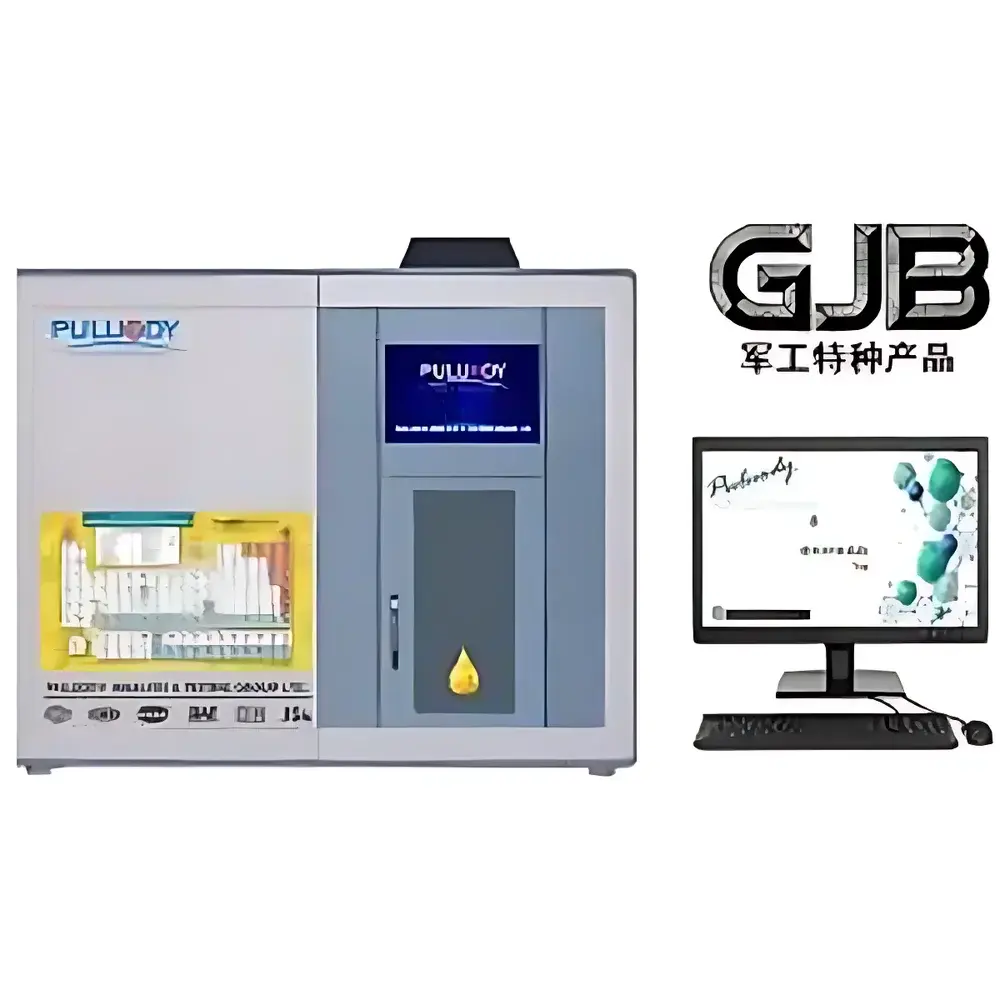
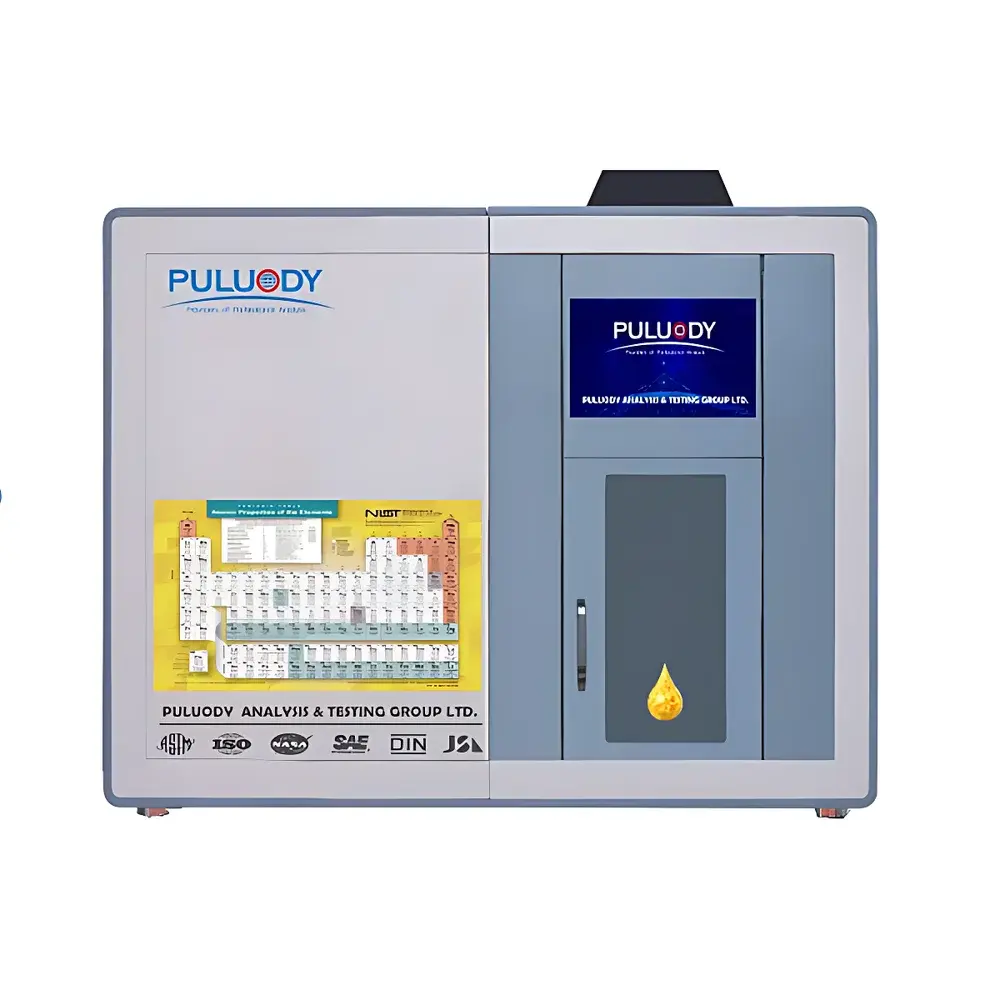
PULUODY P-ICP-P Multi-Channel Atomic Fluorescence Spectrometer for Oil Analysis
| Brand | PULUODY |
|---|---|
| Origin | Shaanxi, China |
| Manufacturer Type | Authorized Distributor |
| Instrument Type | Multi-Channel Atomic Fluorescence Spectrometer |
| Sample Introduction | Direct Nebulization |
| Waste Disposal | Rear Exhaust Design |
| Gas Flow Control | Rotameter-Based Pneumatic System |
| Detectable Elements | Al, Ba, B, Cd, Ca, Cr, Cu, Fe, Pb, Mg, Mn, Mo, Ni, P, Si, Ag, Na, Sn, Ti, V, Zn, K, Li, Sb, Sr, Bi, As, In, Zr, W, Co, Ce |
| Relative Standard Deviation (RSD) | <1% |
| Linear Dynamic Range | 5 orders of magnitude (0.01–10,000 µg/L) |
| Detection Limits | Sub-ppb (≤0.01 µg/L) for most elements |
| Photomultiplier Tube Wavelength Range | 200–1000 nm |
| Atomizer Temperature Control Range | Ambient to 45 °C |
| Optical Resolution | ≤0.015 nm |
| RF Generator Frequency | 27.12 MHz (stability ≤0.05%) |
| RF Power Output | 800–1600 W (stability ≤0.2%) |
| Grating Density | 2400 lines/mm |
| Grating Area | 80 × 110 mm |
| Sample Volume Requirement | >1 mL |
| Operating Temperature | 15–45 °C |
| Operating Humidity | 0–90% RH (non-condensing) |
Overview
The PULUODY P-ICP-P Multi-Channel Atomic Fluorescence Spectrometer is a dedicated elemental analysis system engineered for routine, high-precision quantification of trace and minor metals in petroleum-based and synthetic lubricants, hydraulic fluids, insulating oils, turbine oils, and related hydrocarbon matrices. Unlike conventional atomic absorption or single-channel fluorescence instruments, the P-ICP-P employs a robust rotating disc electrode (RDE) coupled with high-resolution optical emission spectroscopy—operating on the principle of atomic fluorescence excitation induced by radiofrequency plasma (27.12 MHz ICP source). This architecture delivers simultaneous multi-element detection with sub-part-per-trillion sensitivity for wear metals (e.g., Fe, Cu, Cr, Al), contaminants (e.g., Si, Na, B), and additive elements (e.g., Ca, Mg, Zn, P), enabling condition-based oil analysis per ASTM D6595, ASTM D6728, NB/SH/T 0865, SN/T 1652, and DL/T 1550. Its design emphasizes analytical reproducibility, long-term signal stability, and minimal matrix interference—critical for predictive maintenance programs across aerospace, power generation, marine propulsion, and heavy-duty machinery sectors.
Key Features
- Multi-channel parallel detection architecture supporting simultaneous quantification of ≥31 elements—including 24 primary wear/contaminant elements and 8 additive-specific analytes—with full spectral line validation against NIST-traceable reference libraries.
- Integrated RDE sample introduction system with direct nebulization and rear-exhaust waste management, minimizing cross-contamination and ensuring consistent aerosol generation for viscous oil matrices (up to 500 cP).
- Seventh-generation PULUODY spectral detector featuring 2400-line/mm holographic grating (80 × 110 mm active area), ≤0.015 nm optical resolution, and photomultiplier tube response spanning 200–1000 nm—optimized for low-background fluorescence measurement in complex hydrocarbon backgrounds.
- Precise atomizer temperature control (ambient to 45 °C) to stabilize vapor-phase atomization efficiency and mitigate volatility-related bias during transient thermal cycles.
- RF plasma source with digitally stabilized 27.12 MHz generator (≤0.05% frequency drift) and adjustable 800–1600 W output (≤0.2% power fluctuation), ensuring consistent excitation energy across extended run times.
- Compliance-ready hardware architecture supporting audit trails, electronic signatures, and data integrity protocols aligned with FDA 21 CFR Part 11 and GLP/GMP documentation requirements when configured with validated software modules.
Sample Compatibility & Compliance
The P-ICP-P is validated for direct analysis of undiluted or minimally diluted oil samples—including mineral and synthetic lubricants, transformer oil (IEC 60296), turbine oil (ASTM D4378), hydraulic fluid (ISO 4406), aviation fuels (Jet A-1, JP-8), antifreeze solutions, and polymer-based functional fluids. It meets or exceeds performance criteria defined in ASTM D6595 (wear metal analysis in used oils), ASTM D6728 (fuel contaminant screening), NB/SH/T 0865 (Chinese national standard for RDE-AES in lubricants), and DL/T 1550 (copper/iron quantification in insulating oils). All calibration, verification, and performance qualification procedures adhere to JJF (Defense) 1752018—China’s metrological verification regulation for emission spectrometers used in military-grade oil analysis. Instrument certification includes traceability to NIST SRM 1634c (used oil metals), CRM-216 (lubricant additives), and ISO 17025-accredited reference materials.
Software & Data Management
PICP-V2.1 software—available in English, Chinese, Japanese, and Korean localized editions—provides full method development, spectral deconvolution, multi-point calibration, and automated report generation compliant with ISO/IEC 17025 reporting requirements. The platform supports raw spectrum archiving, post-run reprocessing (peak fitting, background correction, inter-element interference modeling), statistical trend analysis (Shewhart X-bar/R charts, linear regression over time series), and configurable alarm thresholds based on historical deviation limits. All analytical results—including intensity values, wavelength assignments, concentration outputs, RSD%, detection limit flags, and operator metadata—are stored in an encrypted relational database with immutable audit logs. Export formats include PDF (signed reports), Excel (.xlsx), CSV, and XML for LIMS integration. Software validation documentation (IQ/OQ/PQ protocols) and 21 CFR Part 11 compliance packages are available upon request.
Applications
The P-ICP-P serves as a core analytical tool in oil condition monitoring (OCM) laboratories, OEM service centers, and third-party testing facilities. Primary use cases include: real-time assessment of mechanical wear via Fe, Cu, Cr, Al, and Pb concentrations; detection of external contamination (Si, Na, B, Ca) indicating dust ingress or coolant leakage; quantification of additive depletion (Zn, P, Ca, Mg, Ba) to determine remaining service life; elemental fingerprinting of fuel batches for quality assurance; and forensic failure analysis following catastrophic equipment events. Its linear dynamic range (five decades) enables concurrent measurement of both ppm-level additives and sub-ppb-level wear particles without dilution or re-injection—reducing turnaround time to <60 seconds per sample for up to four elements, and <180 seconds for full 31-element panels.
FAQ
What regulatory standards does the P-ICP-P support for oil analysis?
It fully complies with ASTM D6595, ASTM D6728, NB/SH/T 0865, SN/T 1652, DL/T 1550, and JJF (Defense) 1752018—covering wear metal, contaminant, and additive analysis in lubricants, fuels, and insulating oils.
Can the instrument analyze non-oil matrices such as water or acid digests?
Yes—when operated with appropriate calibration standards and matrix-matched blanks, it supports aqueous solutions, organic solvents, and acid-digested samples per EPA Method 200.7 and ISO 11885.
Is the system compatible with laboratory information management systems (LIMS)?
Yes—via standardized ODBC/JDBC drivers and XML-based data export, enabling bidirectional communication with major LIMS platforms including LabWare, Thermo Fisher SampleManager, and STARLIMS.
What maintenance intervals are recommended for optimal performance?
Daily: Plasma torch inspection and nebulizer cleaning; Weekly: Argon gas line moisture trap replacement and optical alignment verification; Quarterly: Grating recalibration and PMT gain optimization using certified emission standards.
Does the system support remote diagnostics and software updates?
Yes—secure TLS-encrypted remote access is available for technical support engineers, with version-controlled firmware and PICP-V2.1 patch deployment via authenticated cloud repository.




