
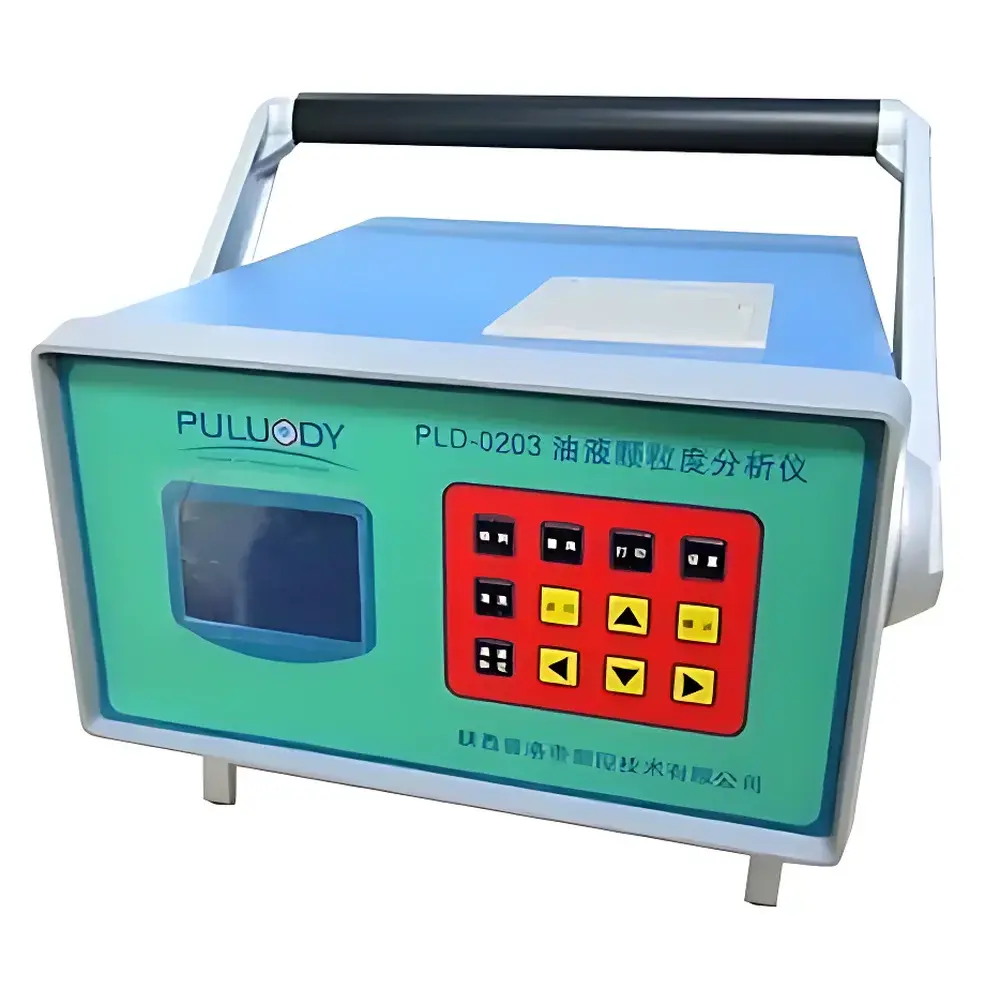
PULUODY PLD-0203 Portable Optical Particle Counter
| Brand | PULUODY |
|---|---|
| Origin | Shaanxi, China |
| Model | PLD-0203 |
| Instrument Type | Optical Particle Counter |
| Detection Principle | Light Obscuration (LO) |
| Laser Sensor Generation | 7th-generation dual-laser narrow-beam detector |
| Calibration Standards | ISO 11171, ISO 4402, ASTM F658-87 (PSL), GB/T 18854, JJG 1061 |
| Compliance | ISO 4406:1999/2017, NAS 1638, SAE AS4059F, GJB 420B, DL/T 432, GJB 380, ISO 11500 |
| Measurement Range | 0.03 µm – 3000 µm (configurable sensor modules) |
| Channel Count | Up to 1000 resolution channels |
| Sensitivity | 1 µm (per ISO 4402) or 4 µm(c) (per ISO 11171 / GB/T 18854) |
| Coincidence Limit | ≤5% error at 10,000 particles/mL |
| Resolution | ≥90% at 60 mL/min |
| Sample Volume Accuracy | ±1% |
| Viscosity Range | Offline: 0–99 mm²/s |
| Online | 0–500 mm²/s |
| Flow Rate | Sampling: 5–60 mL/min |
| Cleaning | 5–150 mL/min |
| Operating Pressure | 0–0.6 MPa (standard) |
| Temperature Range | Sample: 20–65°C |
| Ambient | 0–50°C |
| Power Supply | 220 VAC, 50 Hz, <80 W |
| Data Output | RS232, RS485, USB, 4–20 mA analog, MODBUS RTU |
| Alarm Output | Configurable particle count or size-based threshold alert |
| Internal Storage | Up to 6000 test records (200 tests × 30 results each) |
| Software | P6.4 Particle Analysis Suite (PC & embedded integrated version) |
| Display | Color LCD touchscreen interface |
| Self-cleaning Function | Integrated post-test rinse cycle |
| Regulatory Traceability | Certified by National Northwest Metrology & Testing Center (civilian) and PLA Commission of Science, Technology and Industry for National Defense — First-Level Particle Metrology Station (military) |
Overview
The PULUODY PLD-0203 Portable Optical Particle Counter is an industrial-grade, field-deployable instrument engineered for real-time, in-situ quantification of insoluble particulate contamination in liquid media—primarily lubricants, aviation fuels, hydraulic fluids (including corrosive phosphate ester types), ultrapure water, and pharmaceutical-grade solvents. It operates on the well-established light obscuration (LO) principle: as particles suspended in a laminar fluid stream pass through a focused laser beam, they attenuate the incident light proportionally to their cross-sectional area. This optical signal is converted into pulse amplitude data, enabling high-fidelity sizing and counting across configurable detection thresholds. Designed for mission-critical environments—including military maintenance depots, aerospace ground support facilities, power generation plants, and semiconductor fab utilities—the PLD-0203 delivers metrologically traceable particle concentration data compliant with international fluid cleanliness standards. Its portability, ruggedized housing, and battery-ready architecture allow direct integration into mobile maintenance units or remote field laboratories without reliance on fixed infrastructure.
Key Features
- Modular sensor architecture supporting up to 14 interchangeable optical detection modules—from ultrafine sub-micron (0.03 µm) to coarse particulates (up to 3000 µm)—enabling application-specific configuration.
- 7th-generation dual-laser narrow-beam detection system optimized for high signal-to-noise ratio and minimal refractive index dependency across diverse fluid matrices.
- 1000-channel digital pulse height analysis with user-definable binning; supports simultaneous reporting of up to 16 custom particle size bands per measurement.
- Integrated industrial PC or embedded controller with full-color capacitive touchscreen interface—no external computer required for routine operation.
- Automated post-measurement self-cleaning sequence using programmable reverse-flow rinse cycles to prevent carryover between samples.
- Real-time analog outputs (4–20 mA, 0–5 V) and digital protocols (MODBUS RTU, RS485) for seamless integration into SCADA, CMMS, or predictive maintenance platforms.
- Onboard storage for up to 6000 test records with timestamped metadata, including operator ID, sample ID, calibration status, and environmental conditions.
Sample Compatibility & Compliance
The PLD-0203 accommodates a broad spectrum of challenging liquid matrices without pre-filtration or dilution: aviation turbine fuel (Jet A-1, JP-8), MIL-PRF-5606/83282 hydraulic oils, phosphate ester fire-resistant fluids (e.g., Skydrol), synthetic lubricants, deionized water (≥18.2 MΩ·cm), and low-conductivity organic solvents. Its pressure-rated flow cell (up to 31.5 MPa with integrated regulator) permits direct online monitoring of high-pressure hydraulic systems. All reported particle counts are traceable to national metrological standards—certified by the National Northwest Metrology & Testing Center (CNAS-accredited, civilian applications) and the PLA Science & Technology Commission’s First-Level Particle Metrology Station (military certification). The instrument satisfies regulatory requirements for GLP-compliant data integrity: audit trails, electronic signatures (via P6.4 software), and 21 CFR Part 11–ready configuration options are available upon request.
Software & Data Management
The P6.4 Particle Analysis Suite provides unified control, visualization, and reporting across embedded and desktop platforms. It supports automated compliance grading against ISO 4406:2017 (code format), NAS 1638 Class, SAE AS4059F Contamination Categories, and GJB 420B military grades. Raw pulse data is stored in vendor-neutral CSV and XML formats; histogram overlays, cumulative distribution curves, and trend analytics (e.g., wear debris evolution over time) are exportable for root-cause analysis. The software includes built-in calibration validation tools aligned with JJG 1061 and GB/T 18854 procedures, plus automated drift correction routines based on reference PSL standard suspensions (ASTM F658-87). Audit logs record all user actions, parameter changes, and calibration events with immutable timestamps—essential for FDA, ISO 9001, or AS9100 quality system audits.
Applications
- Condition-based monitoring of aircraft engine oil, transmission fluid, and hydraulic systems during line maintenance and depot overhauls.
- Verification of cleanliness levels for critical components prior to assembly in defense electronics, missile guidance systems, and avionics housings.
- Validation of filtration efficiency in recirculating lubrication circuits for gas turbines and hydroelectric generators.
- Monitoring of particle ingress in closed-loop cooling systems for nuclear power plant instrumentation.
- Quality control of ultrapure water used in wafer cleaning baths and photolithography chemical delivery systems.
- Wear debris analysis in tribology laboratories conducting four-ball, pin-on-disk, or reciprocating rig tests.
FAQ
What particle size ranges can be measured simultaneously?
The PLD-0203 supports concurrent acquisition across up to 16 user-defined size channels. Actual measurable range depends on selected sensor module(s); common configurations span 0.1–100 µm (standard), 0.03–0.2 µm (ultrafine), or 2–750 µm (coarse wear debris).
Is the instrument suitable for online installation in pressurized hydraulic systems?
Yes—equipped with a pressure-regulated flow cell rated to 31.5 MPa, it enables continuous monitoring of high-pressure circuits without external bypass manifolds.
How is calibration traceability maintained?
Calibration follows ISO 11171 and GB/T 18854 using NIST-traceable PSL reference standards (ASTM F658-87); certificates are issued by authorized national metrology institutes.
Can the device operate unattended for extended periods?
With optional external power supply and network connectivity, the PLD-0203 supports scheduled autonomous sampling, data logging, and alarm-triggered notifications via email or SNMP traps.
Does the software support multi-user role-based access control?
P6.4 v6.4.2+ includes configurable user profiles with tiered permissions (operator, supervisor, administrator), enforced password policies, and session timeout settings compliant with IEC 62443-3-3.



