
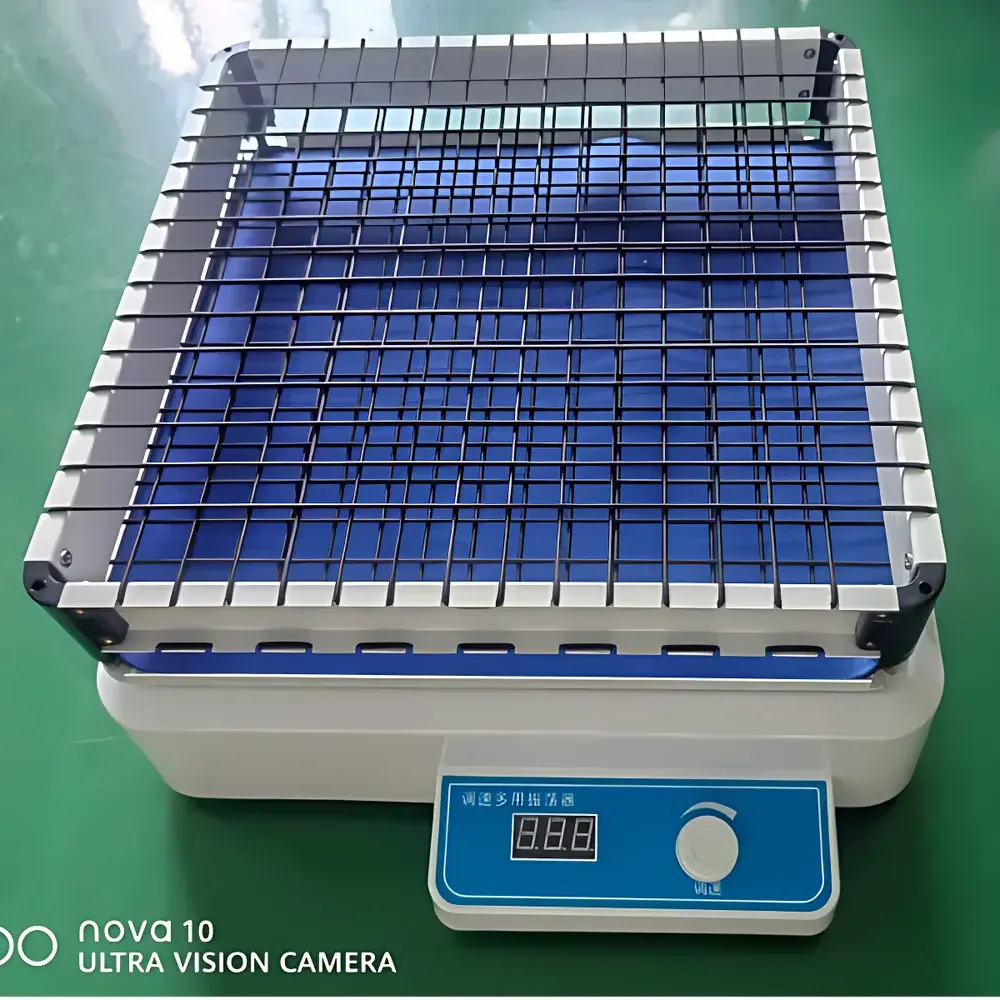
PULUODY PLD-GS2 Multifunctional Fully Automatic Orbital Shaker
| Brand | PULUODY |
|---|---|
| Origin | Shaanxi, China |
| Model | PLD-GS2 |
| Drive Type | Belt-driven orbital motion |
| Display | Digital speed & timer display |
| Speed Range | 30–300 rpm (adjustable) |
| Timer Range | 1–999 minutes |
| Platform Size | 300 × 300 mm |
| Load Capacity | ≤5 kg |
| Operating Noise | <50 dB(A) |
| Construction | Stainless steel platform with corrosion-resistant frame |
| Clamp System | Stainless steel spring clamps (customizable for vials, flasks, tubes, microplates) |
| Power Supply | AC 220 V ±10%, 50 Hz |
| Compliance | CE-marked design principles |
Overview
The PULUODY PLD-GS2 Multifunctional Fully Automatic Orbital Shaker is an engineered solution for precise, reproducible, and uniform sample agitation in analytical and life science laboratories. It operates on the principle of orbital (circular) motion—where the platform rotates around a fixed central axis without vertical displacement—generating consistent shear forces ideal for suspension homogenization, cell culture aeration, reagent mixing, and extraction protocols. Unlike reciprocating or vortex shakers, the PLD-GS2 delivers gentle yet effective motion that minimizes foaming, preserves cell viability, and ensures high repeatability across replicates. Its fully automatic operation—integrated digital speed control, real-time RPM readout, and programmable countdown timer—enables unattended execution of standardized shaking protocols, supporting method traceability and workflow efficiency in regulated environments.
Key Features
- Digital speed control with continuous adjustment from 30 to 300 rpm, calibrated for ±2 rpm accuracy at setpoint.
- Integrated digital timer with 1–999 minute range, auto-shutdown functionality, and memory retention for last-used settings.
- Robust stainless steel platform (300 × 300 mm) with anti-slip surface and reinforced structural frame for long-term mechanical stability.
- Low-noise belt-driven transmission system (<50 dB[A] at 200 rpm), engineered to reduce vibration transfer and maintain ambient laboratory conditions.
- Modular stainless steel spring clamp assembly—standard configuration accommodates Erlenmeyer flasks (50–2000 mL), test tubes, centrifuge tubes, and round-bottom vessels; optional custom fixtures available for microtiter plates (96-well), conical tubes, or irregular containers.
- Thermally stable housing with IP20-rated enclosure, designed for continuous operation under standard laboratory temperature (10–40 °C) and humidity (20–80% RH, non-condensing) conditions.
Sample Compatibility & Compliance
The PLD-GS2 supports heterogeneous sample formats across chemical, biological, and environmental testing workflows. Its platform geometry and clamp adaptability enable simultaneous processing of up to 12 × 100 mL flasks, 4 × 500 mL bottles, or mixed configurations—including combinations of volumetric flasks, serum bottles, and culture vessels—without cross-contamination risk. The device meets functional safety expectations aligned with IEC 61010-1:2010 for laboratory equipment. While not certified under FDA 21 CFR Part 11, its deterministic timer and non-volatile parameter storage support audit-ready documentation practices required under GLP and ISO/IEC 17025 accreditation frameworks. Routine performance verification can be conducted using NIST-traceable tachometers and load-balanced mass distribution protocols.
Software & Data Management
The PLD-GS2 operates as a standalone instrument with embedded firmware—no external PC interface or proprietary software required. All operational parameters (speed, time, elapsed duration) are displayed via a high-contrast LED interface with tactile push-button controls. For laboratories implementing electronic lab notebooks (ELN) or LIMS integration, the unit’s deterministic behavior allows full protocol definition and outcome logging externally. Optional RS-232 or USB-to-serial adapters (sold separately) may be used to capture real-time RPM and timer status via terminal emulation, facilitating CSV-based data export for QA/QC trend analysis and SOP compliance reporting.
Applications
- Chemical analysis: Extraction of analytes from solid matrices (e.g., soil, sediment, polymers) using solvent-based methods per ASTM D3740 or EPA Method 3540C.
- Biochemical research: Suspension culture of bacterial, yeast, and mammalian cells; preparation of competent cells; enzyme reaction mixing under controlled agitation.
- Environmental testing: Homogenization of water, sludge, and wastewater samples prior to filtration or instrumental analysis (ICP-MS, HPLC).
- Pharmaceutical QC: Dissolution media agitation per USP , buffer equilibration, and excipient dispersion studies.
- Academic teaching labs: Standardized demonstration of kinetics, solubility, and mass transfer phenomena in undergraduate chemistry and biology curricula.
FAQ
What is the maximum load capacity of the PLD-GS2 shaker platform?
The rated load capacity is 5 kg, distributed evenly across the platform. Exceeding this limit may affect speed stability and long-term bearing integrity.
Can the PLD-GS2 be used inside a cold room or incubator?
Yes—provided ambient temperature remains within 10–40 °C and relative humidity does not exceed 80% (non-condensing). Condensation must be prevented on electrical components and display panel.
Is calibration documentation provided with the instrument?
Factory calibration records for speed accuracy (±2 rpm) and timer deviation (<±0.5%) are included. Users are advised to perform periodic verification using third-party metrology tools.
Are replacement clamps or custom fixtures available?
Yes—stainless steel universal clamps, flask-specific holders (for 125/250/500 mL Erlenmeyer), and microplate adapters can be ordered directly from PULUODY’s authorized distribution network.
Does the PLD-GS2 meet electromagnetic compatibility (EMC) requirements for use in sensitive instrumentation areas?
It complies with EN 61326-1:2013 Class B emission limits and is suitable for shared lab spaces with HPLC, GC, and spectrophotometers when installed per manufacturer-recommended spacing guidelines.
Related Products





