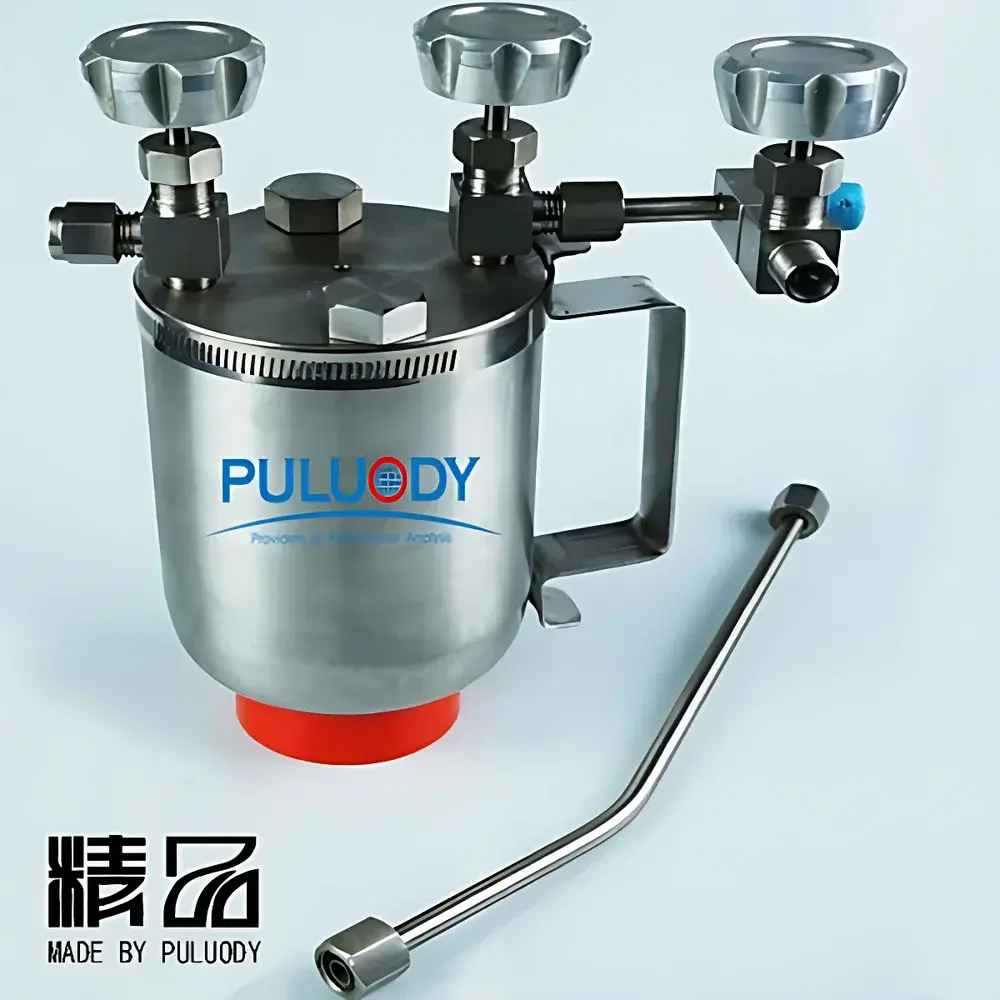
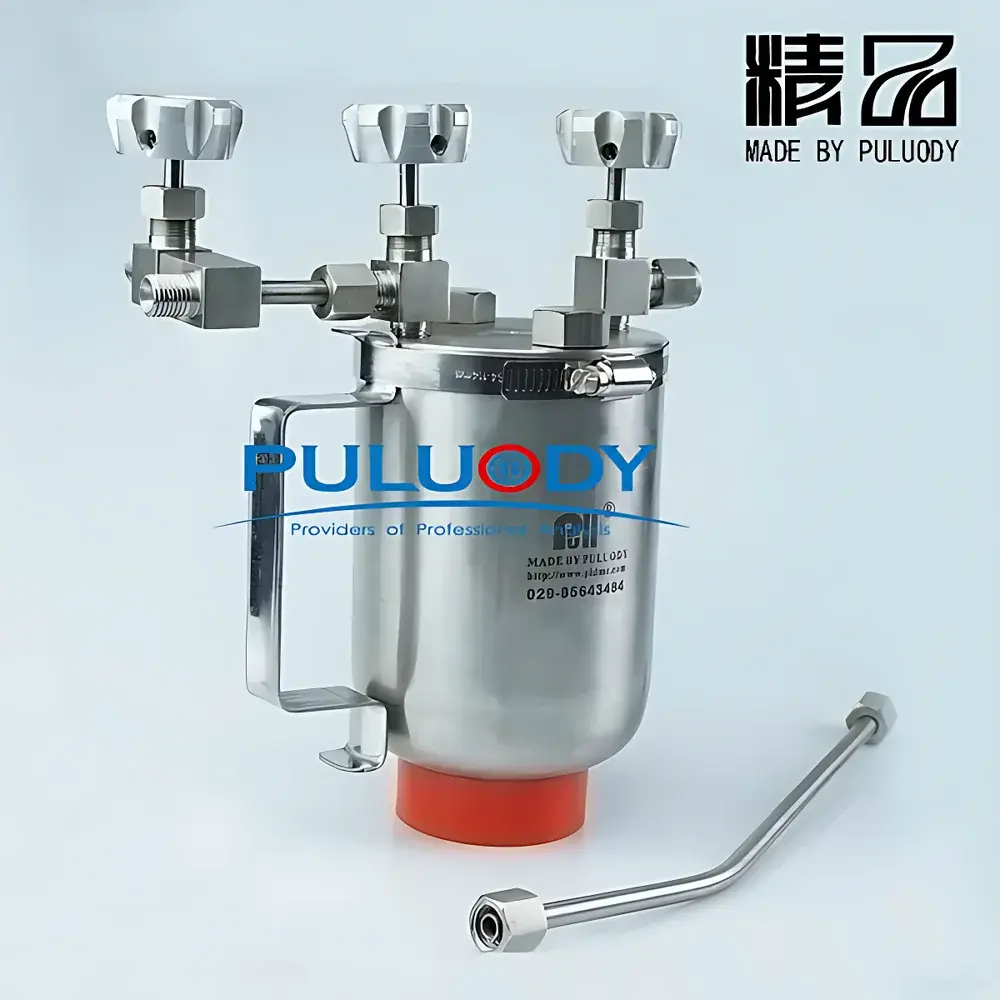
PULL Pull-GP4-1000 Liquid Ammonia Sampling Cylinder
| Brand | PULL |
|---|---|
| Origin | Shaanxi, China |
| Manufacturer Type | Authorized Distributor |
| Country of Origin | China |
| Model | Pull-GP4-1000 |
| Capacity | 1 L |
| Material | Stainless Steel (AISI 316 or equivalent) |
| Design Pressure | 4 MPa |
| Compliance | GB 8570–2008 “Sampling of Laboratory Samples of Anhydrous Liquid Ammonia” |
| Pricing | USD 450 (FOB China, subject to quotation) |
Overview
The PULL Pull-GP4-1000 Liquid Ammonia Sampling Cylinder is a precision-engineered, high-integrity pressure vessel designed exclusively for the safe, representative, and contamination-free collection and transport of anhydrous liquid ammonia (NH₃) in petroleum refining, fertilizer production, chemical manufacturing, and industrial hygiene laboratories. Constructed from corrosion-resistant stainless steel—typically AISI 316 or equivalent—the cylinder operates under a certified design pressure of 4 MPa (580 psi), ensuring structural integrity during both sampling and short-term storage under saturated vapor pressure conditions at ambient temperatures up to 50 °C. Its measurement principle relies on direct-phase equilibrium sampling: the cylinder is evacuated prior to use, then connected to a pressurized liquid ammonia line via a compatible high-pressure valve assembly; filling proceeds by differential pressure until thermal and phase equilibrium is achieved, preserving the true liquid-phase composition without flash vaporization or fractionation. This methodology aligns with the thermodynamic requirements specified in GB 8570–2008, which mandates that samples retain original physical state and purity for subsequent analysis—including determination of water content, oil residue, iron content, and non-volatile residue per GB/T 8570.1–8570.8.
Key Features
- 1-liter nominal capacity with precise internal volume calibration traceable to national metrological standards
- Seamless, cold-drawn stainless steel body with full radiographic inspection (RT) and hydrostatic test certification (test pressure ≥ 1.5 × design pressure)
- Integrated dual-valve configuration: one high-purity stainless steel needle valve for controlled discharge, and one dedicated sampling port with VCR or CGA 660-compliant fitting for inert-gas purging and vacuum evacuation
- Surface finish Ra ≤ 0.4 µm to minimize adsorption and residual carryover
- Marked with permanent laser-engraved identification: model number, serial number, design pressure, test pressure, test date, and compliance reference (GB 8570–2008)
- Equipped with protective cap and transport collar compliant with UN 2035 (Ammonia, anhydrous, Class 2.3, PG I) packaging requirements
Sample Compatibility & Compliance
The Pull-GP4-1000 is validated for use with anhydrous liquid ammonia only—not aqueous ammonia solutions, ammonium hydroxide, or mixed-phase streams. It is incompatible with oxidizers, halogens, or copper-containing alloys due to stress corrosion cracking risk. All materials in contact with NH₃ (valves, seals, O-rings) meet ASTM F2328 and ISO 15136–1 specifications for elastomer compatibility. The cylinder satisfies mandatory pre-market verification under China’s Special Equipment Safety Law (Decree No. 549) and bears the TS (Special Equipment Manufacturing License) mark. For international deployment, it conforms to ASME BPVC Section VIII Div. 1 (2023 Edition) design rules when used within its rated pressure–temperature envelope. Documentation includes a Factory Test Report (FTR), Material Test Report (MTR), and Certificate of Conformance (CoC) issued by the authorized distributor per ISO/IEC 17025-accredited procedures.
Software & Data Management
As a passive sampling device, the Pull-GP4-1000 requires no embedded firmware or software. However, its integration into quality management systems follows GLP and GMP-aligned workflows: each unit is assigned a unique asset ID logged in laboratory information management systems (LIMS); maintenance history—including hydrostatic retest intervals (every 5 years per GB/T 12137), valve servicing, and surface passivation records—is digitally archived. Traceability is enhanced through QR-coded labels linking to digital CoCs and calibration certificates. When used in regulated environments (e.g., ISO/IEC 17025 accredited labs), audit trails for sample chain-of-custody—including operator ID, sampling time/date, source line ID, and post-fill seal verification—are recorded manually or via electronic logbooks compliant with FDA 21 CFR Part 11 requirements.
Applications
- Quality control sampling upstream of ammonia synthesis converters in Haber-Bosch plants
- Batch release testing of commercial-grade anhydrous ammonia per ISO 8570 or ASTM D1583
- Investigation of corrosion product ingress in refrigeration loop monitoring
- Reference material preparation for NH₃ purity certification programs
- Field sampling for environmental compliance monitoring under local emission regulations (e.g., EPA Method TO-15 adaptations)
- Calibration verification of online ammonia analyzers (TDLAS, FTIR, electrochemical sensors)
FAQ
Is the Pull-GP4-1000 suitable for sampling aqueous ammonia solutions?
No. It is engineered solely for anhydrous liquid ammonia. Water content above 0.1 wt% increases risk of chloride-induced pitting and hydrogen embrittlement.
What is the recommended retest interval for hydrostatic pressure verification?
Per GB/T 12137 and national special equipment regulations, retesting is required every 5 years from initial commissioning or last test date.
Can this cylinder be used for long-term storage of liquid ammonia?
It is intended for short-term holding (≤ 72 hours) prior to analysis. Extended storage may induce trace metal leaching or valve seat degradation; analytical protocols require immediate transfer to inert-gas-purged analytical vessels.
Does the cylinder include documentation required for import into the EU or USA?
Yes—upon request, the authorized distributor provides EN 13445-compatibility statements, RoHS/REACH declarations, and English-language CoC and MTRs meeting customs clearance requirements for non-CE-marked pressure equipment under Article 41 of EU Regulation (EU) 2016/425.