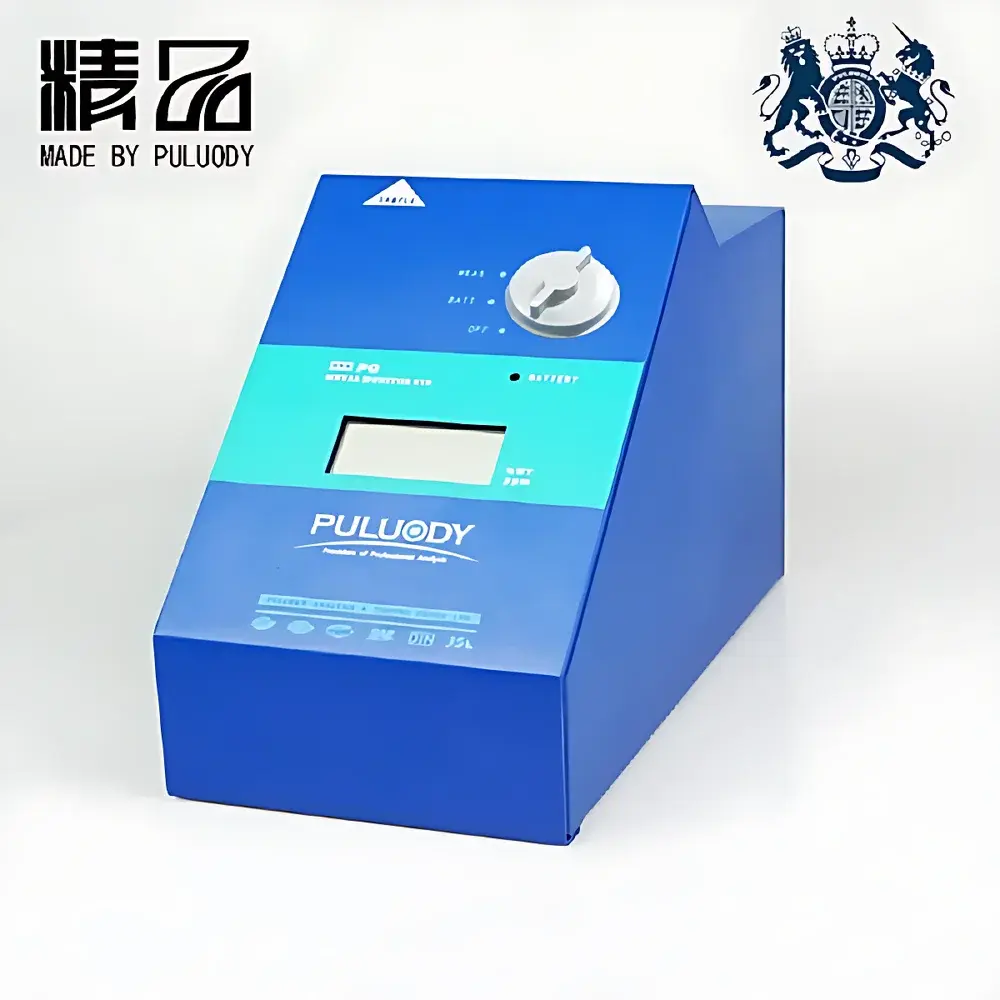
PULUODY Portable Ferrograph Analyzer PQ-2A
| Brand | PULUODY |
|---|---|
| Origin | Shaanxi, China |
| Manufacturer Type | Authorized Distributor |
| Origin Category | Domestic (China) |
| Model | PQ-2A |
| Price | USD 13,800 (FOB) |
| Measurement Principle | Electromagnetic Induction-Based Ferrous Particle Quantification |
| Sensitivity | 0.1 mg/g (100 ppm) |
| Max. Concentration Range | 30,000 mg/g |
| Detectable Ferrous Particle Size | >5 µm |
| Sample Volume | 2–5 mL per test |
| Operating Temperature | 0–55 °C |
| Power Supply | 220 V ±15%, 50 Hz or Integrated Rechargeable Li-ion Battery |
Overview
The PULUODY Portable Ferrograph Analyzer PQ-2A is a field-deployable electromagnetic induction instrument engineered for rapid, non-destructive quantification of ferrous wear debris in lubricating oils and greases. Unlike optical ferrography or elemental spectroscopy, the PQ-2A operates on the principle of magnetic susceptibility perturbation: ferromagnetic particles—primarily iron, steel, and nickel alloys—alter the local magnetic flux density within a precisely calibrated coil assembly. This change is linearly proportional to the mass concentration of ferrous material in the sample matrix. The system digitally captures the induced voltage shift, applies proprietary signal conditioning algorithms to suppress baseline drift, dielectric interference, and temperature-induced noise, and outputs a direct quantitative result in mg/g or ppm. Designed for predictive maintenance workflows, the PQ-2A delivers actionable data within seconds—enabling real-time triage of machinery health without solvent extraction, dilution, or laboratory infrastructure.
Key Features
- True portable architecture: Compact footprint (240 × 180 × 120 mm), ruggedized ABS housing, IP54-rated enclosure, and integrated rechargeable lithium-ion battery supporting ≥8 hours of continuous operation.
- High-fidelity electromagnetic transduction: Dual-layer shielded excitation coil with temperature-compensated Hall-effect sensor array ensures stable calibration across ambient conditions from 0 °C to 55 °C.
- Zero-solvent operation: Eliminates need for chlorinated or aromatic solvents—compliant with ISO 13322-2:2020 Annex B for solvent-free particle quantification and aligned with OSHA 29 CFR 1910.1200 hazard communication requirements.
- Robust matrix compensation: Adaptive baseline correction algorithm mitigates viscosity, oxidation byproduct, and non-ferrous particulate interference—validated against ASTM D7690-22 for ferrous debris measurement in degraded hydrocarbon fluids.
- Intuitive single-button workflow: Auto-zero, auto-calibration, and result display complete in <5 seconds; no operator interpretation or manual curve fitting required.
Sample Compatibility & Compliance
The PQ-2A accepts undiluted samples of mineral-based, synthetic, and semi-synthetic lubricants—including turbine oils, hydraulic fluids (ISO VG 32–68), gear oils (EP and non-EP), compressor oils, and NLGI #0 to #2 greases. It is validated for use with fluids containing up to 15% water content and total acid number (TAN) ≤ 5.0 mg KOH/g. Instrument performance meets the repeatability criteria of ISO 4406:2017 for ferrous-specific contamination grading and supports traceability under GLP-compliant audit trails when paired with optional USB data logging. While not a certified ISO/IEC 17025 testing device, its measurement uncertainty (k=2) is documented per ISO/IEC Guide 98-3:2008 and referenced in OEM condition monitoring specifications (e.g., Siemens Energy SM-1200, GE Power Services PM-8000).
Software & Data Management
The PQ-2A operates autonomously but includes a micro-USB interface for firmware updates and raw data export (CSV format). Optional PULUODY DataLink v3.1 desktop software enables batch reporting, trend charting (time-series concentration vs. operating hours), alarm threshold configuration (e.g., alert at >500 mg/g ferrous load), and integration with CMMS platforms via OPC UA or Modbus TCP. All stored measurements include timestamp, ambient temperature, serial number, and operator ID—supporting 21 CFR Part 11-compliant electronic records when deployed with user authentication and audit log activation.
Applications
The PQ-2A serves as a frontline screening tool in asset-intensive industries where early detection of abnormal ferrous wear directly correlates with failure risk reduction. Field technicians deploy it for routine oil sampling on gas turbines, marine propulsion systems, wind turbine gearboxes, rolling mill bearings, and mining haul truck differentials. Its speed and portability make it ideal for remote site audits, naval vessel dry-dock inspections, and emergency response to vibration anomalies. In power generation, it supplements online particle counters by distinguishing ferrous from non-ferrous debris—critical for diagnosing gear pitting versus filter bypass events. End users report 30–50% reduction in unscheduled downtime when PQ-2A data informs targeted oil analysis lab submissions (e.g., ICP-OES, FTIR, PQ Index correlation).
FAQ
Does the PQ-2A require calibration standards or certified reference materials?
Yes—annual recalibration using PULUODY-certified ferrous standard oils (traceable to NIST SRM 2781) is recommended. Factory calibration certificates include uncertainty budgets per ISO/IEC 17025:2017.
Can the PQ-2A distinguish between cast iron and steel wear particles?
No—it measures total ferromagnetic mass concentration only. Elemental differentiation requires complementary techniques such as SEM-EDS or LIBS.
Is the instrument suitable for use in explosive atmospheres?
Not intrinsically safe by default. For Zone 1/21 applications, it must be operated inside an ATEX-certified sampling hood or used with explosion-proof sample transfer protocols.
How does temperature affect measurement accuracy?
The built-in thermal sensor triggers automatic gain adjustment; deviation remains within ±2% of reading across 0–55 °C when operated within specified ambient limits.
What maintenance is required beyond battery charging?
None—no consumables, no filters, no moving parts. Wipe-down of the sample chamber with lint-free cloth after each use is sufficient.