
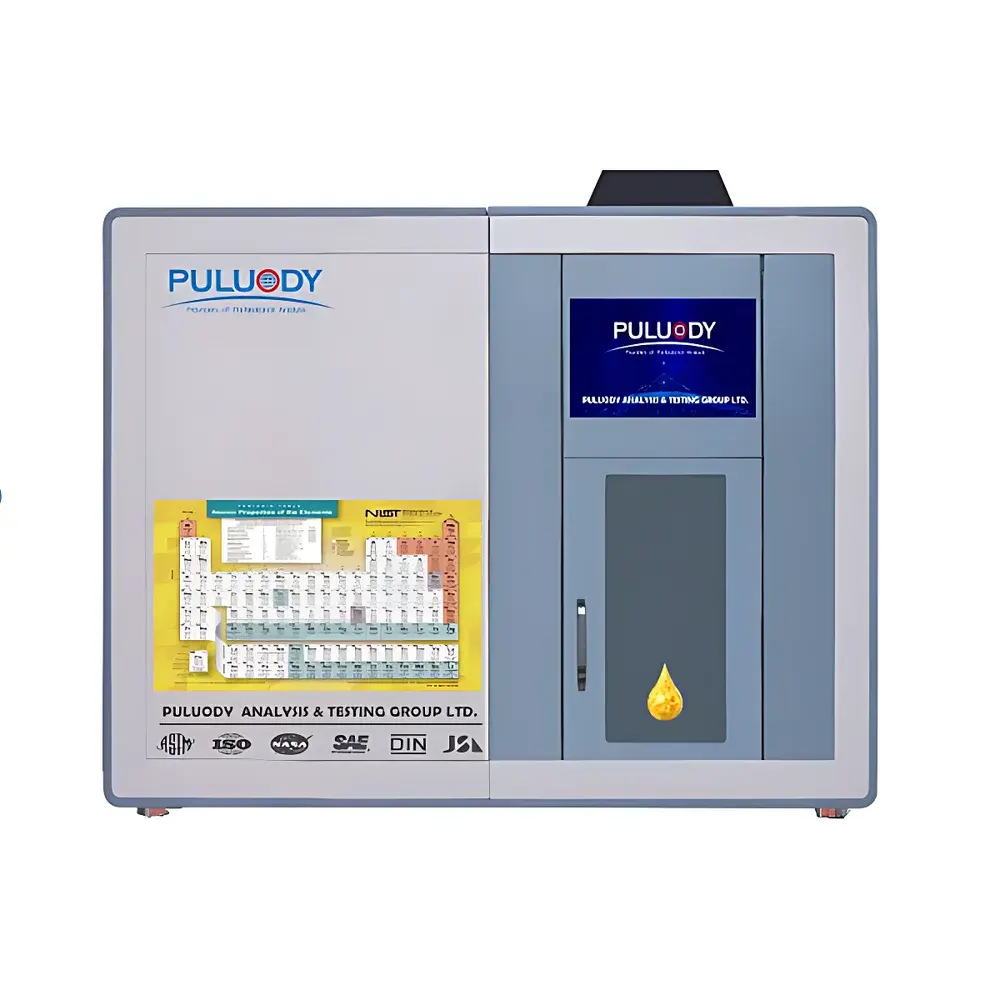
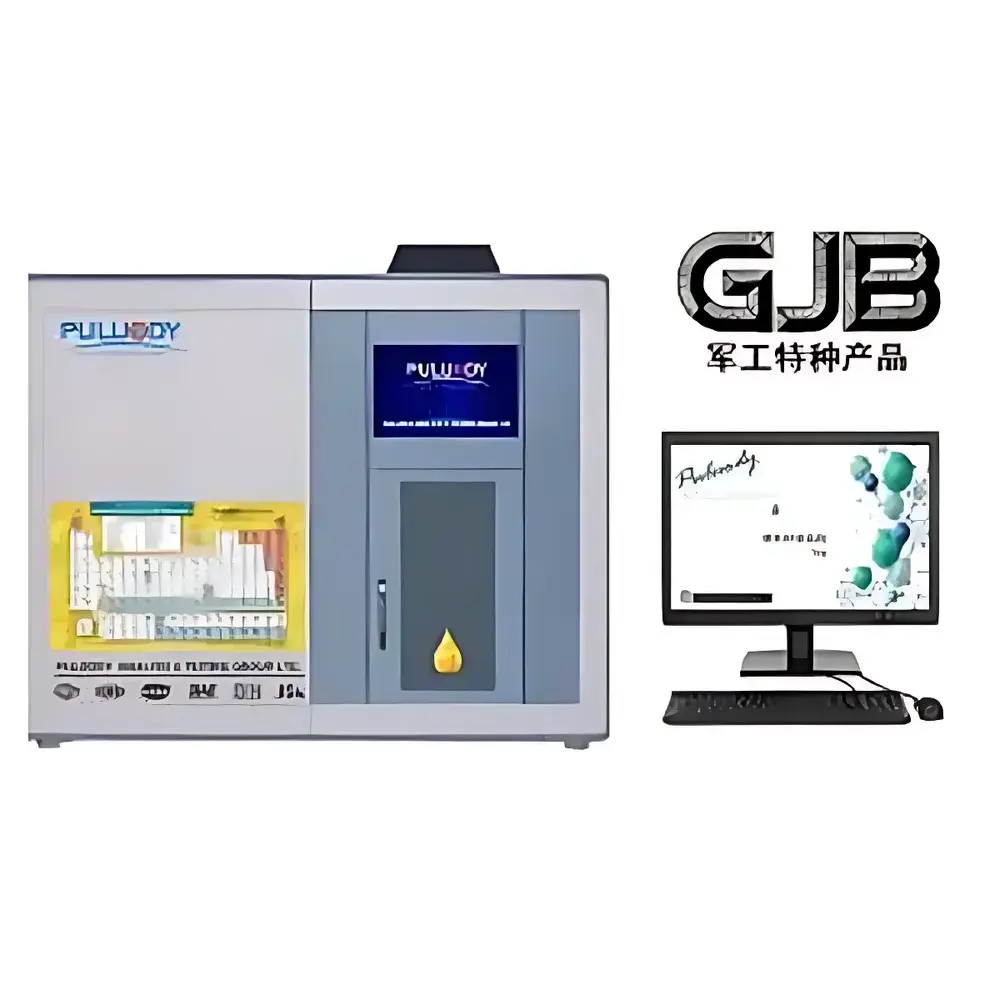
PULUODY P-ICP-I Rotating Disc Electrode Atomic Emission Spectrometer for Multi-Element Oil Analysis
| Brand | PULUODY |
|---|---|
| Origin | Shaanxi, China |
| Manufacturer Type | Authorized Distributor |
| Instrument Type | Rotating Disc Electrode (RDE) Atomic Emission Spectrometer |
| Sample Introduction | Direct liquid introduction |
| Waste Disposal | Rear exhaust configuration |
| Atomization Mode | Vapor generation / Hydride generation |
| Detectable Elements | Al, Ba, B, Cd, Ca, Cr, Cu, Fe, Pb, Mg, Mn, Mo, Ni, P, Si, Ag, Na, Sn, Ti, V, Zn, K, Li, Sb, Sr, Bi, As, In, Zr, W, Co, Ce |
| Detection Limit | ≤1 ppb (μg/L) for most elements |
| Precision | RSD ≤1.5% |
| Stability | RSD ≤2.0% |
| Linear Dynamic Range | 5 orders of magnitude |
| Spectral Range | 190–800 nm |
| Optical Resolution | ≤0.015 nm |
| RF Generator Frequency | 27.12 MHz (±0.05%) |
| RF Power Output | 800–1600 W (±0.2%) |
| Grating Density | 2400 lines/mm |
| Grating Area | 80 × 110 mm |
| Minimum Sample Volume | >1 mL |
| Operating Temperature | 20–45 °C |
| Relative Humidity | 0–90% RH (non-condensing) |
| Software | PICP-V2.1 multi-language platform (CN/EN/KO/JP), compliant with ASTM D6595, D6728, NB/SH/T 0865, SN/T 1652, DL/T 1550, JJF (Defense) 1752018 |
Overview
The PULUODY P-ICP-I Rotating Disc Electrode Atomic Emission Spectrometer is a dedicated analytical system engineered for rapid, precise, and simultaneous multi-element quantification in petroleum-based and synthetic lubricants, hydraulic fluids, transformer oils, turbine oils, fuels, and related organic liquids. Unlike conventional ICP-OES systems requiring acid digestion or nebulization, the P-ICP-I employs a rotating disc electrode (RDE) excitation source—where a high-frequency plasma arc is generated directly on the surface of a conductive oil sample deposited on a rotating graphite disc. This direct solid-phase excitation eliminates matrix-induced interferences common in solution-based plasma techniques and delivers exceptional sensitivity for metallic wear debris, additive elements, and contaminant species at sub-ppb levels. The instrument is purpose-built for condition monitoring laboratories operating under ASTM D6595, D6728, and equivalent national standards—including NB/SH/T 0865 and DL/T 1550—ensuring regulatory alignment for aerospace, power generation, marine, and heavy industrial maintenance programs.
Key Features
- Rotating Disc Electrode (RDE) excitation architecture enabling direct analysis of undiluted oil samples without digestion or dilution
- Detection capability for ≥31 elements—including wear metals (Fe, Cu, Cr, Al, Pb), contaminants (Si, Na, B, Ca), and additives (Zn, P, Mg, Ca, Ba)—with validated detection limits ≤1 ppb
- High-resolution optical system (≤0.015 nm resolution) across 190–800 nm spectral range, supported by a 2400 lines/mm holographic grating (80 × 110 mm)
- Stable RF plasma source (27.12 MHz, ±0.05%; 800–1600 W output, ±0.2%) ensuring reproducible excitation and low baseline drift
- Automated direct liquid introduction with rear-exhaust waste handling, minimizing operator exposure and cross-contamination risk
- Analysis speed of ≥4 elements per minute with full spectral acquisition, supporting high-throughput laboratory workflows
- Linear dynamic range spanning five orders of magnitude (0.01 ppm to 10,000 ppm), permitting concurrent quantification of trace wear particles and major additive constituents
Sample Compatibility & Compliance
The P-ICP-I is validated for use with mineral and synthetic hydrocarbon-based fluids—including hydraulic oils, engine oils, turbine oils, gear oils, aviation kerosene, antifreeze solutions, and insulating oils—as well as aqueous samples, organic solvents, and polymer solutions. It complies with internationally recognized standard methods: ASTM D6595 (wear metals and contaminants in used lubricants), ASTM D6728 (contaminants in gas turbine and diesel fuels), NB/SH/T 0865 (Chinese national standard for RDE-AES in lubricants), SN/T 1652 (import/export fuel testing), and DL/T 1550 (copper/iron in transformer oil). All calibration protocols, validation procedures, and instrument performance verification align with GLP principles and support audit readiness under ISO/IEC 17025-accredited environments. The system meets electrical safety requirements per IEC 61010-1 and electromagnetic compatibility per IEC 61326-1.
Software & Data Management
PICP-V2.1 is a modular, multi-language (English, Chinese, Korean, Japanese) software platform built on PULUODY GROUP’s seventh-generation spectral measurement architecture. It supports qualitative identification, semi-quantitative screening, and fully calibrated quantitative analysis using internal standardization and matrix-matched calibration curves. The software includes spectral library management (>10,000 reference lines), real-time background correction, peak deconvolution, and automated interference correction algorithms. Data integrity features include electronic signatures, time-stamped audit trails, and user-access-level controls compliant with FDA 21 CFR Part 11 requirements. Reports are exportable in PDF, Excel, Word, and plain-text formats and include method metadata (standard, instrument ID, element, wavelength, intensity, concentration, RSD, units), analyst name, approval signature, and uncertainty estimates. Historical data trending, statistical process control (SPC) charts, and alarm threshold configuration enable predictive maintenance integration.
Applications
The P-ICP-I serves as a core analytical tool in tribology and fluid condition monitoring programs across critical infrastructure sectors. In power generation, it monitors copper and iron in transformer oil per DL/T 1550 to assess winding degradation and core corrosion. In aviation and defense, it tracks Al, Cr, Ni, and Ti in jet fuel and hydraulic fluids per ASTM D6728 to detect turbine wear or seal degradation. In marine and rail applications, it identifies elevated Si (dust ingress), Na (seawater contamination), and Ca (coolant leakage) alongside wear metals in engine oils. For additive package verification, it quantifies Zn, P, Mg, and Ba concentrations to confirm formulation integrity and depletion kinetics. Its robustness and low detection limits also support research into catalytic metal leaching from refinery catalysts, nanoparticle dispersion stability, and elemental impurity profiling in battery electrolytes and semiconductor process fluids.
FAQ
What sample preparation is required prior to analysis?
No acid digestion or dilution is needed. Samples are introduced directly onto the graphite disc after filtration through a 5-µm membrane to remove particulates >5 µm.
Can the system analyze water-based coolants or glycol solutions?
Yes—provided conductivity exceeds 50 µS/cm; low-conductivity samples may require addition of a low-volume ionic modifier (e.g., 0.1% KNO₃) to stabilize arc discharge.
How is calibration verified between runs?
Daily calibration verification is performed using a certified multi-element check standard traceable to NIST SRMs; drift correction is applied via internal standard (e.g., Y or Sc) normalization.
Is method transfer possible between different P-ICP-I instruments?
Yes—PICP-V2.1 supports method portability across instruments via encrypted .pmd files containing all spectral parameters, calibration coefficients, and QC criteria.
Does the system support remote diagnostics and preventive maintenance alerts?
Yes—integrated Ethernet connectivity enables secure remote access for firmware updates, spectral health monitoring, and predictive component lifetime estimation based on RF generator duty cycles and optical throughput decay.





