
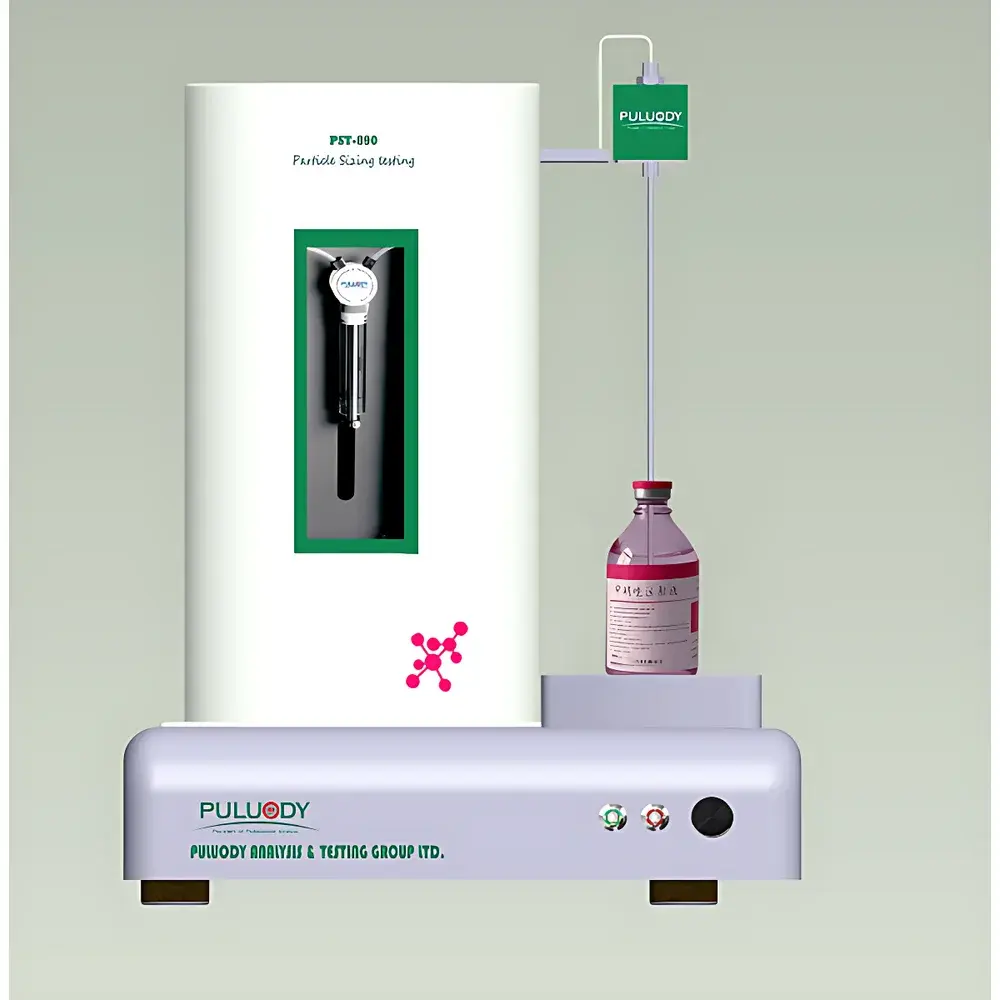
PULUODY PST-890 Dual-Laser Narrow-Beam Insoluble Particle Analyzer for Pharmaceutical Emulsions and Parenteral Solutions
| Brand | PULUODY |
|---|---|
| Origin | Shaanxi, China |
| Manufacturer Type | Authorized Distributor |
| Country of Origin | China |
| Model | PST-890 |
| Price | USD 53,200 (approx. ¥380,000) |
| Sensor Generation | 8th-Gen Dual-Laser Narrow-Beam Detector |
| Detection Principle | Light Obscuration (LO) / Single-Particle Optical Sizing (SPOS) |
| Calibration Standards | ISO 21501-4, JJG 1061, NIST-Traceable Latex Spheres |
| Software | V8.9 Integrated Particle Analysis Suite (PC & Embedded Touch UI) |
| Sample Flow Rate | 5–150 mL/min |
| Rinse Flow Rate | 5–500 mL/min |
| Temperature Range (Fluid) | 0–80 °C |
| Environmental Operating Range | −15–50 °C |
| Counting Channels | 1000 configurable channels (user-definable from 4 to 128 size bins) |
| Detection Range | 1–450 µm (extended range 0.03–3000 µm optional) |
| Custom Ranges | 1–100 µm, 4–70 µm(c), 0.1 µm(c) |
| Sampling Accuracy | <±1% |
| Coincidence Limit | 1000 particles/mL (2.5% coincidence error) |
| Resolution | >95% (per ChP 2015/2020), <10% (per USP <788>, ISO 21501-4) |
| Compliance | GB/T 11446.9–2013, ChP 0903, USP <788>/<789>/<797>, EP 10.0/9.0/8.0, BP 2019/2018, JP 17/16/15, IP 2015, WHO IntPh IV, YBB 00272004–2015, GB 8368, ISO 21510, ISO 11171, NAS 1638, ISO 4406, SAE AS4059, MIL-STD-1246C, JIS B 9933, IP 564/565, ROC T 17216, GB/T 14039, DL/T 432, DL/T 1096, JB/T 9737, GJB/T 420A/B, GB/T 18854 |
Overview
The PULUODY PST-890 Dual-Laser Narrow-Beam Insoluble Particle Analyzer is an advanced light obscuration (LO)-based instrument engineered for quantitative, high-resolution particle sizing and counting in parenteral pharmaceutical formulations. It operates on the principle of single-particle optical sensing—where individual particles suspended in a liquid medium pass through a precisely collimated dual-laser beam, generating transient signal pulses proportional to their cross-sectional area. The system’s eighth-generation dual-laser narrow-beam sensor architecture minimizes diffraction artifacts and enhances signal-to-noise ratio, enabling reliable detection of sub-micron contaminants—including lipid droplets in intravenous fat emulsions, crystalline precipitates in concentrated solutions, and leachables from primary packaging or filtration components. Designed specifically for compliance-driven environments, the PST-890 meets stringent regulatory requirements for sterility assurance, process validation, and quality control across drug product development, manufacturing, and release testing.
Key Features
- 8th-generation dual-laser narrow-beam optical sensor with independent wavelength alignment for improved sensitivity across broad particle morphologies (spherical, irregular, semi-transparent)
- Dual-flow precision control: micro-stepper-driven metering pump + ultra-stable electromagnetic flow regulation ensures reproducible volumetric sampling (±1% accuracy) and eliminates pulsation-induced counting artifacts
- 1000-channel high-resolution sizing engine supports user-defined binning—from coarse 4-bin groupings for rapid QC screening to granular 128-bin distributions for root-cause analysis of aggregation or degradation pathways
- Configurable detection thresholds: selectable lower limits of quantification at 0.1 µm(c), 1 µm, or 4 µm(c) to align with pharmacopoeial thresholds (e.g., USP ≥10 µm & ≥25 µm; ChP 0903 ≥10 µm & ≥25 µm; EP 2.9.19 ≥2 µm & ≥5 µm)
- Thermally stabilized fluid path (0–80 °C operating range) accommodates temperature-sensitive biologics, viscous emulsions, and cold-chain formulations without thermal shock or viscosity-induced bias
- Embedded 10.1″ capacitive touchscreen interface with offline operation capability; full PC software suite (V8.9) provides audit-trail-enabled data management compliant with FDA 21 CFR Part 11 and EU Annex 11
Sample Compatibility & Compliance
The PST-890 is validated for direct analysis of a comprehensive range of pharmaceutical liquids and solids-in-solution matrices: lipid-based IV emulsions (e.g., soybean oil, MCT/LCT formulations), aqueous injectables (including low-conductivity saline and dextrose), sterile powders reconstituted per monograph instructions, ophthalmic solutions, vaccine suspensions, water-for-injection (WFI), and purified water (PW). It further supports extractables/leachables assessment from polymeric containers, elastomeric closures, and infusion sets per YBB 00272004–2015 and GB 8368. All measurement protocols are traceable to ISO 21501-4 and calibrated using NIST-traceable polystyrene latex standards (PSL) or JJG 1061-certified reference materials. System validation documentation supports GLP/GMP audits and satisfies requirements under ICH Q5A(R2), Q5C, and Annex 1 for sterile product manufacturing.
Software & Data Management
The V8.9 Particle Analysis Suite delivers integrated acquisition, visualization, statistical reporting, and electronic record retention. Real-time histogram generation, cumulative distribution plots, and differential counts per ISO 4406 code are auto-generated per sample. The software embeds over 510 pharmacopoeial and industrial standards—including dynamic rule-based pass/fail logic per USP , ChP 0903, and EP 2.9.19—and allows custom threshold definition for internal specifications. Audit trails log all user actions, parameter changes, calibration events, and report exports with immutable timestamps and digital signatures. Raw data files (.pda) are stored in vendor-neutral HDF5 format, ensuring long-term readability and third-party interoperability. Export options include CSV, PDF, XML, and LIMS-compatible ASTM E1382-compliant structured reports.
Applications
- Final container testing of IV lipid emulsions per USP and ChP 0903 for subvisible particle burden (≥10 µm and ≥25 µm)
- Filter integrity verification of 0.22 µm sterilizing-grade membranes via upstream/downstream particle challenge studies
- Stability-indicating monitoring of protein therapeutics for aggregation onset (e.g., dimers, submicron oligomers ≥0.1 µm)
- Raw material qualification of sterile APIs, excipients, and WFI per compendial limits
- Leachables profiling from pre-filled syringes, IV bags, and tubing systems during extractables studies
- Routine cleaning validation of bioreactors, fill-finish lines, and clean steam systems using particle load tracking
- Root-cause investigation of visible particulates observed in batch releases through correlation with subvisible count profiles
FAQ
Does the PST-890 comply with FDA 21 CFR Part 11 for electronic records and signatures?
Yes—the V8.9 software includes role-based access control, electronic signature capture, and immutable audit trails meeting all technical and procedural requirements of 21 CFR Part 11 and EU Annex 11.
Can it analyze highly viscous emulsions without dilution?
Yes—its dual-flow electromagnetic control maintains stable laminar flow up to 150 mL/min across viscosities ≤500 cP; optional heated flow cell prevents phase separation during analysis.
How is calibration verified between runs?
Each analysis sequence includes automated zero-check, background noise validation, and optional in-line PSL standard injection for real-time drift correction per ISO 21501-4.
Is method transfer supported between labs using different PST-890 units?
Yes—hardware-agnostic .pda files, standardized SOP templates, and inter-laboratory comparison modules ensure consistent interpretation across global QC networks.
What maintenance is required to sustain optical performance?
Annual sensor alignment verification and quarterly flow-path cleaning with certified solvents (IPA/water) are recommended; no consumable optics require replacement under normal use.






