
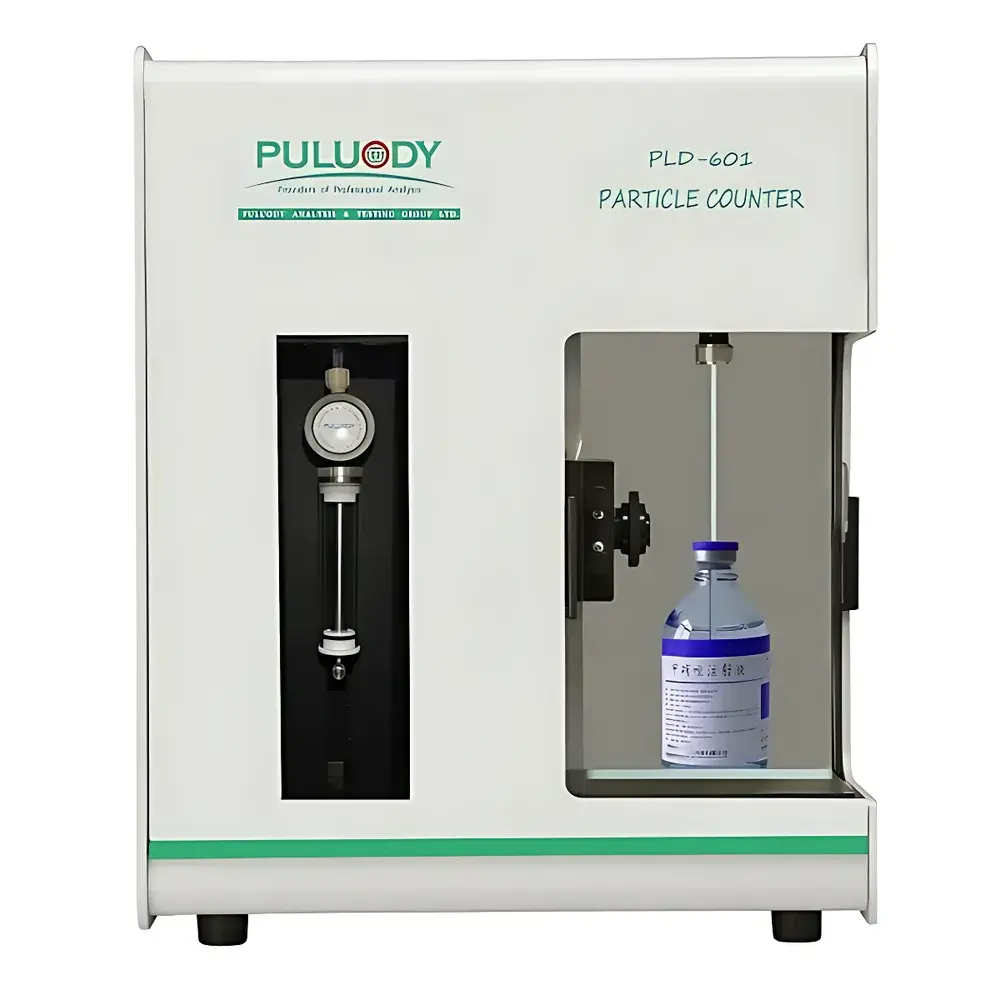
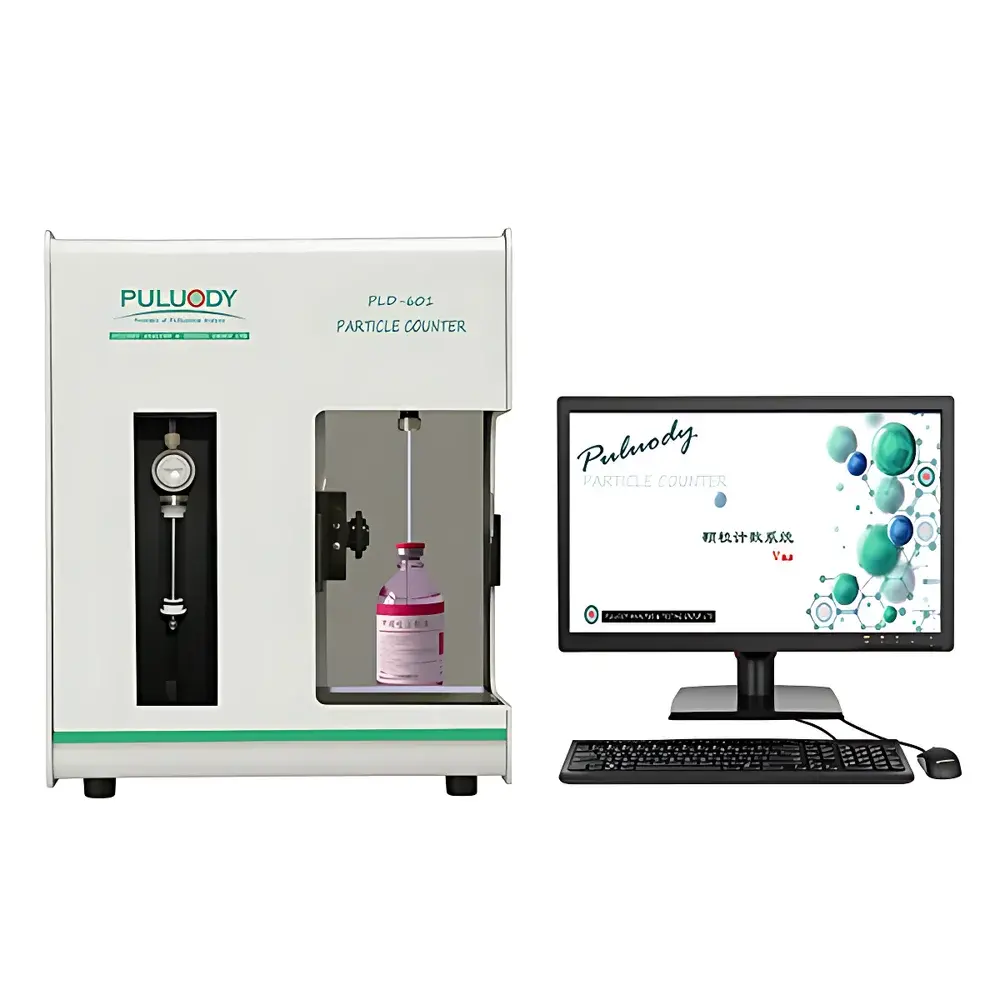
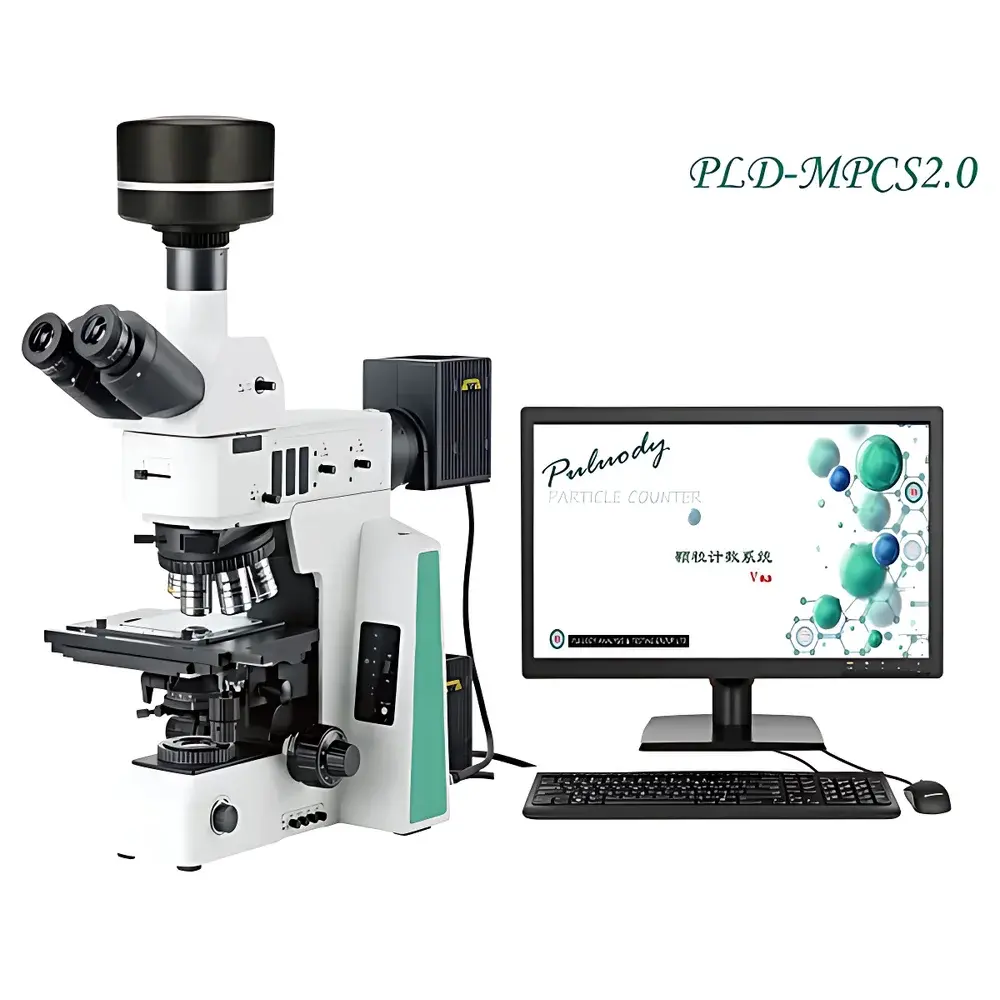
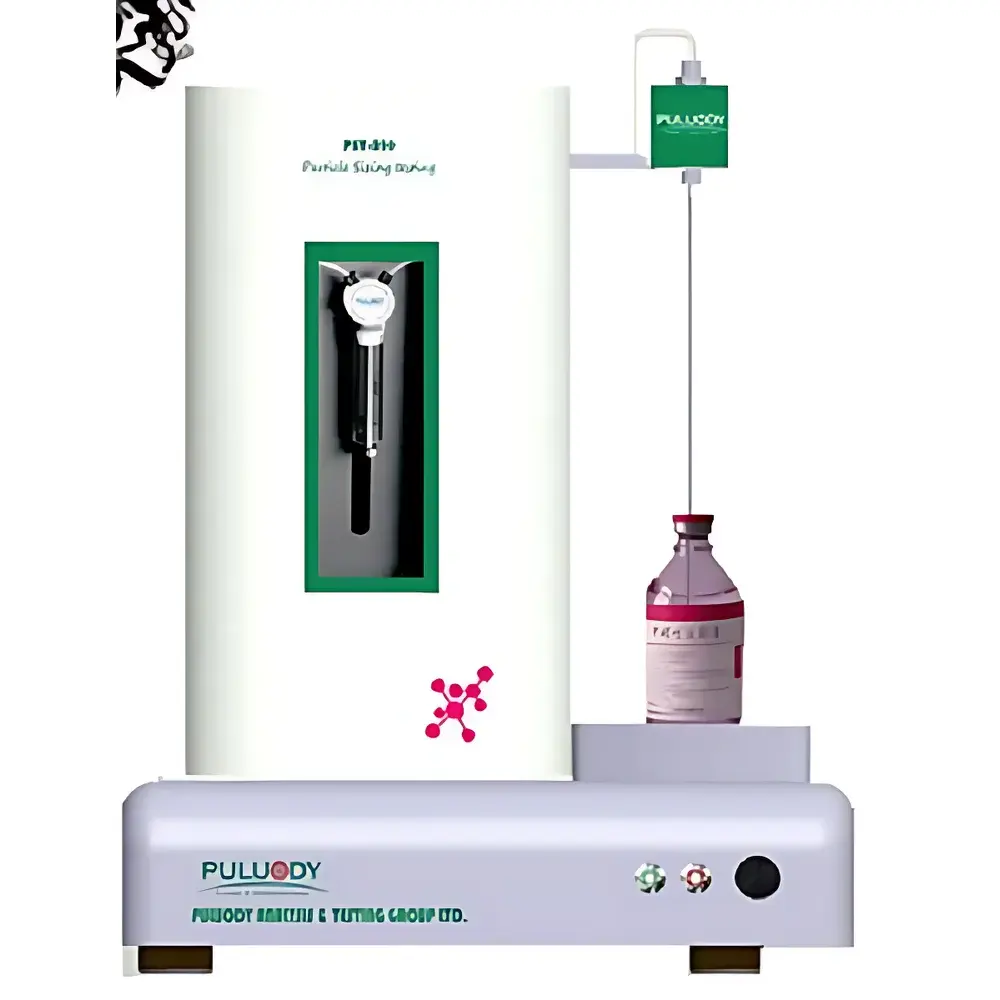
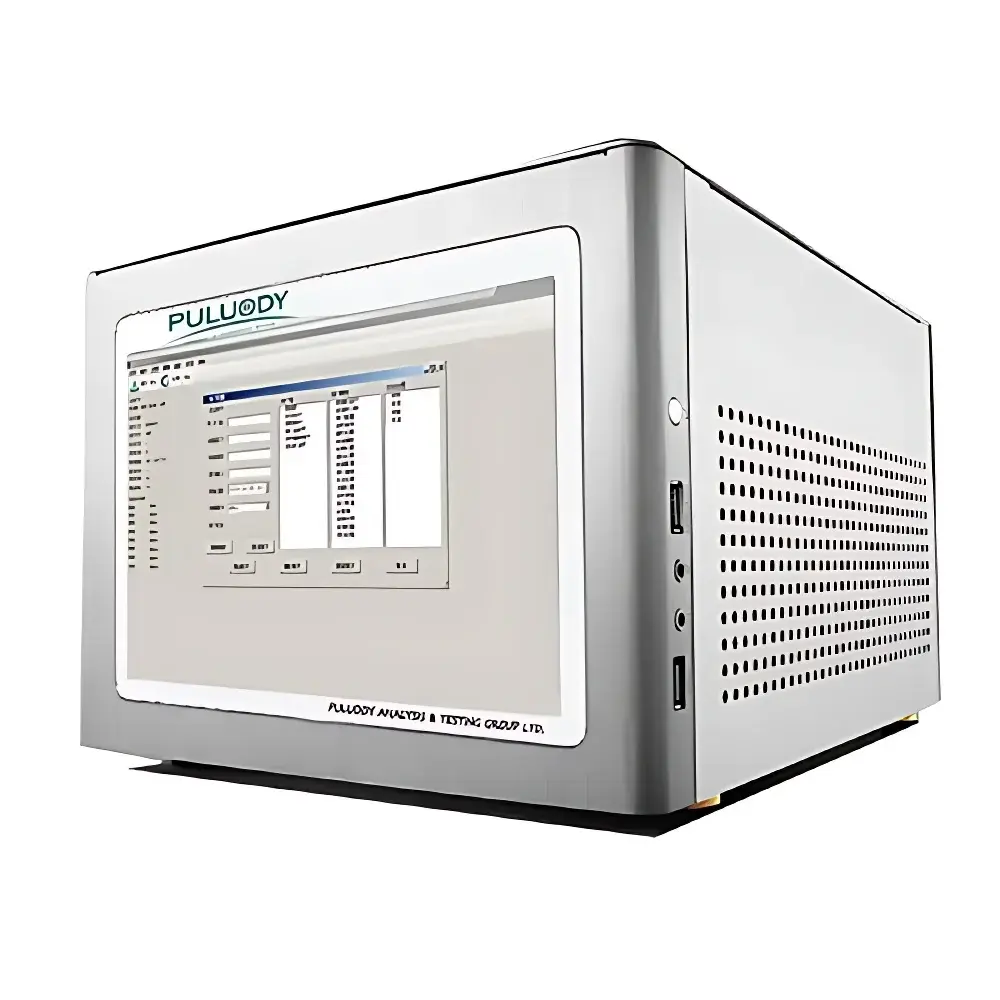
PULUODY PLD-601 Chinese Pharmacopoeia 2020 Edition Insoluble Particle Analyzer
| Brand | PULUODY |
|---|---|
| Origin | Shaanxi, China |
| Model | PLD-601 |
| Detection Principle | Light Obscuration (LO) / Single-Particle Optical Sizing (SPOS) |
| Laser Source | Dual-narrow-beam laser diode array (8th-generation) |
| Sensor Resolution | 1000 channels, down to 0.01 µm |
| Flow Control | Precision metering piston pump + ultra-precise electromagnetic flow regulation |
| Sample Volume Accuracy | < ±1% |
| Counting Accuracy | ±3% typical (per ChP 2020 & USP <788>) |
| Coincidence Limit | ≤2.5% at 1000 particles/mL |
| Channel Flexibility | User-definable size bins (e.g., 4–70 µm(c), 1–100 µm, or 0.1 µm(c)) |
| Flow Rate Range | Sample: 5–150 mL/min |
| Rinse | 5–500 mL/min |
| Fluid Temperature Range | 0–80 °C |
| Ambient Operating Range | −15–50 °C |
| Compliance | ChP 2020 <0903>, USP <788>/<789>/<797>, EP 10.0, BP 2019, JP 17, ISO 21501-4, ISO 11171, GB/T 11446.9–2013, YBB00272004–2015, GB 8368 |
| Software | V8.9 Analytical Suite (PC & embedded touchscreen), FDA 21 CFR Part 11 compliant (audit trail, electronic signature, role-based 5-level access, data backup/restore, power-fail recovery) |
| Calibration Standards | NIST-traceable polystyrene latex (PSL) spheres, JJG 1061–2019, ISO 21501-4 |
Overview
The PULUODY PLD-601 Insoluble Particle Analyzer is a fully validated, regulatory-grade light obscuration (LO) instrument engineered for quantitative analysis of non-viable particulate contamination in parenteral and ophthalmic pharmaceutical products. Designed in strict alignment with the Chinese Pharmacopoeia (ChP) 2020 Edition General Chapter <0903>, it employs an 8th-generation dual-narrow-beam laser sensor architecture to deliver high-fidelity particle sizing and counting across a dynamic range of 0.01 µm to 500 µm — extendable to 3000 µm upon configuration. The system operates on the principle of single-particle optical sensing: as particles traverse a precisely focused laser beam within a laminar-flow detection zone, they generate transient light blockage signals proportional to their cross-sectional area. These analog pulses are digitized and classified into user-defined size channels (up to 1000), enabling compliance with multi-tiered pharmacopeial thresholds including USP <788>, EP 10.0, JP 17, and BP 2019. Its dual-stage flow control — combining a positive-displacement metering piston pump with closed-loop electromagnetic flow regulation — ensures volumetric accuracy better than ±1% and minimizes hydrodynamic coincidence error (<2.5% at 1000 particles/mL), critical for accurate reporting in high-concentration samples such as vaccine suspensions or concentrated biologics.
Key Features
- 8th-generation dual-narrow-beam laser sensor optimized for low-noise, high-sensitivity detection of sub-micron particles (down to 0.01 µm)
- 1000-channel resolution with fully customizable binning — supports simultaneous evaluation against ChP <0903>, USP <788>, and ISO 21501-4 calibration protocols
- Precision fluid handling system: metering piston pump + electromagnetic flow controller for repeatable sample draw, rinse, and purge cycles
- FDA 21 CFR Part 11-compliant software suite (V8.9) with full audit trail, electronic signatures, five-tier user permission management, and encrypted data backup/restore
- Embedded 10.1″ color touchscreen interface with optional wireless keyboard/mouse support; bilingual (English/Chinese) UI designed for GMP-aligned laboratory workflows
- Thermally stabilized fluid path supporting operation from 0 °C to 80 °C — suitable for cold-chain injectables and heat-stable APIs
- Integrated validation-ready documentation package: IQ/OQ templates, calibration certificates traceable to NIST and JJG 1061–2019, and metrological verification by NWMS (China National Institute of Metrology Northwest Center)
Sample Compatibility & Compliance
The PLD-601 is validated for direct analysis of a broad spectrum of liquid pharmaceuticals and excipients without filtration or dilution, including sterile aqueous solutions, lyophilized powder reconstitutes, viscous concentrates, ophthalmic drops, vaccines, WFI, and purified water. It also supports testing of medical device components per YBB00272004–2015 (packaging materials) and GB 8368 (infusion sets), enabling quantification of filter retention efficiency and leachable particulate generation. Regulatory compliance extends beyond pharmacopeias: the system meets ISO 21501-4 requirements for instrument calibration and performance verification, aligns with ISO 11171 for flow reference standards, and supports data integrity practices consistent with ALCOA+ principles. All software operations generate time-stamped, immutable audit logs meeting GLP and GMP documentation expectations for inspection readiness.
Software & Data Management
The V8.9 Analytical Suite provides a unified platform for method setup, real-time monitoring, statistical reporting, and long-term archival. Each test record includes raw pulse data, channel histograms, cumulative distribution curves, and pass/fail flags against selected pharmacopeial limits (e.g., ChP <0903> Table 1 for large-volume parenterals). Data export formats include CSV, PDF, and XML for LIMS integration. Role-based access control enforces separation of duties: administrators configure instruments, analysts execute tests, reviewers approve reports, and QA personnel audit historical records. Electronic signatures comply with 21 CFR Part 11 Subpart B requirements, while automatic power-loss recovery preserves unsaved data during unexpected shutdowns. Optional cloud synchronization enables remote oversight without compromising on-premise data sovereignty.
Applications
- Pharmaceutical QC/QA: Routine release testing of injectables, vaccines, and ophthalmics per ChP, USP, EP, and JP monographs
- Process development: Monitoring microcontamination during filtration validation, container-closure integrity studies, and extractables/leachables screening
- Medical device evaluation: Quantifying particulate shedding from IV tubing, syringes, stoppers, and terminal filters
- Water system qualification: Assessing particle load in purified water (PW), water for injection (WFI), and ultrapure water (UPW) per ISO 14644-1 and ASTM D5127
- Semiconductor & electronics: CMP slurry cleanliness, wafer rinse water purity, and nano-dispersion stability in photoresists
- Chemical & cosmetics: Stability assessment of pigment dispersions, nanomaterial suspensions, and emulsified actives
FAQ
Does the PLD-601 meet FDA requirements for electronic records and signatures?
Yes — its V8.9 software implements full 21 CFR Part 11 functionality, including system validation documentation, audit trail generation, role-based permissions, and cryptographic electronic signatures.
Can the instrument be calibrated to ISO 21501-4 and USP <788> simultaneously?
Yes — the 1000-channel architecture allows concurrent application of multiple calibration curves and size thresholds; users may switch between ChP, USP, and ISO modes without hardware modification.
What sample volume precision does the system achieve?
Volumetric accuracy is < ±1% across the full 5–150 mL/min flow range, verified using gravimetric measurement per JJG 1061–2019.
Is third-party metrological verification available?
Yes — PULUODY partners with NWMS (Northwest Metrology Testing Center) and the National Defense Science & Technology Commission’s Level-1 Particle Measurement Station No. 116 for formal calibration and uncertainty reporting.
How is data integrity maintained during extended unattended operation?
The system features non-volatile memory buffering, auto-save intervals configurable to ≤30 seconds, and journaling file system architecture that prevents data corruption during power interruption.





