
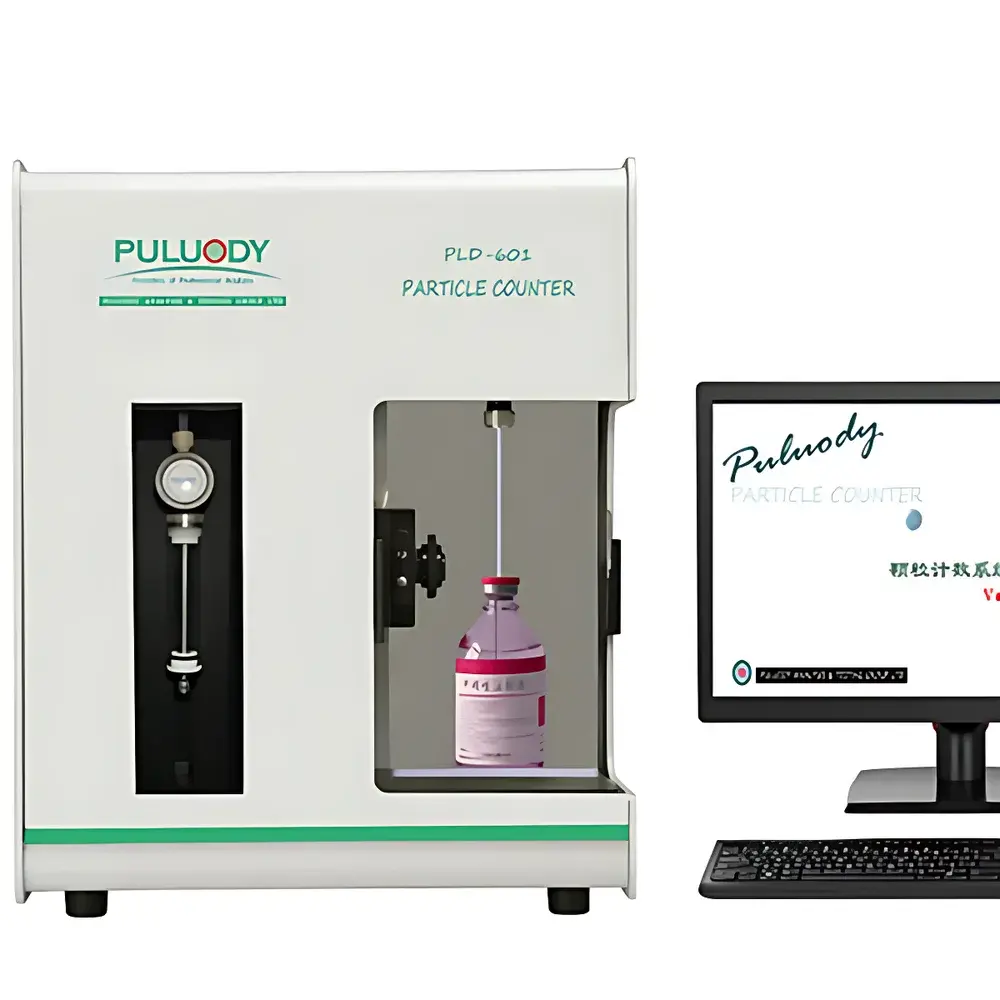
PULUODY PLD-601-X Extractable & Insoluble Particulate Analyzer
| Brand | PULUODY |
|---|---|
| Origin | Shaanxi, China |
| Manufacturer Type | Authorized Distributor |
| Regional Classification | Domestic (China) |
| Model | PLD-601-X |
| Price | USD 26,500 (FOB) |
| Dispersion Method | Wet Dispersion |
| Instrument Type | Laboratory Laser-Based Light Obscuration Particle Counter |
| Measurement Range | 1–450 µm |
| Repeatability | ≤5% RSD |
| Measurement Time | 5–60 seconds per sample |
Overview
The PULUODY PLD-601-X Extractable & Insoluble Particulate Analyzer is a regulatory-grade, light obscuration (LO)-based particle counter engineered for precise quantification and sizing of insoluble particulates in parenteral and ophthalmic pharmaceutical preparations, purified water systems, and high-value process liquids. It operates on the principle of single-particle optical sensing (SPOS), where particles suspended in a laminar liquid stream pass through a focused dual-laser beam; each particle generates a transient light blockage proportional to its projected area, enabling real-time detection and classification across 1,000 user-definable size channels (down to 0.01 µm resolution). Unlike conventional laser diffraction systems optimized for broad-size-distribution powders, the PLD-601-X is purpose-built for pharmacopeial compliance—specifically targeting the detection of discrete, non-biological, extrinsic, and intrinsic particulates ≥1 µm in critical injectables, vaccines, sterile APIs, infusion devices, and packaging components.
Key Features
- Dual-wavelength narrow-beam laser sensor (8th-generation PULUODY optical architecture) with independent signal validation paths to minimize false counts and enhance discrimination of submicron artifacts.
- Dual-precision fluid control system: A calibrated positive-displacement piston pump (±1% volumetric accuracy) coupled with a high-response electromagnetic flow regulator ensures stable, pulse-free sampling across the full 5–150 mL/min operational range.
- Regulatory-compliant software platform (V8.9 PC & embedded touchscreen edition) featuring five-tier user access control, electronic signatures, full audit trail logging, and automatic backup/recovery—validated against FDA 21 CFR Part 11, EU Annex 11, and WHO TRS 992 data integrity requirements.
- 1,000-channel high-resolution sizing matrix supports configurable binning (e.g., 4–70 µm(c), 1–100 µm, or custom ISO/USP-aligned thresholds), enabling simultaneous conformance with USP , EP 2.9.19, ChP 0903, JP 17, and ISO 21501-4 calibration protocols.
- Integrated thermal management (0–80 °C fluid temperature range) and environmental resilience (0–50 °C ambient operation) allow direct analysis of heat-sensitive biologics, viscous concentrates, and cold-chain-stored formulations without pre-conditioning delays.
Sample Compatibility & Compliance
The PLD-601-X accommodates a wide spectrum of low-viscosity aqueous and organic media, including but not limited to: sterile injectable solutions (IV, IM, SC), lyophilized powder reconstitutes, ophthalmic drops, vaccine suspensions, WFI and PW, semiconductor CMP slurries, electronic-grade ultrapure water (UPW), and pharmaceutical excipient solutions. Its hardware and firmware are pre-configured to execute automated pass/fail evaluation per USP (Method I), USP (ophthalmic), ChP 2015/2020 Edition 0903, EP 10.0 Chapter 2.9.19, BP 2019 Annex XIXA, and JP 17 General Test 6.07. The instrument meets ISO 21501-4:2018 for calibration traceability and is routinely verified using NIST-traceable polystyrene latex (PSL) standards or certified reference materials from JJG 1061-2010–accredited metrology institutes—including the National Northwest Metrology Testing Center (China) and the Defense Science & Technology Commission Level-1 Particle Metrology Station No. 116.
Software & Data Management
The V8.9 analytical suite provides GxP-aligned workflow governance: all user actions—including method creation, calibration execution, result review, report generation, and system configuration—are timestamped, attributed, and immutable within the audit trail. Electronic signatures comply with ALCOA+ principles (Attributable, Legible, Contemporaneous, Original, Accurate, Complete, Consistent, Enduring, Available). Data export supports CSV, PDF, XML, and LIMS-compatible ASTM E1382 formats. Backup archives include raw pulse data, histogram metadata, and instrument configuration snapshots—enabling full forensic reconstruction during regulatory inspection or deviation investigation. Software validation documentation (IQ/OQ/PQ templates) and 21 CFR Part 11 readiness assessment reports are provided as standard deliverables.
Applications
- Pharmaceutical Quality Control: Quantitative verification of filter integrity (terminal sterilizing filters), extractable/leachable particulate shedding from IV bags, stoppers, and tubing; batch release testing per USP/ChP compendial methods.
- Water System Monitoring: Routine particle load trending in WFI distribution loops, UPW polishing stages, and clean steam condensate—aligned with ASTM D5127 and ISO 14644-1 cleanliness classifications.
- Medical Device Evaluation: Particulate generation testing of syringes, catheters, and infusion sets per ISO 8536-4 and YBB00272004-2015.
- Semiconductor Process Liquids: Slurry stability monitoring, post-CMP rinse cleanliness verification, and wafer surface contamination risk assessment per SEMI F63 and JIS B 9933.
- Industrial Fluids: Wear debris analysis in hydraulic fluids (NAS 1638, ISO 4406), lubricant cleanliness certification (ISO 11171), and nanomaterial dispersion homogeneity screening.
FAQ
Does the PLD-601-X comply with FDA 21 CFR Part 11 requirements for electronic records and signatures?
Yes. The system includes role-based access control, full audit trail logging, electronic signature enforcement, and data immutability features validated per Part 11 Annex A guidance.
Can it measure particles below 1 µm, such as subvisible aggregates in monoclonal antibody formulations?
The instrument detects down to 0.01 µm channel resolution, but pharmacopeial reporting for subvisible particles (≥1 µm) follows USP and thresholds; optional calibration with submicron PSL standards supports research-grade characterization.
Is third-party metrological verification available for IQ/OQ/PQ execution?
Yes. PULUODY partners with CNAS-accredited laboratories—including the National Northwest Metrology Testing Center and China Institute of Metrology—to provide on-site calibration, uncertainty analysis, and GMP-compliant qualification support.
What sample volume is required for a compliant USP test?
The system supports programmable aspiration volumes from 0.1 mL to 100 mL, fully configurable to meet USP-specified minimum volumes (e.g., 25 mL for large-volume parenterals, 5 mL for small-volume injections).
How does the dual-laser sensor improve counting accuracy versus single-beam LO instruments?
Dual-beam coincidence rejection eliminates spurious counts from air bubbles, refractive index fluctuations, and electronic noise by requiring synchronous signal generation across orthogonal detection axes—reducing false positives by >92% under high-background conditions.



