
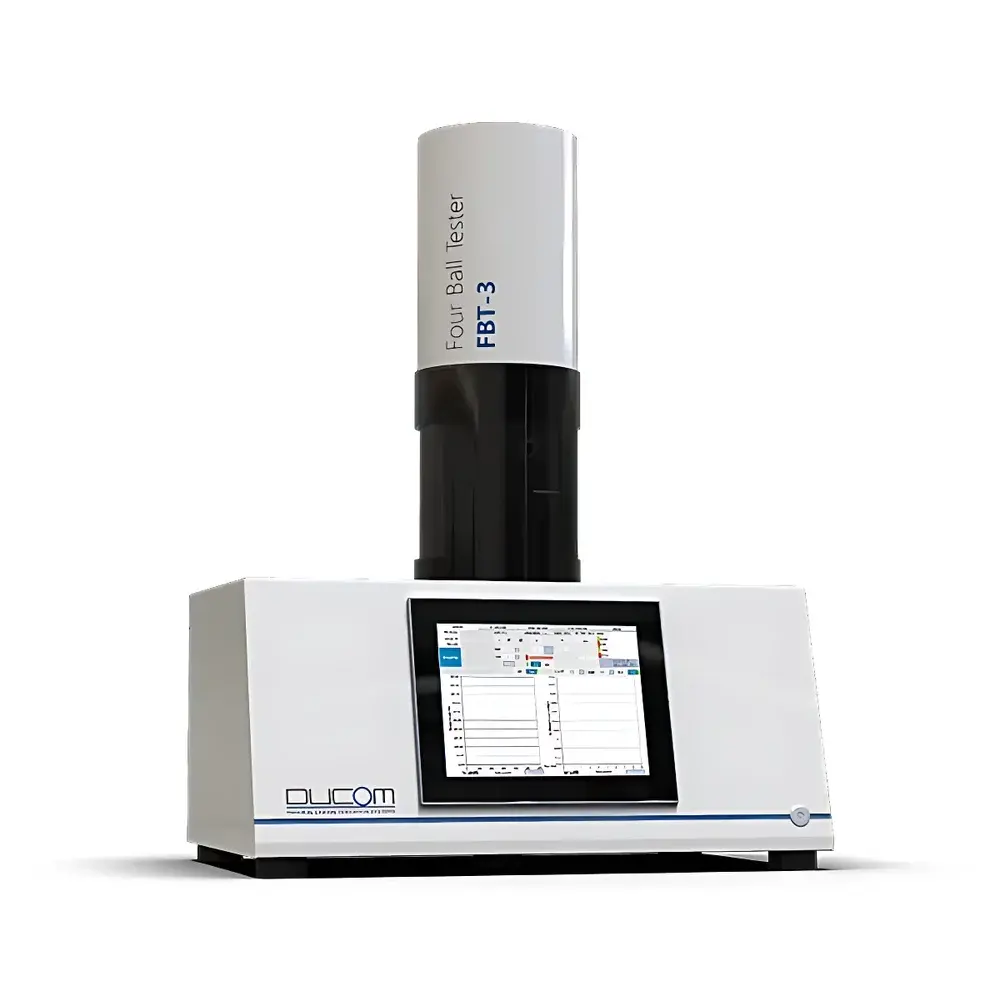
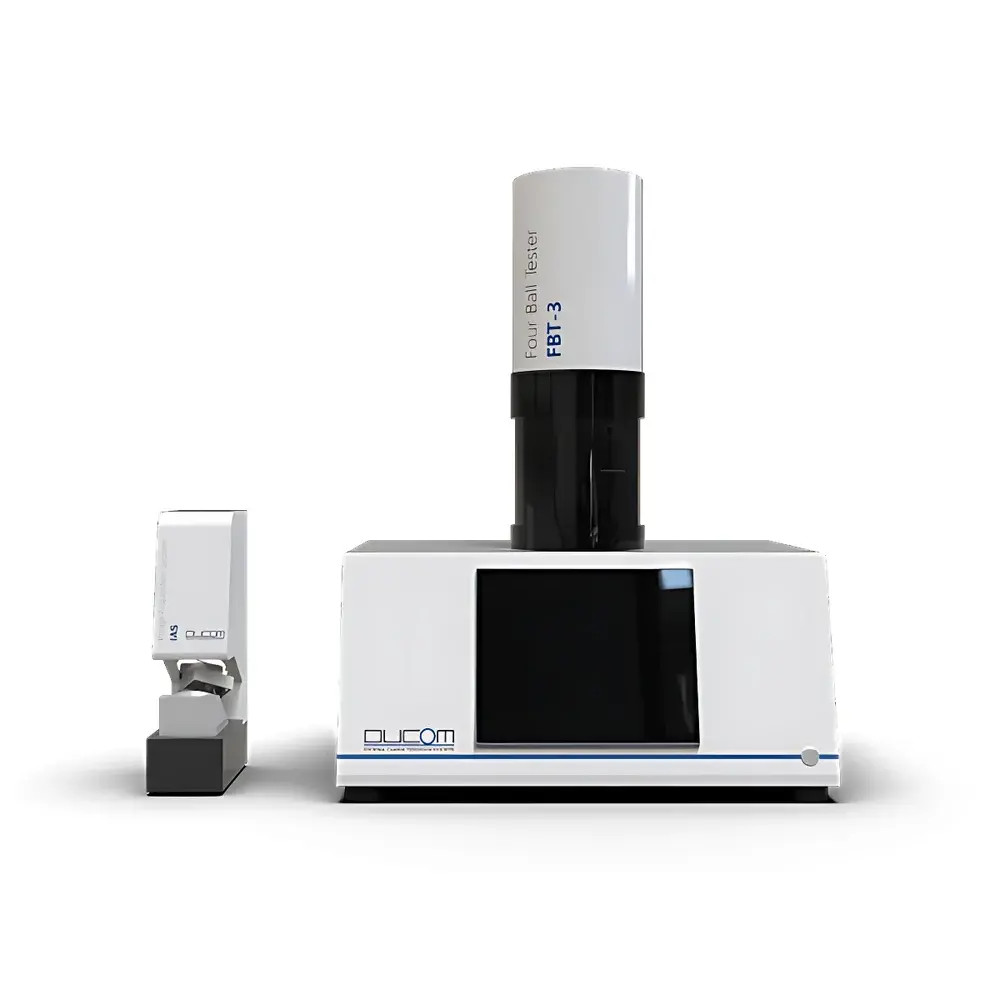
Ducom FBT-3 Four-Ball Tribological Tester
| Brand | Ducom |
|---|---|
| Origin | USA |
| Model | FBT-3 |
| Instrument Type | Four-Ball Friction and Wear Tester |
| Maximum Load Capacity | 10,000 N |
| Load Resolution | 0.5 N |
| Rotational Speed Range | 0–3000 rpm |
| Temperature Range | Ambient to 120 °C (optional high-temp upgrade to 1000 °C) |
| Test Ball Diameter | 12.7 mm |
| Compliance Standards | ASTM D2783, D2596, D2266, D4172, D5183 |
Overview
The Ducom FBT-3 Four-Ball Tribological Tester is a precision-engineered, benchtop instrument designed for standardized evaluation of lubricant performance under controlled sliding and rolling contact conditions. Based on the classical four-ball configuration—three stationary balls held in a triangular cup and one rotating upper ball—the system measures frictional torque, wear scar diameter (WSD), and weld point under defined load, speed, temperature, and time parameters. This configuration enables quantitative assessment of three critical lubricant properties: extreme pressure (EP) resistance, wear prevention (WP), and coefficient of friction (COF). The FBT-3 implements a closed-loop servo-controlled loading system with dual-range capability (high- and low-load modes), ensuring high reproducibility across the full 0–10,000 N load spectrum. Its modular architecture supports both ambient and elevated temperature testing (standard up to 120 °C; optional furnace module extends range to 1000 °C), making it suitable for evaluating thermally stable additives, greases, and next-generation synthetic formulations.
Key Features
- Benchtop footprint with rigid cast-iron base and vibration-damped optical table integration capability
- Automated load application via electro-mechanical actuator; manual override available for method validation
- Direct-drive brushless DC motor with encoder feedback ensures precise speed control (0–3000 rpm, ±0.5% accuracy)
- Digital force transducer with 0.5 N resolution and real-time torque sampling at ≥1 kHz
- Integrated thermal management: PID-controlled oil bath or cartridge heater (ambient to 120 °C); optional molybdenum-furnace assembly for 1000 °C operation
- Onboard safety interlocks: overtemperature cutoff, exhaust airflow monitoring, emergency stop with hardware-based circuit break
- Pre-loaded test methods compliant with ASTM, IP, and CEC standards; customizable method templates via software interface
- Automatic report generation with embedded calibration traceability (NIST-traceable load cell & temperature sensor certificates)
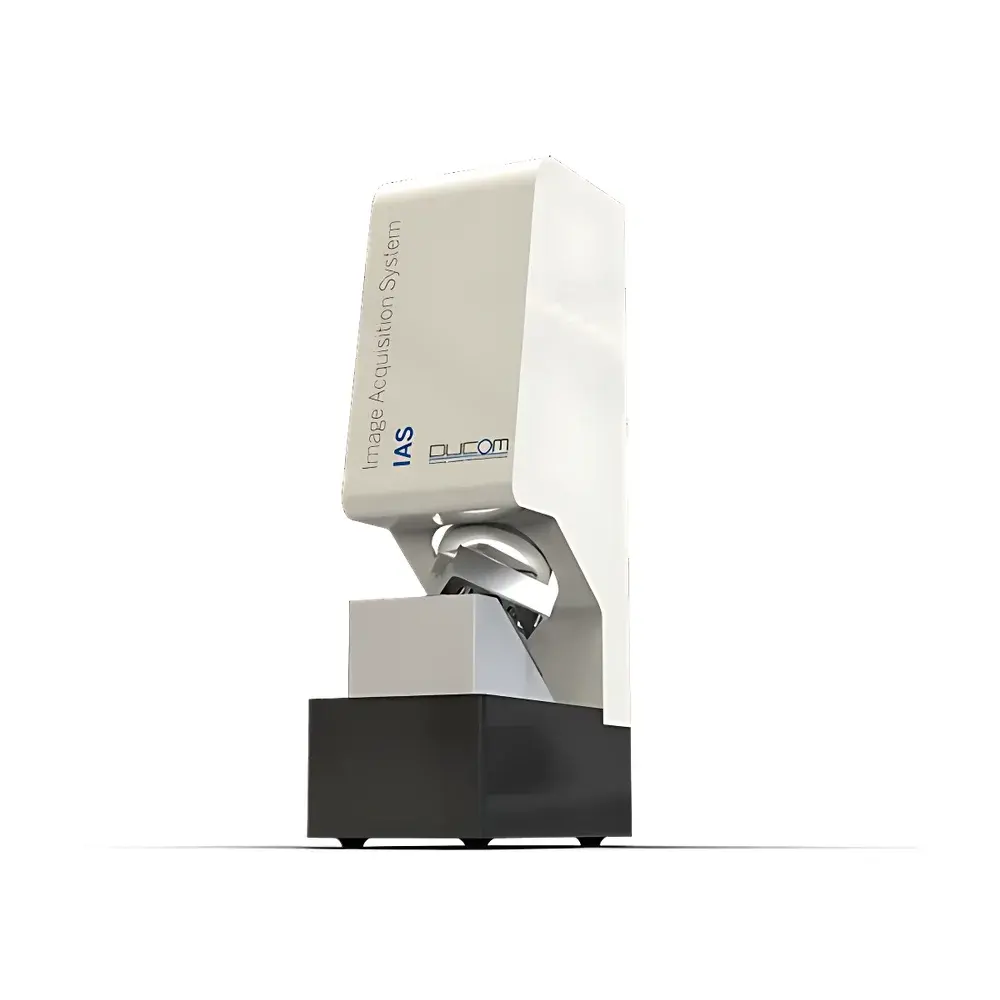
- Optional high-resolution digital imaging module (10 MP, calibrated scale bar) for automated WSD measurement per ASTM D4172
Sample Compatibility & Compliance
The FBT-3 accommodates standard 12.7 mm (½ inch) steel test balls (AISI E52100, 60–66 HRC) and accepts liquid lubricants, greases, pastes, and solid lubricant dispersions. Sample volume requirements are minimal (typically 2–5 mL for liquids, 0.5–2 g for greases), supporting R&D-scale formulation screening. All mechanical and thermal subsystems are designed to meet ISO/IEC 17025 requirements for testing laboratories. The system supports audit-ready documentation per GLP and GMP frameworks, including electronic signatures, change logs, and 21 CFR Part 11-compliant data integrity controls when paired with Ducom’s certified software suite. Optional accessories include corrosion-resistant cups for aggressive chemistries and inert-atmosphere glovebox integration for oxygen-sensitive testing.
Software & Data Management
Control and analysis are managed through Ducom Tribology Suite v4.x—a Windows-based application built on .NET Framework with deterministic real-time acquisition (≤1 ms latency). The software provides synchronized logging of load, torque, RPM, temperature, and time-stamped video (if imaging module installed). Raw data exports to CSV, HDF5, and ASTM-compliant XML formats. Built-in analysis tools calculate EP parameters (load wear index, weld point), WP metrics (mean WSD, standard deviation), and dynamic COF profiles. Calibration data—including load cell linearity curves and thermal drift compensation tables—is stored in encrypted firmware memory and automatically applied during test execution. Audit trails record all user actions, parameter changes, and calibration events with timestamp and operator ID.
Applications
- Development and qualification of anti-wear (AW) and extreme pressure (EP) additives for engine oils, gear oils, and hydraulic fluids
- Comparative wear performance ranking of biobased lubricants vs. mineral/synthetic basestocks
- Thermal stability assessment of grease thickeners and complex soap systems under shear and heat
- QC release testing of finished lubricants against internal specifications aligned with ASTM D2596 (EP) and ASTM D4172 (WP)
- Fundamental tribological research on boundary lubrication mechanisms, tribofilm formation kinetics, and nanomaterial dispersion efficacy
- Supporting regulatory submissions requiring documented repeatability (RSD ≤ 5% for WSD under ASTM D4172 conditions)
FAQ
What ASTM standards does the FBT-3 support out-of-the-box?
The system includes pre-configured test templates for ASTM D2783 (EP), D2596 (EP), D2266 (friction), D4172 (WP), and D5183 (micro-pitting), with automatic pass/fail logic based on standard-defined thresholds.
Can the FBT-3 operate under inert or vacuum conditions?
Yes—optional vacuum chamber integration (up to 10⁻³ mbar) and nitrogen purge ports enable oxidation-sensitive testing; compatible with standard glovebox interfaces.
Is third-party calibration certification included?
Each unit ships with factory calibration certificates traceable to NIST for load, temperature, and rotational speed; annual recalibration services are available through Ducom’s A2LA-accredited metrology lab.
How is wear scar diameter measured without the imaging option?
Standard operation uses an integrated optical microscope with calibrated eyepiece graticule; digital imaging is optional but recommended for automated, operator-independent WSD quantification per ASTM D4172 Annex A1.
Does the FBT-3 support multi-step load ramping protocols?
Yes—the software allows programmable load ramps (linear, step, or custom profile) with dwell times, enabling simulation of transient operational conditions such as startup/shutdown sequences or shock loading events.
Related Products



