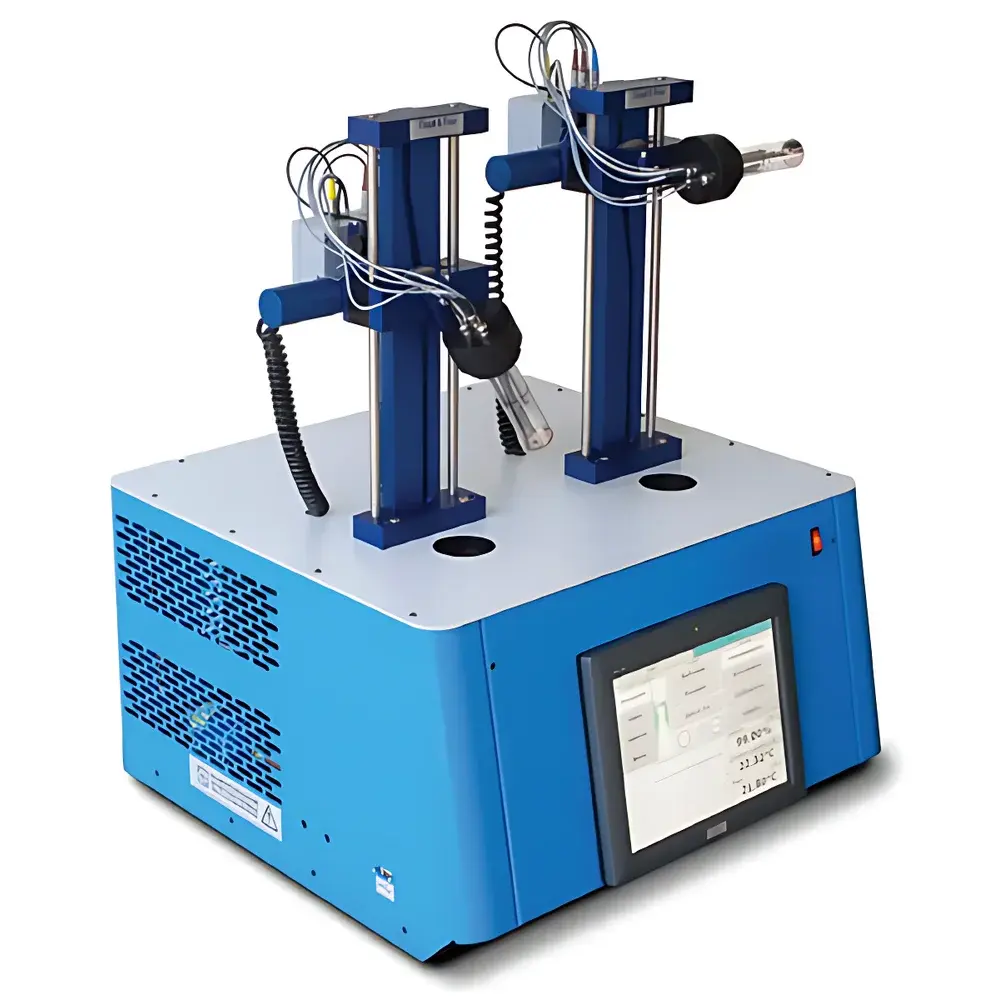
Ducom CPP Automated Cloud Point and Pour Point Tester
| Brand | Ducom |
|---|---|
| Model | CPP |
| Origin | USA |
| Type | Integrated Dual-Function Petroleum Low-Temperature Property Analyzer |
| Temperature Range | –80 °C to +80 °C |
| Temperature Resolution | 0.06 °C |
| Temperature Accuracy | ±0.1 °C (PT100 Class A) |
| Cooling System | Single-stage (to –40 °C) or Dual-stage (to –80 °C), CFC-free motor-compressor |
| Detection Methods | Cloud Point — coaxial infrared optical pulse detection |
| Compliance | ASTM D2500, D5771–D5773, D97, D5853, D5950 |
| Power Supply | 220 V ±15 %, 50–60 Hz or 115 V ±15 %, 60 Hz |
| Dimensions (W×D×H) | 66 × 60 × 80 cm |
| Weight | 60 kg (max 6-test-head configuration) |
| Interface | 12″ integrated high-resolution TFT/LCD touch-panel PC |
Overview
The Ducom CPP Automated Cloud Point and Pour Point Tester is an engineered solution for precise, standardized low-temperature performance evaluation of petroleum-based fluids—including crude oil, distillates, biodiesel blends, lubricants, and fuel additives. It operates on two distinct physical principles: cloud point determination via infrared optical transmittance monitoring under controlled stepwise or linear cooling, and pour point assessment through dynamic viscosity transition detection using a calibrated PT100 temperature probe and automated mechanical sample reorientation. The instrument conforms to the thermodynamic and kinetic requirements defined in major international test standards, enabling laboratories to meet regulatory, quality control, and product specification obligations under ASTM, ISO, IP, and DIN EN frameworks. Its dual-function architecture eliminates cross-instrument calibration drift and inter-method variability—critical for comparative analysis across batches, formulations, or supply chains.
Key Features
- Integrated dual-parameter testing platform supporting simultaneous or independent cloud point and pour point determinations in a single instrument footprint.
- High-fidelity temperature control system featuring a CFC-free, dual-stage motor-compressor capable of reaching –80 °C with programmable cooling profiles (stepwise, linear, or constant-rate), compliant with ASTM D5771–D5773 and IP 444–446.
- Optical cloud point detection based on coaxial infrared light pulse transmission, minimizing scattering artifacts and ensuring reproducible onset detection at sub-degree resolution.
- Pour point measurement utilizing a precision PT100 Class A sensor coupled with a servo-driven robotic arm that tilts the test jar at defined intervals—fully automating the visual inspection protocol per ASTM D97 and D5950.
- 12-inch industrial-grade touch-panel PC with embedded firmware for method selection, real-time curve visualization, result validation, and audit-ready data logging.
- Robust safety architecture including compressor pressure regulation, thermal cutoffs per cooling/heating zone, internal overload protection, and environmental operation limits (≤35 °C ambient, ≤80 % RH).
Sample Compatibility & Compliance
The CPP accommodates standard ASTM/IP sample volumes (typically 30–50 mL) in ASTM D97/D2500-compliant cylindrical glass jars. It supports a broad matrix of hydrocarbon-based liquids—from paraffinic diesel and kerosene to esterified biodiesel (B100), synthetic lubricant base stocks, and multifunctional additive packages. All measurement protocols are traceable to NIST-calibrated reference materials and validated against certified reference oils. The system meets GLP/GMP documentation requirements with timestamped, user-identified test records, electronic signatures, and configurable retention policies. Full compliance with FDA 21 CFR Part 11 is enabled via optional software modules supporting role-based access control, audit trails, and electronic record integrity verification.
Software & Data Management
The embedded operating system provides intuitive workflow navigation, customizable test templates, and real-time plotting of temperature vs. optical signal (cloud point) or tilt-angle response (pour point). Raw data—including time-stamped temperature readings, detector voltage outputs, and mechanical actuation logs—are stored in structured CSV/Excel-compatible formats. Exported datasets retain full metrological context: calibration certificate IDs, operator credentials, environmental conditions, and deviation flags. Optional network integration allows centralized data aggregation into LIMS environments via secure HTTPS or OPC UA protocols. All software updates are digitally signed and version-controlled, with change logs archived for regulatory review.
Applications
- Refinery QC labs verifying cold flow properties of middle distillates prior to blending or shipment.
- Biodiesel producers validating cloud point suppression efficacy of cold-flow improvers (CFIs) per ASTM D6751 and EN 14214.
- Lubricant OEMs assessing pour point depression in synthetic gear oils under ISO 6743-6 specifications.
- Contract testing laboratories performing third-party certification for API, SAE, or OEM-specification compliance.
- Research institutions studying wax crystallization kinetics and phase separation behavior in complex hydrocarbon mixtures.
- Regulatory agencies conducting surveillance testing of fuel quality parameters in accordance with national petroleum standards.
FAQ
Does the CPP support both manual and automated test initiation?
Yes—the system permits either touchscreen-initiated runs or remote triggering via Ethernet-connected host systems using Modbus TCP or custom REST API endpoints.
Can the instrument be configured for unattended overnight testing?
Absolutely. With its integrated thermal stability management and auto-shutdown safeguards, the CPP supports up to six concurrent tests with full data capture and error logging without operator intervention.
Is calibration verification required before each test series?
No—routine calibration verification is performed daily or per shift using certified reference oils; full recalibration follows ASTM D4057 guidelines and is recommended annually or after major maintenance.
What sample preparation steps are necessary?
Samples must be filtered (≤5 µm), degassed if volatile, and equilibrated to room temperature prior to loading; no derivatization or solvent addition is required.
How does the CPP handle non-standard or highly viscous samples?
The robotic tilt mechanism accommodates viscosities up to 100,000 cSt at test temperature; optional pre-heating modules ensure uniform thermal history for waxy or asphaltic feeds.