
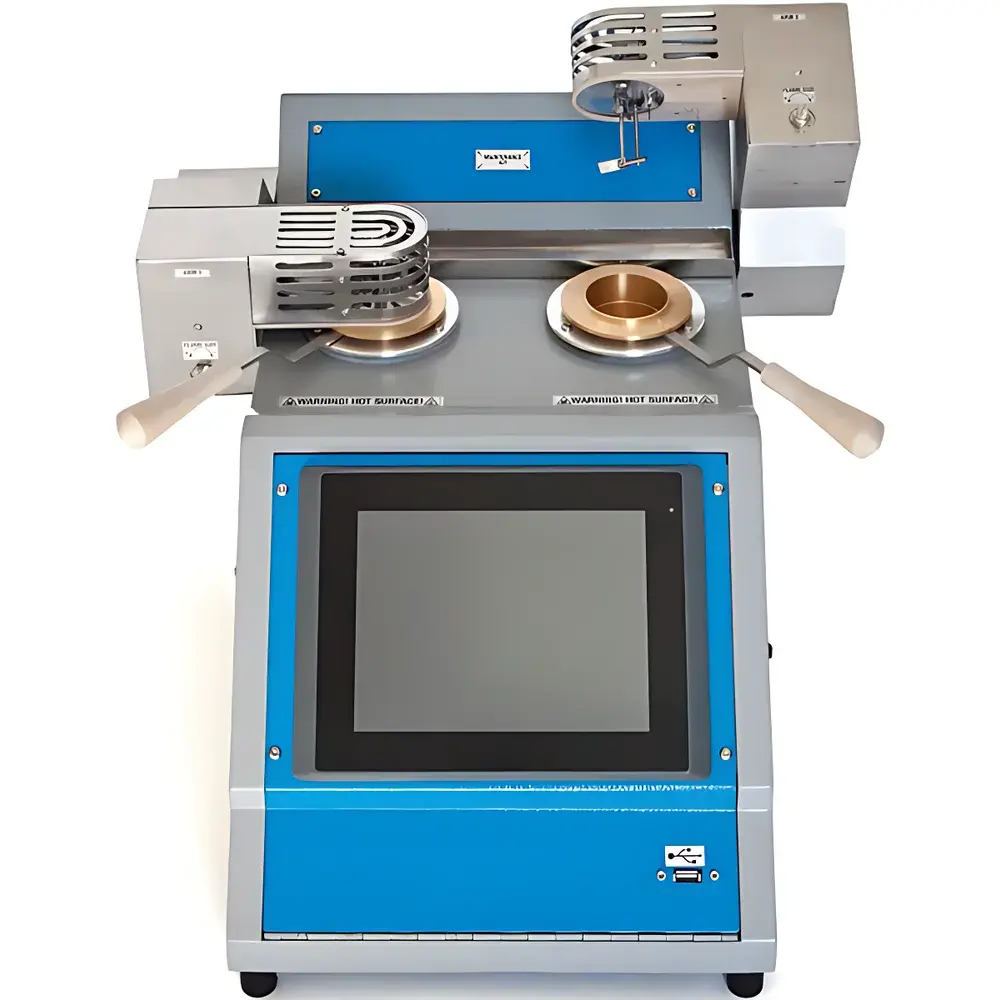
Ducom ABEL Flash Point Tester AFP1
| Brand | Ducom |
|---|---|
| Origin | USA |
| Model | AFP1 |
| Test Method | Closed Cup (ABEL) |
| Operation Mode | Fully Automatic |
| Applicable Standards | EN 924, IP 170, IP 491, IP 492, ISO 1516, ISO 3679, ISO 13736 |
| Temperature Range | −50 °C to +100 °C |
| Temperature Accuracy | ±0.1 °C |
| Temperature Resolution | 0.06 °C |
| Repeatability | ±0.1 °C |
| Sensor | Class A PT100 |
| Ignition System | Dual electric spark igniter with ionization flame detection |
| Sample Cup | Brass, ASTM-compliant geometry |
| Safety Features | Thermal cut-off, automatic shutter, integrated flame detection |
| Dimensions (W×D×H) | 310 × 470 × 520 mm |
| Weight | 27 kg |
| Power Supply | 220 V ±15 %, 50–60 Hz or 115 V ±15 %, 60 Hz |
| Display | 8.4″ TFT/LCD touchscreen interface |
| Data Output | Excel-compatible CSV export |
| Compliance | GLP/GMP-ready audit trail, 21 CFR Part 11–compatible software architecture |
Overview
The Ducom ABEL Flash Point Tester AFP1 is a precision-engineered, fully automated closed-cup flash point analyzer designed for rigorous compliance with international petroleum and chemical testing standards. Based on the ABEL closed-cup principle—where sample vapor concentration is equilibrated under controlled temperature conditions before ignition—the AFP1 delivers high reproducibility in flash point determination across flammable and combustible liquids with flash points ranging from −18 °C to +71 °C. Its thermally stable brass test cup, dual electric spark ignition system, and real-time ionization-based flame detection ensure unambiguous endpoint identification without subjective visual interpretation. The instrument operates within a broad ambient-compensated temperature range (−50 °C to +100 °C), enabling reliable testing of low-volatility solvents, kerosene fractions, adhesives, coatings, and industrial chemicals under standardized thermal ramping protocols.
Key Features
- Fully automated operation with integrated 8.4″ high-resolution TFT/LCD touchscreen interface—no external PC required
- Class A PT100 temperature sensor with 0.06 °C resolution and certified ±0.1 °C accuracy across full operating range
- Dual electric spark ignition system coupled with ionization flame detector for objective, non-subjective flash event confirmation
- Motorized shutter mechanism synchronized precisely with ASTM/ISO/IP timing requirements for closed-cup equilibrium phases
- Brass test cup conforming to dimensional specifications defined in IP 170, ISO 13736, and EN 924
- Thermal cut-off protection and overtemperature lockout for operator and instrument safety
- Modular firmware architecture supporting method-specific parameter presets for EN 924, IP 170, IP 491, IP 492, ISO 1516, ISO 3679, and ISO 13736
- Onboard data storage with timestamped results exportable as CSV files compatible with Microsoft Excel and LIMS integration
Sample Compatibility & Compliance
The AFP1 accommodates liquid samples including hydrocarbon solvents, mineral oils, synthetic lubricants, resin solutions, and solvent-borne adhesives. Its closed-cup design minimizes vapor loss and ensures consistent headspace saturation—critical for accurate flash point assessment of volatile organic compounds. All operational sequences adhere strictly to the procedural constraints of EN 924 (solvent- and solvent-free adhesives), IP 170 (ABEL closed-cup method), IP 491/IP 492 (equilibrium closed-cup variants), and corresponding ISO standards (ISO 1516, ISO 3679, ISO 13736). Instrument validation documentation supports IQ/OQ/PQ protocols, and firmware includes configurable audit trail logging compliant with FDA 21 CFR Part 11 requirements for regulated laboratories operating under GLP or GMP frameworks.
Software & Data Management
The embedded control software provides intuitive method selection, real-time temperature profiling, and dynamic adjustment of heating rate per selected standard. Each test generates a complete metadata record—including operator ID, sample ID, ambient pressure, calibration status, and raw temperature/time series—stored locally with optional network upload. Exported CSV files retain column headers aligned with ISO/IEC 17025 reporting conventions. Audit trail functionality logs all user actions (e.g., method edits, calibration events, result overrides) with immutable timestamps and operator authentication. Software updates are delivered via secure USB or Ethernet, maintaining version traceability for regulatory review.
Applications
- Quality control of petroleum distillates (e.g., kerosene, diesel, naphtha) per IP 170 and ISO 13736
- Flammability classification of industrial solvents and cleaning agents in accordance with EN 924 and CLP Regulation (EC) No 1272/2008
- R&D screening of formulation volatility in coatings, inks, and adhesive systems
- Safety assessment of bio-based fuels and synthetic esters under ISO 3679 rapid equilibrium protocols
- Regulatory submission testing for transportation hazard classification (UN TDG, ADR/RID/IMDG)
- Third-party certification labs requiring ISO/IEC 17025-accredited flash point measurement capability
FAQ
What standards does the AFP1 support out-of-the-box?
The AFP1 is pre-configured for EN 924, IP 170, IP 491, IP 492, ISO 1516, ISO 3679, and ISO 13736. Custom method templates can be added via firmware update upon request.
Is the instrument suitable for low-flash-point solvents below 0 °C?
Yes—the AFP1 achieves stable sub-zero operation down to −50 °C using active Peltier-assisted cooling (optional accessory) or ambient-controlled laboratory environments, ensuring reliable testing of acetone, diethyl ether, and similar highly volatile materials.
How is calibration verified and maintained?
The system supports daily verification using certified reference materials (e.g., n-decane, heptane, tetradecane) traceable to NIST or UKAS. Built-in diagnostics monitor PT100 linearity, shutter timing, and ignition energy consistency.
Can test data be integrated into a laboratory information management system (LIMS)?
Yes—CSV exports include structured fields compatible with common LIMS parsers; optional RS-232 or Ethernet API enables direct instrument-to-LIMS bidirectional communication.
Does the AFP1 meet requirements for pharmaceutical excipient testing?
While not specifically validated for USP or , its ISO 13736 compliance and 21 CFR Part 11–ready software architecture support adoption in pharma-adjacent QC labs performing flammability screening of solvents used in manufacturing.




