
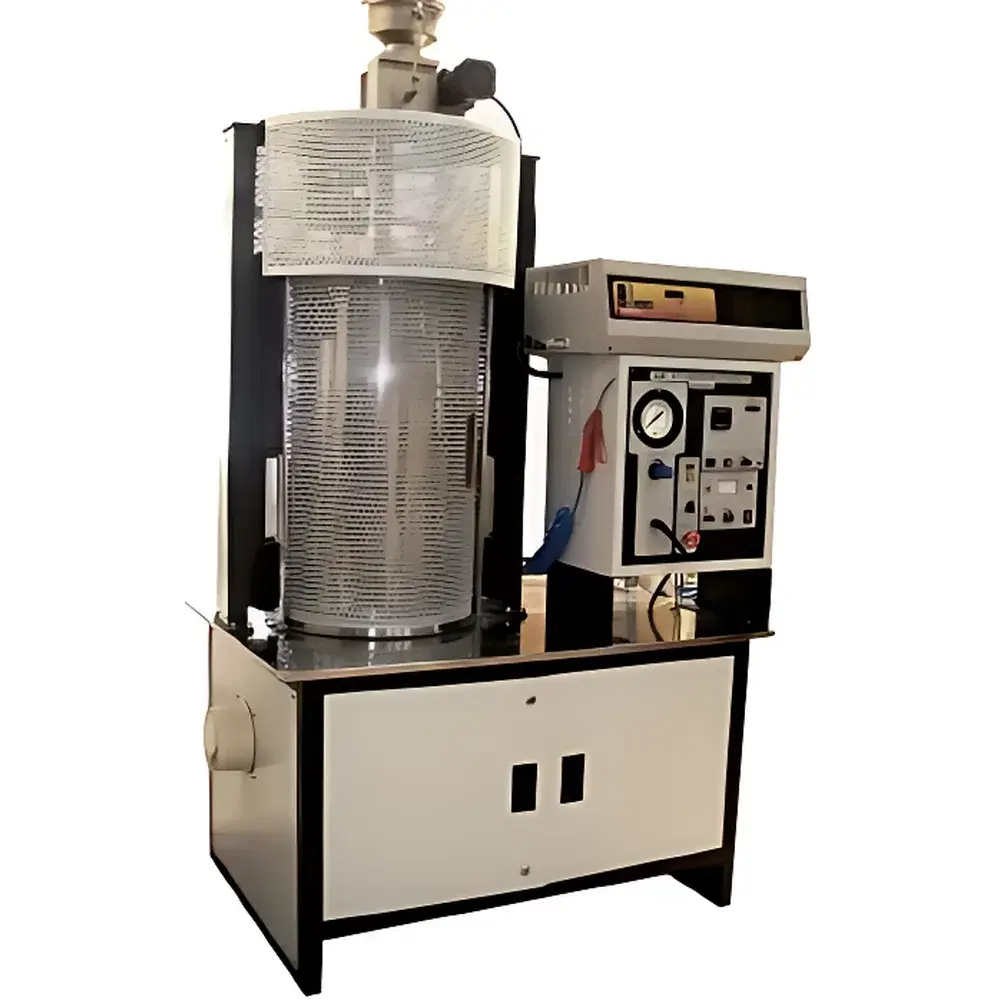
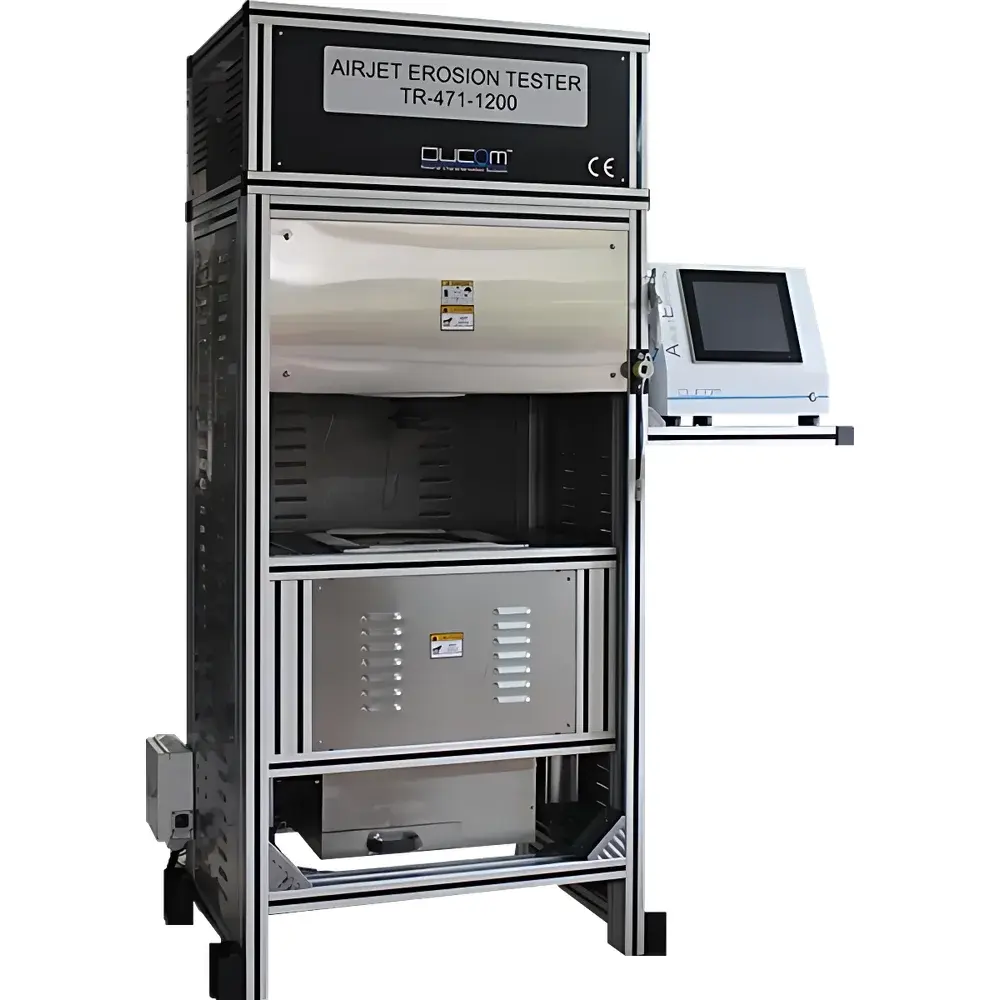
Ducom AJET Air Jet Erosion Tester (ASTM G76 Compliant)
| Brand | Ducom |
|---|---|
| Origin | USA |
| Model | AJET |
| Instrument Type | High-Temperature Tribological Tester |
| Max Friction Force | 2000 N |
| Friction Force Resolution | 0.1 mN |
| Max Operating Temperature | 1000 °C |
| Erosion Velocity Range | 30–150 m/s |
| Abrasive Feed Rate | 1–5 g/min (nominal 200-mesh Al₂O₃) |
| Impact Angles | 15°, 30°, 45°, 60°, 75°, 90° (customizable with upgraded fixture) |
| Nozzle Orifice Diameter | 1.5 mm (optional 2–3 mm for ≥800 °C operation) |
| Specimen Dimensions | 25 × 25 × 5 mm (custom sizes available) |
| Abrasive Hopper Capacity | 2 L |
Overview
The Ducom AJET Air Jet Erosion Tester is an ASTM G76-compliant tribological testing system engineered to quantify solid particle erosion wear under controlled high-velocity gas-suspended abrasive conditions. It operates on the principle of impingement erosion: accelerated abrasive particles—typically angular alumina (200 mesh)—are entrained in a high-pressure carrier gas (e.g., air or nitrogen), directed through a precision nozzle onto a stationary or rotating test specimen. The resulting mass loss, measured gravimetrically before and after exposure, is converted to volumetric wear rate (mm³/g or mm³/kJ) to enable material ranking and service life prediction. Designed for R&D and quality assurance laboratories in aerospace, power generation, and thermal processing industries, the AJET replicates real-world degradation mechanisms observed in gas turbine blades, boiler tubes, heat exchanger surfaces, and refractory linings subjected to fly ash, sand, or combustion byproduct impingement.
Key Features
- Full compliance with ASTM G76 – Standard Test Method for Determining the Resistance of Materials to Solid Particle Erosion Using Gas Jets
- Integrated high-temperature furnace module enabling continuous operation up to 1000 °C, with independent thermocouple monitoring and PID-controlled temperature stability (±2 °C)
- Dual-mass-flow instrumentation for precise, independent regulation of carrier gas flow and abrasive feed rate—critical for reproducible kinetic energy delivery
- Modular specimen stage with quick-release clamping mechanism; accommodates standard 25 × 25 × 5 mm coupons or custom geometries upon request
- Interchangeable hardened tungsten carbide nozzles (1.5 mm nominal orifice; optional 2–3 mm variants rated for >800 °C service)
- Motorized angular adjustment stage for impact angle selection (15°–90° in 15° increments); extended range achievable via fixture modification per user specification
- Onboard digital mass loss logging synchronized with test duration, velocity, temperature, and abrasive flux—exportable as CSV for traceability
Sample Compatibility & Compliance
The AJET supports metallic alloys (e.g., Ni-based superalloys, stainless steels), ceramics (Al₂O₃, SiC, ZrO₂), thermal barrier coatings (TBCs), and polymer composites. Specimens require minimal surface preparation—flatness tolerance ≤ 5 µm and parallelism ≤ 10 µm are recommended for consistent impact geometry. All test protocols adhere to ASTM G76 requirements for jet alignment verification, abrasive characterization (particle size distribution per ISO 13320, hardness per ASTM E384), and environmental control documentation. The system meets GLP audit readiness criteria: full electronic test logs include operator ID, calibration timestamps, instrument configuration snapshots, and raw gravimetric data with uncertainty propagation per ISO/IEC 17025 guidelines.
Software & Data Management
Control and acquisition are managed via Ducom’s ErosionSuite™ v4.2 software—a Windows-based application compliant with FDA 21 CFR Part 11 for electronic records and signatures. The interface provides real-time visualization of erosion rate (mg/min), cumulative mass loss, and thermal profile overlays. All parameters—including velocity setpoint, gas pressure, feed rate, temperature ramp rate, and dwell time—are programmable in multi-step test sequences. Audit trails record every parameter change with user ID, timestamp, and reason code. Export formats include .xlsx (for statistical analysis in Minitab or JMP), .tdms (NI-compatible), and PDF test reports embedding digital signatures and calibration certificates. Raw data files are SHA-256 hashed to ensure integrity during archival or regulatory submission.
Applications
- Ranking candidate materials for compressor blade leading-edge protection in aviation gas turbines
- Evaluating erosion resistance of FeCrAl- and Cr₃C₂-NiCr-coated boiler tubes under coal-fired flue gas conditions
- Validating thermal spray coating adhesion and microstructural stability at elevated temperatures (600–1000 °C)
- Correlating erosion rate with particle kinetic energy (½mv²) and impact angle dependence for model validation (e.g., Finnie, Bitter, or Neilson-Gilchrist frameworks)
- Supporting ASTM WK72855 revision efforts by generating interlaboratory comparison datasets under standardized G76 Annexes
- Life-cycle cost modeling for refractory replacement intervals in waste-to-energy incinerators
FAQ
Does the AJET support inert gas environments (e.g., N₂ or Ar) for oxidation-sensitive materials?
Yes—the gas supply manifold accepts regulated N₂, Ar, or synthetic air; optional O₂ analyzers and dew point sensors can be integrated for controlled oxidizing atmospheres.
Can erosion tests be run under vacuum or reduced pressure?
No—the ASTM G76 methodology requires atmospheric or pressurized gas jet dynamics; vacuum operation is outside scope and not supported.
What calibration standards are provided with the system?
NIST-traceable load cell calibration certificate (2000 N range), Class I analytical balance verification report (0.01 mg resolution), and thermocouple calibration certificate (Type K, -50 to 1300 °C).
Is remote diagnostics and firmware updates available?
Yes—via secure TLS-encrypted Ethernet connection; Ducom Remote Assist enables authorized engineers to perform health checks and update firmware without onsite visits.
How is abrasive particle size distribution verified prior to testing?
Users are required to provide sieve analysis (ASTM E11) or laser diffraction (ISO 13320) reports for each abrasive batch; the AJET includes a certified 200-mesh Al₂O₃ reference standard for routine verification.



