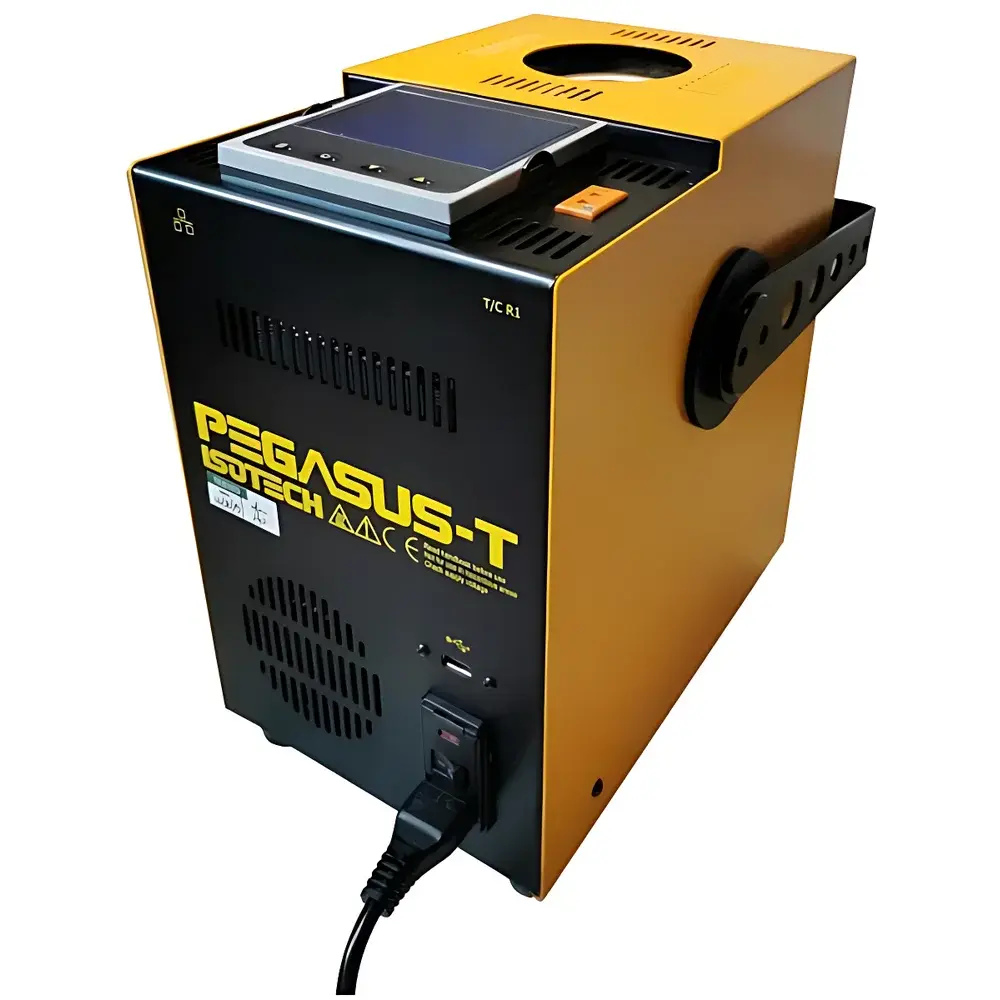
ISOTECH Pegasus-T High-Temperature Short-Stem Sensor Calibration Dry-Block Furnace
| Brand | ISOTECH |
|---|---|
| Origin | United Kingdom |
| Model | Pegasus-T |
| Instrument Type | Dry-Block Calibrator |
| Temperature Range | 150 °C to 1100 °C |
| Stability | ±0.05 °C @ 150 °C |
| Temperature Resolution | 0.1 °C |
| Calibration Well Dimensions | Ø33.5 mm × 130 mm depth |
| Interface | Ethernet & USB |
Overview
The ISOTECH Pegasus-T is a purpose-engineered high-temperature dry-block calibration furnace designed specifically for the metrological validation of short-stem temperature sensors—particularly those with limited immersion depth, such as automotive exhaust gas temperature (EGT) sensors, turbine blade thermocouples, and compact industrial RTDs. Unlike conventional dry-well calibrators optimized for deep immersion probes, the Pegasus-T addresses the fundamental challenge of axial temperature gradients in short-stem devices by integrating a multi-zone thermal control architecture. Its core principle relies on precise spatial temperature regulation within the heated block, enabled by an advanced digital PID controller that dynamically selects from multiple embedded reference sensors located at discrete depths (e.g., 25 mm, 50 mm, 75 mm, and 100 mm). This architecture ensures that the controlled setpoint corresponds directly to the actual measurement zone of the device under test (DUT), minimizing stem conduction error and improving traceable accuracy per ISO/IEC 17025 requirements.
Key Features
- Multi-depth reference sensor array enabling user-selectable control point—ideal for sensors with immersion lengths from 15 mm to 90 mm
- External reference thermocouple input mode: supports real-time closed-loop control using a calibrated external thermocouple positioned at the same depth as the DUT
- High-stability heating block constructed from proprietary high-temperature alloy with optimized thermal mass distribution for minimal drift and rapid equilibration
- 0.1 °C display resolution and verified stability of ±0.05 °C at 150 °C and ±0.08 °C at 1100 °C—validated per ASTM E644 and IEC 60584-2
- Dual communication interfaces: isolated USB 2.0 and IEEE 802.3 Ethernet for remote operation, scripting, and integration into automated calibration management systems
- Modular well insert design: custom-machined aluminum or Inconel inserts available for non-standard probe geometries (e.g., flanged, threaded, or tapered short-stem configurations)
Sample Compatibility & Compliance
The Pegasus-T accommodates short-stem thermocouples (Types B, R, S, K, N, E, J, T), thin-film RTDs (Pt100, Pt1000), and semiconductor-based temperature transducers up to Ø6.5 mm diameter and 130 mm insertion depth. Its 33.5 mm-diameter calibration well provides sufficient thermal mass to maintain uniformity across the working zone while allowing adequate clearance for airflow-sensitive or shielded probes. The system complies with key international standards for calibration equipment, including ISO 17025:2017 (clause 6.4.3 on equipment suitability), EURAMET cg-18 (Guidelines on Dry-Block Calibrators), and supports full audit trails required under FDA 21 CFR Part 11 when operated with compliant calibration software. All factory verification reports include NIST-traceable uncertainty budgets referenced to ITS-90.
Software & Data Management
The Pegasus-T is fully compatible with ISOTECH’s CalSoft™ v4.x calibration suite, which provides automated calibration sequences, real-time deviation plotting, uncertainty calculation per GUM (JCGM 100:2008), and electronic signature support for GLP/GMP environments. Data export options include CSV, XML, and PDF formats conforming to ISO/IEC 17025 reporting requirements. Remote control via SCPI commands over TCP/IP enables seamless integration into enterprise-level metrology asset management platforms (e.g., MET/TEAM, LabWare LIMS). Firmware updates are delivered via secure HTTPS and include cryptographic signature verification.
Applications
- Primary calibration of short-stem thermocouples used in automotive exhaust aftertreatment systems (SCR, DPF monitoring)
- Factory acceptance testing (FAT) of aerospace turbine inlet temperature sensors
- Periodic verification of process sensors in heat treatment furnaces and sintering ovens
- Research-grade characterization of novel micro-thermocouple designs in materials science laboratories
- Supporting UKAS and A2LA-accredited calibration laboratories performing accredited short-stem sensor calibrations
FAQ
What is the minimum recommended immersion depth for accurate calibration using the Pegasus-T?
For optimal thermal equilibrium and minimized stem conduction error, ISOTECH recommends a minimum immersion depth of 15 mm. The system’s multi-sensor architecture allows stable control even at this depth, provided the selected reference sensor is aligned with the DUT’s active junction location.
Can the Pegasus-T be used for calibrating two-wire RTDs with lead-wire compensation?
Yes—the instrument supports 2-, 3-, and 4-wire resistance measurements when paired with an external precision resistance bridge (e.g., ISOTECH 9100 series), and its software includes configurable lead-wire correction algorithms per IEC 60751.
Is the calibration well insert interchangeable between different temperature ranges?
No—each insert (aluminum for ≤650 °C, Inconel 600 for ≤1100 °C) is thermally optimized and mechanically rated for its designated range. Mixing inserts invalidates traceability and voids warranty.
Does the Pegasus-T meet requirements for ISO/IEC 17025 accreditation?
Yes—when operated within specified environmental conditions (23 ±2 °C ambient, <60% RH), and with documented uncertainty budgets, the Pegasus-T satisfies clause 6.4.3 and 6.5.2 of ISO/IEC 17025:2017 for calibration equipment used in accredited laboratories.