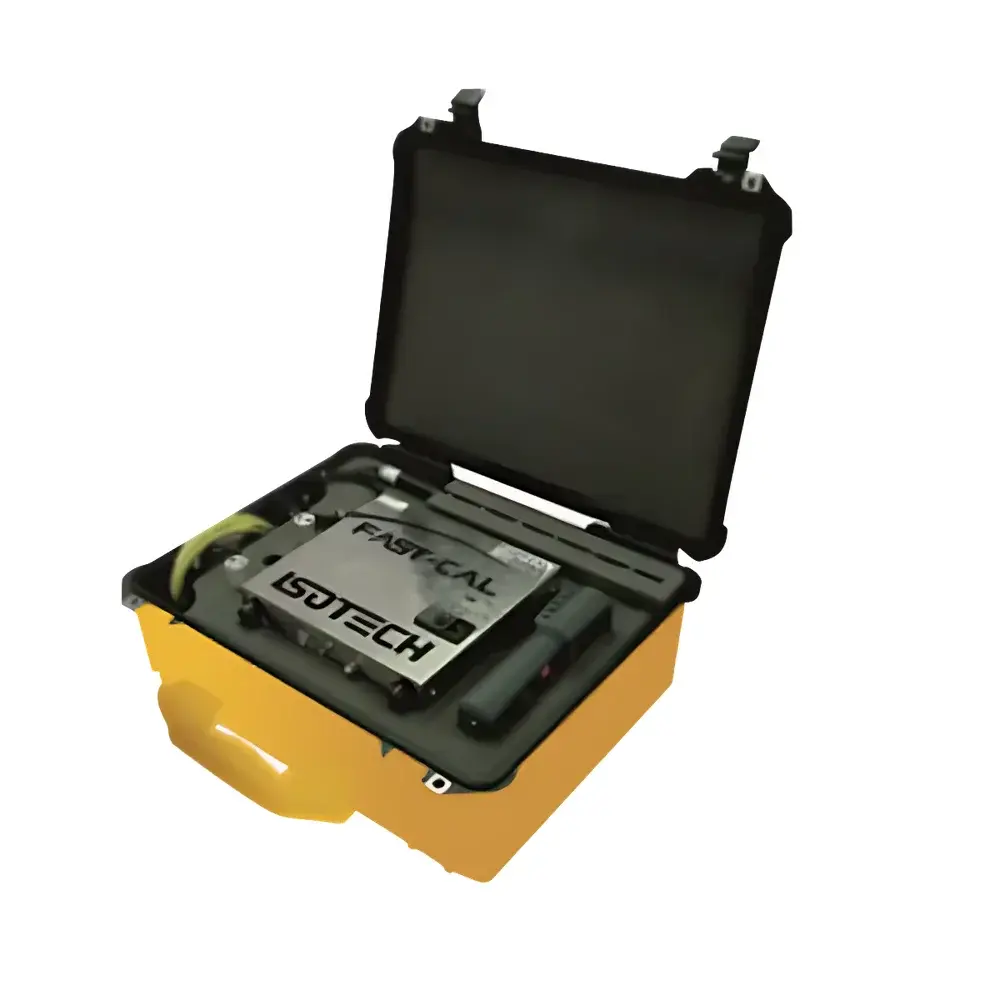
ISOTECH Fast Temperature Calibration System (TTI-10 + Fast Cal Dry-Well)
| Brand | ISOTECH |
|---|---|
| Origin | United Kingdom |
| Product Type | Portable Temperature Verification and Calibration System |
| Core Components | TTI-10 Dual-Channel Precision Thermometer & Fast Cal Series Dry-Block Calibrator |
| Measurement Accuracy | ±10 mK (±0.01 °C) |
| Resolution | 0.001 °C |
| Data Logging Capacity | Up to 4,000 points (min/max/avg) |
| Sampling Interval | 1 s to 30 min |
| Interface | USB 2.0 |
| Software Compatibility | ISOTECH Cal Notepad v3.x |
| Compliance | Designed for traceable calibration per ISO/IEC 17025 requirements |
| Portability | Handheld thermometer + lightweight dry-well (<4.5 kg typical) |
Overview
The ISOTECH Fast Temperature Calibration System integrates the TTI-10 dual-channel precision thermometer with a Fast Cal series dry-block calibrator to deliver a portable, field-deployable solution for temperature sensor verification and calibration in industrial, metrology, and quality assurance environments. Engineered for high reproducibility and traceable measurement, the system operates on the principle of comparative calibration: the dry-well establishes a stable, uniform thermal environment across its well bore, while the TTI-10—equipped with two independent Pt100 or Pt1000 inputs—simultaneously monitors reference and unit-under-test (UUT) sensors with resolution down to 0.001 °C and total uncertainty of ±10 mK (±0.01 °C) at key fixed points (e.g., 0 °C, 100 °C). This architecture eliminates reliance on external ice baths or liquid baths, significantly reducing setup time and environmental sensitivity while maintaining metrological integrity aligned with ISO/IEC 17025 clause 6.5.2 (equipment calibration).
Key Features
- Dual-channel TTI-10 thermometer with simultaneous real-time comparison of reference and UUT sensors—enabling direct deviation calculation without post-processing.
- High-stability Fast Cal dry-block calibrator featuring rapid thermal equilibration (≤15 min from ambient to 150 °C), low axial gradient (<0.02 °C over 100 mm depth), and lateral uniformity <0.03 °C across multiple probe positions.
- Configurable data logging: records min, max, and average values across up to 4,000 measurement cycles; sampling interval programmable from 1 second to 30 minutes via front-panel interface or Cal Notepad software.
- USB 2.0 interface supports bidirectional communication—enabling firmware updates, real-time streaming, and synchronized timestamped data export in CSV and XML formats.
- Ruggedized handheld design (IP54-rated enclosure) with backlit graphical LCD, battery operation (>12 h continuous use), and integrated thermistor cold-junction compensation for thermocouple support (optional).
Sample Compatibility & Compliance
The system accommodates standard industrial temperature sensors including RTDs (Pt100, Pt1000, Ni120), thermistors (10 kΩ, 100 kΩ), and thermocouples (Types J, K, T, E, N, R, S, B) via configurable input modules. Probe diameters from 1.5 mm to 13 mm are supported using interchangeable well inserts. All components comply with CE marking directives (2014/30/EU EMC, 2014/35/EU LVD) and meet essential requirements of IEC 61000-4 for electromagnetic immunity. Calibration certificates issued with the system include as-found/as-left data, measurement uncertainty budgets (k=2), and traceability to UKAS-accredited primary standards (NPL). The platform supports audit-ready documentation for GLP, GMP, and FDA 21 CFR Part 11 compliance when used with Cal Notepad’s electronic signature and audit trail features.
Software & Data Management
ISOTECH Cal Notepad v3.x is a Windows-based calibration management application designed specifically for this system. It provides automated test sequence generation (per ASTM E2877-22 or ISO 17025 Annex C), real-time deviation trending, uncertainty propagation modeling, and customizable certificate templates compliant with ISO/IEC 17025, ISO 9001, and ANSI/NCSL Z540-1. All raw data—including timestamps, environmental conditions (optional external humidity/pressure input), and operator ID—are stored with immutable audit trails. Export options include PDF reports with digital signatures, CSV for LIMS integration, and XML for enterprise MES systems. Software validation documentation (IQ/OQ protocols) is available upon request for regulated laboratories.
Applications
This system is deployed across pharmaceutical manufacturing (sterilization cycle validation, cleanroom sensor verification), power generation (turbine bearing temperature monitoring), aerospace MRO (engine sensor recalibration), food processing (HACCP-compliant temperature mapping), and national metrology institutes conducting inter-laboratory comparisons. Its portability enables on-site calibration of distributed sensor networks—such as HVAC duct arrays, reactor vessel thermowells, or warehouse temperature loggers—without requiring equipment disassembly or facility shutdown. In QC labs, it serves as a secondary standard for daily verification of benchtop thermometers and data loggers prior to critical measurements.
FAQ
What is the recommended calibration interval for the TTI-10 and Fast Cal calibrator?
Annual calibration is recommended under normal use; however, interval adjustments may be justified based on risk assessment, usage frequency, and stability history per ISO/IEC 17025 clause 7.7.
Can the system validate thermocouples with cold-junction compensation?
Yes—the TTI-10 includes built-in thermistor-based cold-junction reference with automatic compensation; external CJC modules are optional for enhanced accuracy.
Is the dry-well suitable for calibration below 0 °C?
Fast Cal models with Peltier cooling (e.g., Fast Cal-100C) support ranges from –25 °C to 150 °C; standard resistive-heating models operate from 35 °C to 660 °C.
Does Cal Notepad support multi-user role-based access control?
Yes—administrator, technician, and reviewer roles can be assigned with granular permissions for test execution, report approval, and database modification.
How is measurement uncertainty calculated for a given calibration point?
Cal Notepad applies GUM-compliant uncertainty propagation using contributions from TTI-10 accuracy, dry-well stability, probe immersion depth, and reference standard uncertainty—all documented in the final certificate.