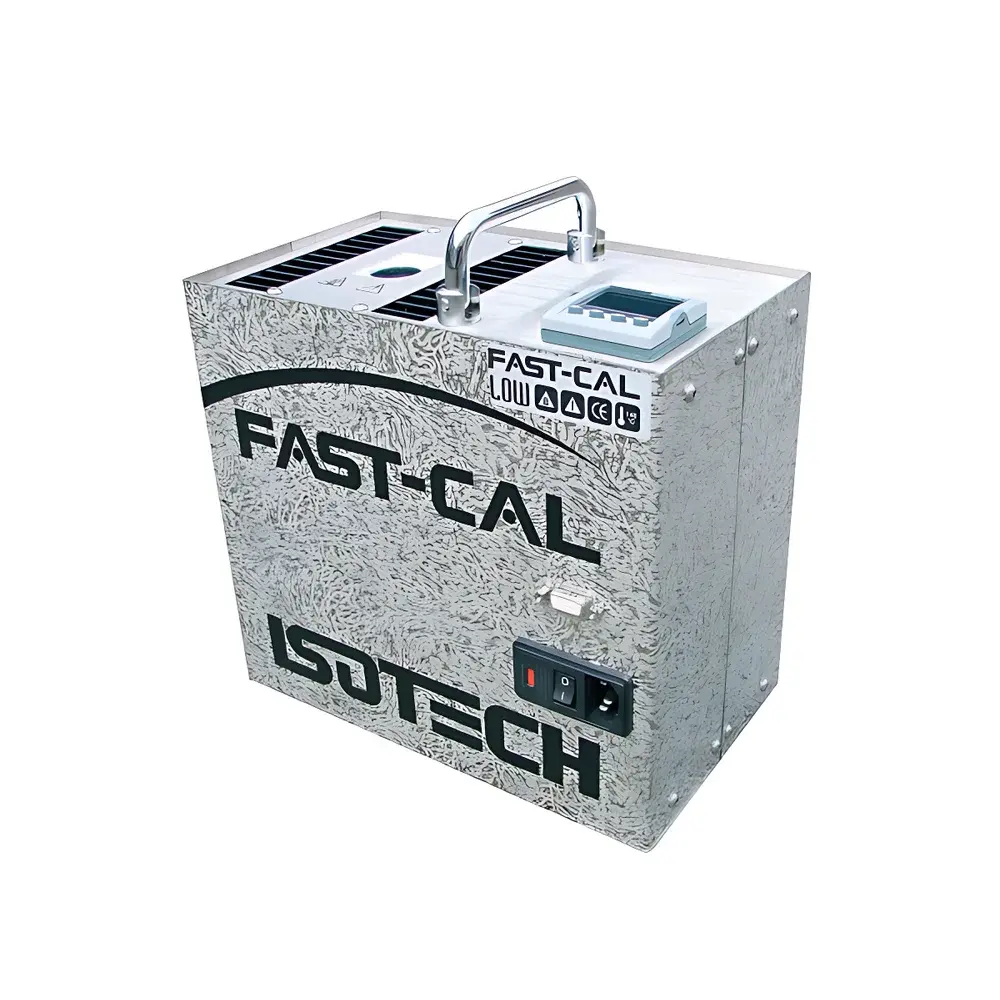
ISOTECH FC Series Portable Dry-Block Calibrators
| Brand | ISOTECH |
|---|---|
| Origin | United Kingdom |
| Model | FC Series |
| Instrument Type | Dry-Block Temperature Calibrator |
| Temperature Ranges | −35°C to 140°C |
| Stability | ±0.02°C (FC140/FC350), ±0.03–0.05°C (FC650) |
| Display Accuracy | ±0.15°C (FC140), ±0.2°C (FC350), ±0.5°C (FC650) |
| Heating Time | 15 min (−30°C → 140°C), 20 min (50°C → 350°C), 20 min (50°C → 650°C) |
| Cooling Time | 15 min (140°C → 0°C), 40 min (350°C → 100°C), 20 min (650°C → 300°C) |
| Calibration Well Dimensions | Ø25 mm × 148 mm depth |
| Power Consumption | 150 W (FC140), 750 W (FC350/FC650) |
| Dimensions (D×W×H) | 228 mm × 248 mm × 143 mm |
| Weight | 6.60 kg (FC140), 6.35 kg (FC350/FC650) |
| Traceability | UKAS-accredited calibration certificate available |
| Optional Interfaces | 4–20 mA input, RS232/USB communication, PC software for automated calibration routines, temperature switch testing, ramp-and-soak profiling |
Overview
The ISOTECH FC Series Portable Dry-Block Calibrators are precision-engineered thermal calibration instruments designed for field and laboratory verification of contact temperature sensors—including RTDs, thermistors, thermocouples, and liquid-in-glass thermometers. Utilizing a solid-metal heating block with high thermal mass and active PID-controlled resistive heating elements, the FC Series achieves rapid thermal equilibration and exceptional short-term stability through optimized heat distribution and low thermal gradient design. Each model operates within a defined temperature range—FC140 (−35°C to 140°C), FC350 (30°C to 350°C), and FC650 (35°C to 650°C)—and is constructed to meet the mechanical and environmental demands of industrial metrology workflows. The calibrators comply with fundamental requirements of ISO/IEC 17025 for calibration laboratories and support traceable verification in accordance with ASTM E2877 (Standard Guide for Calibration of Thermal Sensors) and IEC 60584 (Thermocouple reference tables). Their compact footprint and integrated handle facilitate transport between production lines, calibration labs, and on-site maintenance locations without compromising thermal performance.
Key Features
- Three calibrated temperature ranges optimized for distinct industrial applications: cryogenic-to-moderate (FC140), mid-range process control (FC350), and high-temperature furnace/sensor validation (FC650)
- High thermal stability: ±0.02°C (FC140 & FC350), ±0.03–0.05°C (FC650) over 30-minute dwell periods at setpoint
- Rapid thermal response: full-range heating completed in ≤20 minutes; forced-air-assisted cooling reduces cooldown time by up to 40% versus passive models
- Robust aluminum alloy housing with anodized finish, IP20-rated enclosure, and vibration-damped base for operation on uneven surfaces
- Dual configuration options: Basic (standalone operation) and Onsite (software-enabled automation, 4–20 mA loop simulation, and digital output logging)
- Calibration well geometry standardized to Ø25 mm × 148 mm depth—compatible with industry-standard probe diameters (3–6 mm) and accommodates up to four sensors simultaneously with minimal inter-probe thermal interference
- Low power consumption architecture: 150 W for FC140 enables battery-backed or generator-powered operation in remote settings
Sample Compatibility & Compliance
The FC Series supports calibration of all common industrial temperature sensors without requiring fluid media or external baths. Its dry-block design eliminates contamination risks associated with oil or sand-based systems and ensures compatibility with sealed or hermetically packaged probes. Each unit ships with a UKAS-accredited calibration certificate (optional at time of order), documenting as-found/as-left data against NPL-traceable standards. The system meets mechanical and electromagnetic compatibility requirements per EN 61326-1:2013 for measurement equipment used in industrial environments. For regulated industries—including pharmaceutical manufacturing and aerospace component testing—the Onsite variant supports audit-ready data capture compliant with FDA 21 CFR Part 11 when paired with validated software (e.g., ISOTECH CalSoft v4.x), including electronic signatures, user access controls, and immutable audit trails.
Software & Data Management
The optional CalSoft PC application provides full instrument control, automated calibration sequence execution (including multi-point ramps, soak steps, and hysteresis sweeps), and real-time deviation reporting against reference standards. It generates ISO/IEC 17025-compliant calibration records in PDF and CSV formats, with embedded metadata (operator ID, ambient conditions, uncertainty budgets per GUM). The 4–20 mA input channel enables closed-loop verification of temperature transmitters and controllers. All firmware updates and configuration backups are managed via USB or RS232 interface. Software-generated reports include uncertainty statements calculated per ISO/IEC GUIDE 98-3 (GUM) and may be integrated into LIMS or MES platforms via structured export.
Applications
- Periodic verification of RTDs and thermocouples in HVAC, food processing, and chemical plant instrumentation loops
- Factory acceptance testing (FAT) of temperature sensors prior to installation in critical process equipment
- On-site calibration of handheld thermometers and portable data loggers during preventive maintenance campaigns
- Validation of temperature switches and limit controllers in safety-critical shutdown systems (e.g., burner management systems)
- Supporting GLP/GMP compliance in pharmaceutical cleanroom environmental monitoring networks
- Educational use in metrology training programs for thermodynamic principles and uncertainty analysis
FAQ
What is the difference between Basic and Onsite configurations?
The Basic version operates independently with front-panel controls and local display only. The Onsite version adds digital communication interfaces (RS232/USB), 4–20 mA analog input, and PC software for automated procedures, report generation, and regulatory documentation.
Can the FC650 calibrate Type K thermocouples at 600°C with traceable uncertainty?
Yes—when used with a NIST-traceable reference thermometer and appropriate correction factors, the FC650 achieves expanded uncertainty (k=2) of ≤±0.35°C at 600°C under controlled ambient conditions (23±2°C, <60% RH).
Is the calibration well depth sufficient for immersion-type probes?
With 148 mm depth and adherence to the 15×D immersion rule (where D = probe diameter), the well satisfies minimum immersion requirements for probes up to 10 mm diameter at all operating temperatures.
Does the FC Series support external reference sensor inputs?
Yes—the Onsite model accepts Pt100 or thermistor reference inputs via the 4–20 mA channel when configured with optional adapter hardware and CalSoft firmware v4.2 or later.
How often should the unit itself be recalibrated?
ISOTECH recommends annual recalibration against national standards; intervals may be extended to 2 years based on usage frequency, environmental exposure, and internal quality assurance review per ISO/IEC 17025 Clause 6.6.