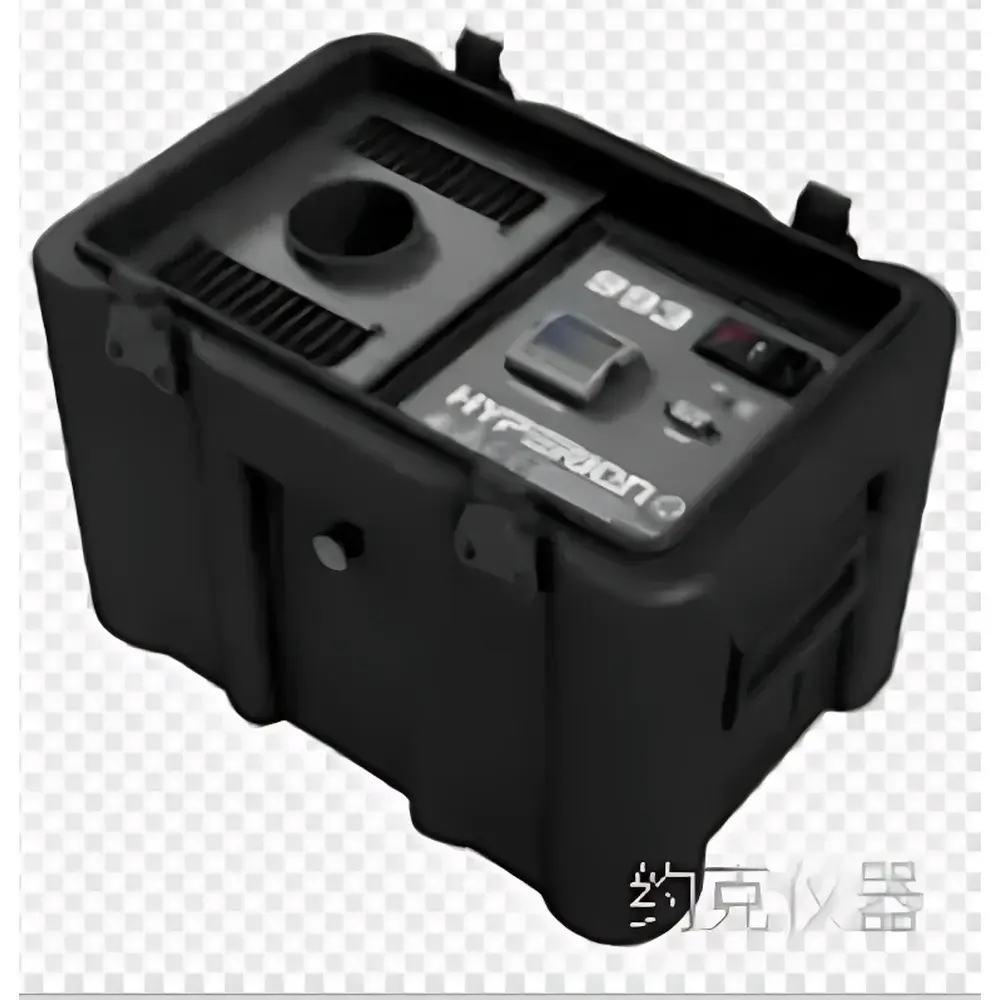
ISOTECH Field-Deployable Blackbody Calibrator Models 993 and 996
| Brand | ISOTECH |
|---|---|
| Origin | United Kingdom |
| Model | 993, 996 |
| Instrument Type | Blackbody Calibrator |
| Temperature Range | −10 °C to 550 °C |
| Stability | ≤ 0.1 °C |
| Temperature Resolution | 0.01 °C |
| Warm-up Time | 40 min (from ambient to 80 °C) |
| Cool-down Time | 45 min (from ambient to −10 °C) |
| Operating Ambient Temperature | −29 °C to 50 °C |
| Cavity Aperture | 50 mm (Model 993), 65 mm (Model 996) |
| Emissivity | > 0.995 |
| Temperature Uniformity | ≤ ±0.15 °C or ±0.15% of reading (whichever is greater) |
| Enclosure Rating | IP56 |
| Interface | RS-232 |
| Internal Cavity Dimensions | 355 mm × 279 mm × 406 mm |
| External Dimensions (D×W×H) | 355 mm × 279 mm × 406 mm |
| Mass | 18.1 kg |
| Compliance | MIL-PRF-28800F, BS EN 60068-2-1:2007, BS EN 60068-2-14:2009, ISO 3744:2010 |
Overview
The ISOTECH Field-Deployable Blackbody Calibrators Models 993 and 996 are precision-engineered thermal reference sources designed for high-integrity temperature calibration in non-laboratory environments. These instruments operate on the principle of cavity radiation thermometry, generating a highly stable, spatially uniform blackbody field within an isothermal cavity whose effective emissivity exceeds 0.995 — a critical requirement for traceable infrared thermometer and thermal imaging system calibration. Unlike conventional laboratory blackbodies, the 993 and 996 models integrate ruggedized mechanical architecture with active thermal control systems capable of maintaining stability ≤ 0.1 °C across their full operating range (−10 °C to 550 °C). Their compact monolithic enclosure—identical in external dimensions (355 × 279 × 406 mm) and mass (18.1 kg)—is optimized for transport and rapid deployment in field operations, including aerospace ground support, defense maintenance depots, industrial outage sites, and remote infrastructure monitoring.
Key Features
- Ruggedized IP56-rated enclosure certified to MIL-PRF-28800F for environmental resilience—including ingress protection against dust and water jets, shock/vibration tolerance, and operational reliability at ambient temperatures from −29 °C to 50 °C
- Dual-model configuration: Model 993 (50 mm aperture, optimized for portable IR thermometers); Model 996 (65 mm aperture, suited for larger FOV thermal imagers and radiometric sensors)
- High-emissivity cavity surface with geometric optimization to minimize reflection errors and ensure spectral radiance conformity to Planck’s law under steady-state conditions
- Temperature resolution of 0.01 °C and uniformity ≤ ±0.15 °C (or ±0.15% of reading), validated per ASTM E2847 and ISO/IEC 17025-compliant calibration procedures
- RS-232 serial interface supporting SCPI command set for integration into automated calibration workflows and remote operation via host PC or embedded controller
- Thermal management architecture enabling 40-minute warm-up to 80 °C and 45-minute cool-down to −10 °C without auxiliary cooling, minimizing downtime during sequential field calibrations
Sample Compatibility & Compliance
The 993 and 996 calibrators accommodate a broad class of non-contact temperature measurement devices, including handheld infrared thermometers (single- and dual-wavelength), fixed-mount pyrometers, uncooled microbolometer-based thermal cameras, and radiometric reference sensors. Each unit undergoes full environmental qualification testing per MIL-PRF-28800F Sections 4.5.5.2 (altitude), 4.5.5.4.3 (workbench handling), and scatter-bounce protocols; BS EN 60068-2-1 (cold storage) and BS EN 60068-2-14 (thermal cycling); and ISO 3744:2010 (acoustic noise emission). Emissivity validation is performed using absolute radiometric comparison against NPL-traceable transfer standards. Units are supplied with a UKAS-accredited calibration certificate (optional upgrade to ISO/IEC 17025:2017 scope), documenting as-found/as-left data, uncertainty budgets, and traceability to the International Temperature Scale of 1990 (ITS-90).
Software & Data Management
While standalone operation requires no software, ISOTECH provides optional PC-based calibration management software compatible with Windows 10/11. The application supports instrument discovery over RS-232, real-time temperature logging at user-defined intervals (100 ms to 60 s), multi-point ramp/soak profiling, and automated generation of calibration reports compliant with FDA 21 CFR Part 11 (audit trail, electronic signature, data integrity controls). All raw temperature data are stored in CSV format with metadata tags (timestamp, setpoint, actual cavity temperature, stability deviation, ambient sensor reading). Software-generated reports include uncertainty analysis per GUM (JCGM 100:2008), compliance statements against ISO 17025 clause 7.8.3, and configurable pass/fail thresholds aligned with user-defined acceptance criteria.
Applications
- On-site verification and adjustment of infrared thermography systems used in predictive maintenance of power transformers, switchgear, and rotating machinery
- Field calibration of handheld IR thermometers deployed in HVAC commissioning, food safety audits, and pharmaceutical cold-chain monitoring
- Military and aerospace applications requiring MIL-STD-810G-compliant thermal references for avionics IR sensor validation and weapons system diagnostics
- Emergency response scenarios where rapid deployment of metrologically sound temperature references is required for fire scene thermal camera verification or hazardous material incident assessment
- Research-grade radiometric intercomparisons between mobile thermal imaging platforms and fixed reference sources in outdoor test ranges
FAQ
What is the difference between Model 993 and Model 996?
Model 993 features a 50 mm aperture and is optimized for calibrating handheld IR thermometers with narrow fields of view; Model 996 offers a 65 mm aperture to support larger-diameter sensors and thermal imagers requiring higher radiant flux density.
Can these units be used indoors as primary calibration standards?
Yes—both models meet laboratory-grade uniformity and stability specifications and are routinely employed as secondary standards in accredited calibration labs when operated under controlled ambient conditions (20 ±2 °C, <60% RH).
Is NIST or UKAS traceability included with purchase?
A UKAS-accredited calibration certificate is available as a factory option; certificates include full uncertainty budgets, ITS-90 traceability, and compliance with ISO/IEC 17025:2017 requirements.
Does the unit support external temperature monitoring of ambient conditions?
Yes—the integrated environmental sensor continuously measures and logs ambient temperature and relative humidity, enabling correction of cavity temperature drift due to convective heat exchange.
Are firmware updates available, and how are they applied?
Firmware revisions are distributed via ISOTECH’s secure customer portal and installed using the RS-232 interface and provided utility; each update includes version-locked cryptographic signatures and rollback capability.