
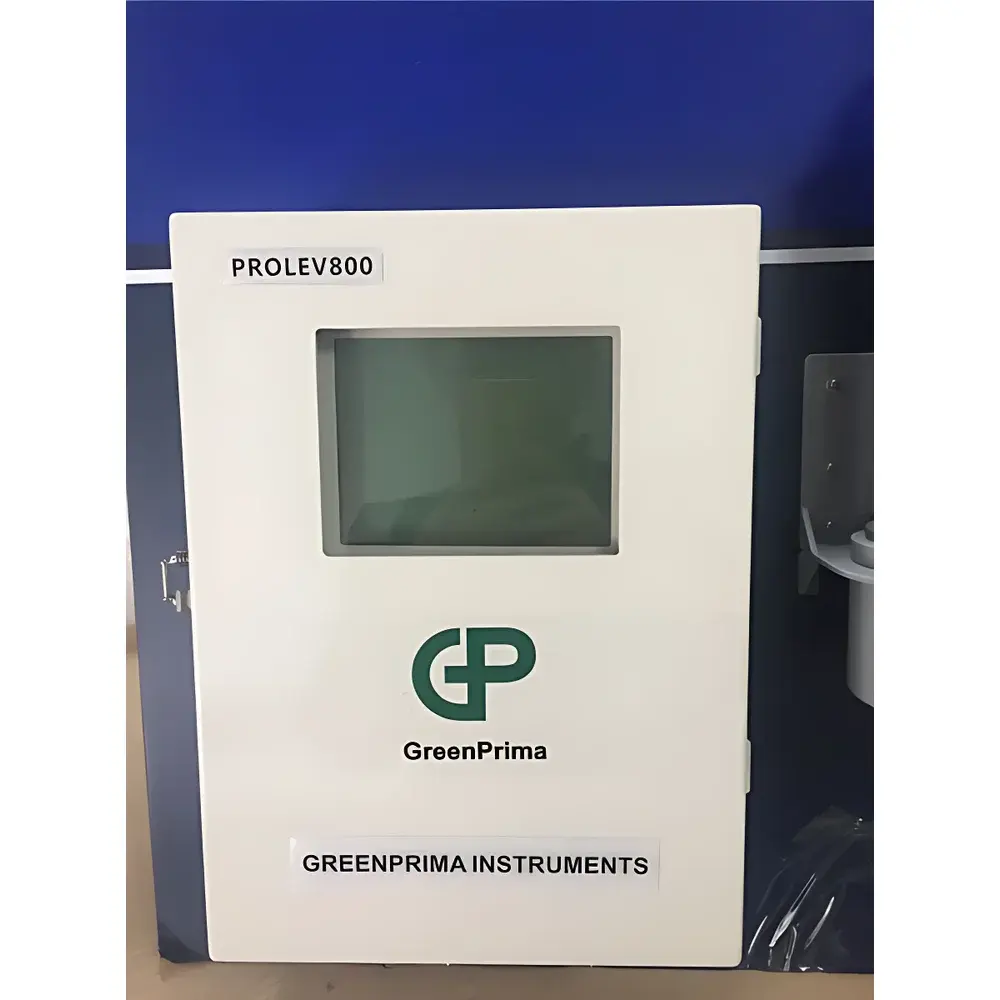
GreenPrima ProLev800 Ultrasonic Sludge Interface Detector
| Brand | GreenPrima |
|---|---|
| Origin | Japan |
| Manufacturer Type | Manufacturer |
| Origin Category | Imported |
| Model | ProLev800 |
| Measurement Range | 0.4–10 m |
| Sensor Capacity | Up to 2 independent probes |
| Accuracy | ±1 cm |
| Response Time | 1 s |
| Operating Temperature | −20 to +60 °C |
| Display | Large LCD with graphical interface (numeric readout, trend plot, echo waveform) |
| Protection Rating | IP68 |
| Weight | 3.6 kg (transmitter), 3 kg (probe) |
| Output | 4–20 mA analog output |
| Alarm Outputs | 2 relay outputs (high/low level) |
| Communication Interface | RS-232C (cable length ≤10 m) |
| Power Supply | 85–264 VAC, 10 VA |
| Cable Length | 20 m |
| Trend Logging | 5 minutes to 48 hours on display |
Overview
The GreenPrima ProLev800 Ultrasonic Sludge Interface Detector is an industrial-grade, microprocessor-controlled instrument engineered for continuous, non-invasive monitoring of sludge blanket depth and interface position in clarifiers, thickeners, and settling basins. Based on time-of-flight ultrasonic pulse-echo principle, the ProLev800 emits high-frequency acoustic waves (typically 20–50 kHz) toward the liquid–sludge boundary and precisely calculates distance by measuring the transit time of reflected signals. Unlike optical or conductivity-based methods, ultrasonic detection remains unaffected by turbidity, color, suspended solids concentration, or chemical composition—making it uniquely suited for harsh wastewater environments where consistent signal integrity is critical. The device delivers real-time interface height data with ±1 cm repeatability under dynamic hydraulic conditions, supporting closed-loop control of return activated sludge (RAS) and waste activated sludge (WAS) flows in biological treatment systems.
Key Features
- Large backlit LCD display featuring simultaneous numeric height readout, real-time echo waveform visualization, and configurable trend graphs (5 min to 48 h)
- Dual-sensor capability: single transmitter unit supports up to two independently mounted ultrasonic probes for differential interface profiling or redundancy
- Embedded digital signal processor (DSP) with adaptive gain control and noise suppression algorithms to maintain stable detection across variable sludge density gradients
- No moving parts or immersed electronics—probe housing rated IP68 for submersion in aggressive wastewater or ash slurry applications
- Adjustable screen brightness and intuitive menu navigation via membrane keypad for field commissioning without external tools
- Configurable 4–20 mA analog output with linear or square-root scaling; two programmable relay outputs for high/low level alarms
- RS-232C serial interface for local diagnostics, firmware updates, and raw data export (max. 10 m cable length)
Sample Compatibility & Compliance
The ProLev800 is validated for use in municipal and industrial water–wastewater infrastructure including primary and secondary clarifiers, gravity thickeners, dissolved air flotation (DAF) units, and coal-fired power plant ash settling ponds. It operates reliably in mixed-liquor suspended solids (MLSS) concentrations ranging from 1,000 to 15,000 mg/L and withstands ambient temperatures from −20 °C to +60 °C. While not certified to IEC 61508 or SIL standards out-of-the-box, its hardware architecture complies with EN 61326-1 (EMC for industrial environments) and meets general requirements for installation in Zone 2 hazardous areas when used with appropriate conduit and junction boxes. Data logging functionality supports GLP-aligned operational records, and analog outputs are compatible with PLC-based SCADA systems conforming to ISA-88 and ISA-95 frameworks.
Software & Data Management
The ProLev800 does not require external software for basic operation—configuration, calibration, and alarm thresholds are managed entirely via the onboard interface. However, the RS-232 port enables integration with third-party historian platforms (e.g., Ignition, Siemens Desigo CC, or ABB Ability™) using ASCII protocol commands. Raw echo amplitude and time-stamped height values can be polled at user-defined intervals (1–60 s). Trend plots stored locally on the display retain last 48 hours of data at 1-minute resolution and support visual diagnosis of sludge bulking, compaction failure, or hydraulic overloading. For audit readiness, all parameter changes—including date/time stamps and operator ID input—are logged internally and retrievable via serial dump.
Applications
- Optimization of RAS flow rate in activated sludge processes based on real-time sludge blanket elevation
- Early detection of sludge blanket rise preceding effluent turbidity excursions in final clarifiers
- Monitoring separation layer stability in pre-thickening basins feeding anaerobic digesters
- Control of sludge withdrawal timing in batch-operated thickeners to maximize solids capture
- Performance verification of lamella settlers and tube settlers in potable water treatment plants
- Interface tracking in fly ash and bottom ash slurry ponds at thermal power stations
FAQ
Does the ProLev800 require periodic recalibration?
Calibration is performed once during initial setup using a known reference distance (e.g., still-water surface). No routine recalibration is needed unless mechanical probe alignment shifts or transducer face becomes coated with biofilm—cleaning per maintenance schedule restores baseline accuracy.
Can it distinguish between multiple layers (e.g., scum, sludge, and clear supernatant)?
The ProLev800 identifies the strongest echo return corresponding to the dominant acoustic impedance discontinuity—typically the sludge–supernatant interface. While multi-layer analysis is not supported, dual-probe configuration allows comparative profiling across vertical zones.
Is the probe suitable for installation in abrasive or corrosive slurries?
Probe housing is constructed from 316 stainless steel with EPDM or Viton® sealing materials, rated for continuous immersion in pH 4–11 wastewater and ash slurry containing <5% solids by weight. Optional ceramic-coated transducers are available for extended service life in highly abrasive applications.
How does temperature variation affect measurement accuracy?
The built-in temperature sensor compensates sound velocity in water across −20 °C to +60 °C. Uncertainty contribution from thermal drift is less than ±0.3% of full scale within this range.
What documentation is provided for regulatory compliance reporting?
Factory calibration certificate (traceable to JIS Z 8015), CE Declaration of Conformity, RoHS compliance statement, and IP68 test report are included. Optional IQ/OQ protocols are available upon request for GMP-regulated utilities.
Related Products







