
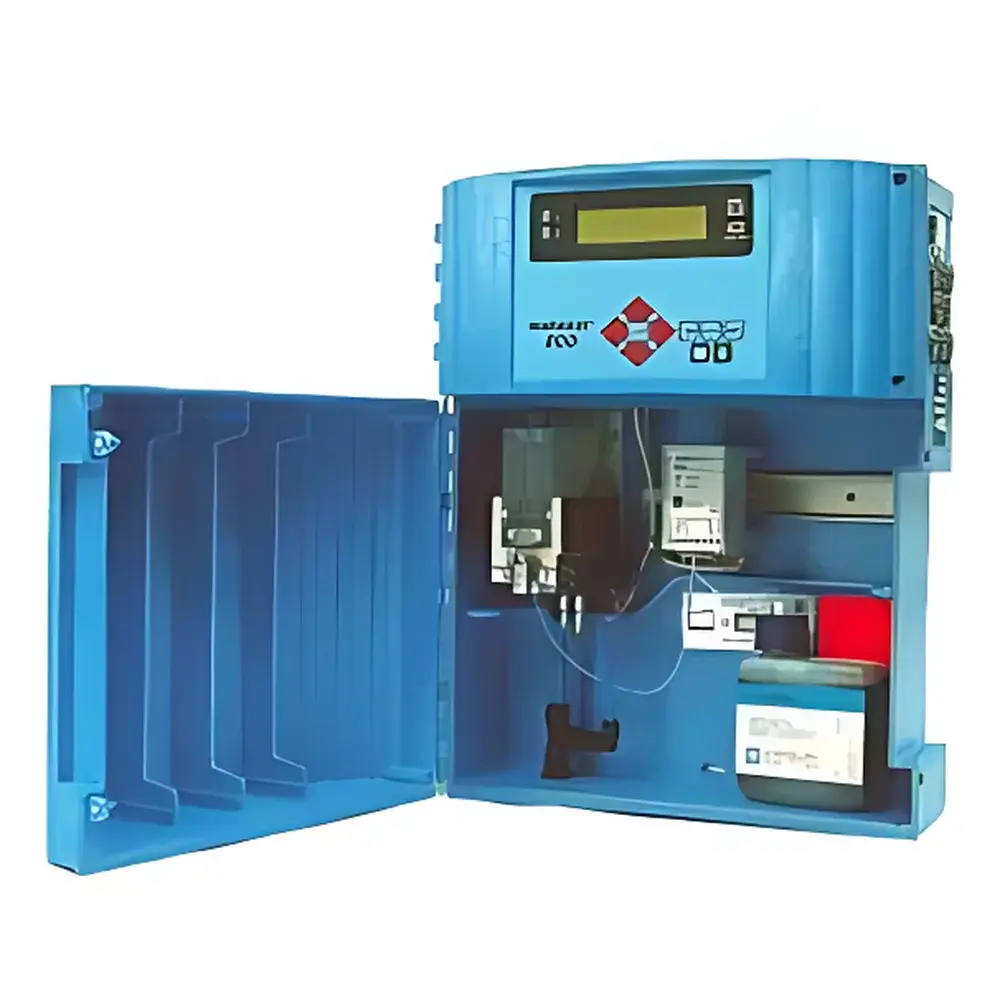
HEYL Testomat CrVI Online Hexavalent Chromium Analyzer
| Brand | HEYL |
|---|---|
| Origin | Germany |
| Model | Testomat CrVI |
| Measurement Principle | Colorimetric Titration |
| Measurement Range | 0.01–1.0 mg/L Cr⁶⁺ |
| Resolution | 0.01 mg/L (0–0.65 mg/L), 0.1 mg/L (0.7–1.0 mg/L) |
| Accuracy | ±3% (0–0.65 mg/L), ±10% (0.7–1.0 mg/L) |
| Power Supply | 230 V AC or 24 V DC |
| Max. Power Consumption | 30 VA |
| Enclosure Rating | IP65 |
| Protection Class | Class I |
| Environmental Operating Temperature | 10–45 °C |
| Sample Inlet Pressure | 0.1–8 bar |
| Sample Inlet Temperature | 10–40 °C |
| Dimensions (W×H×D) | 380 × 480 × 280 mm |
| Weight | ~9.5 kg |
| Relay Output Capacity | 4 A |
| Analog Output (Optional) | 0/4–20 mA, max. load 500 Ω |
| Compliance | EN 50081-1, EN 50082-2, EN 61010-1 |
Overview
The HEYL Testomat CrVI is a dedicated online analyzer engineered for continuous, automated determination of hexavalent chromium (Cr⁶⁺) in aqueous effluents using standardized colorimetric titration methodology. Designed for integration into industrial wastewater treatment streams—particularly where regulatory compliance with Cr⁶⁺ discharge limits is mandatory—the instrument operates on the principle of selective chromogenic reaction between Cr⁶⁺ and a proprietary reagent, followed by photometric quantification at a defined wavelength. The system employs a piston-driven metering pump to ensure precise reagent dosing and reproducible stoichiometric titration, minimizing drift and interferences from matrix components such as chloride, sulfate, or suspended solids common in electroplating or tanning industry effluents. Its robust architecture supports unattended operation over extended intervals, with built-in diagnostics for critical process parameters including inlet pressure, reagent level, optical path integrity, and reaction chamber status.
Key Features
- Two independent measurement channels for parallel monitoring of dual sample streams (e.g., influent and effluent)
- Configurable analysis frequency: programmable timer (0–99 minutes), flow-proportional measurement (via pulse input from water meter), external trigger (e.g., pump activation signal), or manual initiation
- High-contrast LCD interface with intuitive text-based menu navigation and full on-device programming capability
- Dual user-adjustable limit thresholds with configurable relay outputs for process control (e.g., actuating chemical dosing or valve switching)
- Corrosion-resistant wetted materials—including PTFE, PVDF, and borosilicate glass—ensuring long-term stability in aggressive industrial wastewater matrices
- Low reagent and sample consumption design, reducing operational cost and waste generation per analysis cycle
- Integrated alarm system with relay outputs for maintenance events: low inlet pressure, empty reagent reservoir, optical blockage, or calibration deviation
- Optional analog output module (SK 910) supporting 0/4–20 mA transmission with galvanic isolation and configurable scaling; optional RS 232 digital interface (RS 910) for data logging or SCADA integration
Sample Compatibility & Compliance
The Testomat CrVI is validated for use with municipal and industrial wastewater containing total suspended solids (TSS) ≤ 50 mg/L and turbidity ≤ 100 NTU. It meets electromagnetic compatibility (EMC) and safety requirements per EN 50081-1 (emission), EN 50082-2 (immunity), and EN 61010-1 (safety of electrical equipment for measurement, control, and laboratory use). While not certified under ISO/IEC 17025 for accredited testing, its performance characteristics align with routine monitoring applications referenced in EPA Method 7196A and DIN 38405-27 for Cr⁶⁺ determination. The analyzer supports GLP-aligned operational traceability through timestamped event logging (e.g., calibration, cleaning, alarm triggers) stored in non-volatile memory. All firmware updates and configuration changes are auditable via local interface or optional serial connection.
Software & Data Management
No embedded PC or proprietary software suite is required for basic operation—the device functions autonomously with onboard logic. However, the RS 232 interface enables direct communication with third-party data acquisition systems or PLCs using ASCII protocol. Logged data includes measurement values, timestamps, alarm codes, and diagnostic flags (e.g., “LOW_PRESSURE”, “REAGENT_EMPTY”). Optional configuration tools allow remote parameter adjustment, calibration coefficient entry, and limit value modification—provided the connected host system implements appropriate access controls. For facilities subject to FDA 21 CFR Part 11 or EU Annex 11 requirements, external validation of data integrity, audit trail completeness, and electronic signature implementation must be performed at the system integration level, as the analyzer itself does not provide cryptographic authentication or role-based user management.
Applications
The Testomat CrVI is deployed primarily in regulated industrial settings where real-time Cr⁶⁺ monitoring informs process control and regulatory reporting. Key application domains include:
- Electroplating and anodizing facilities—monitoring rinse water and final effluent prior to discharge or recycling
- Tannery operations—verifying Cr⁶⁺ reduction efficiency in pretreatment units before biological treatment stages
- Metal finishing plants—ensuring compliance with local wastewater ordinances (e.g., EU Industrial Emissions Directive, US Clean Water Act NPDES permits)
- Chemical manufacturing sites—tracking Cr⁶⁺ breakthrough in ion exchange or adsorption columns
- Publicly owned treatment works (POTWs)—screening industrial influent for toxicant loading surges
Its dual-channel capability allows simultaneous verification of upstream Cr⁶⁺ concentration and downstream removal efficiency—a configuration frequently specified in environmental management system (EMS) audits.
FAQ
What is the minimum detectable concentration for Cr⁶⁺?
The lower detection limit is 0.01 mg/L within the 0–0.65 mg/L range, with resolution maintained at this level.
Can the instrument operate on DC power?
Yes—it accepts either 230 V AC or 24 V DC input, making it suitable for installations with uninterruptible power supplies or solar-powered remote monitoring stations.
Is regular calibration required?
Calibration is recommended before initial commissioning and after any major maintenance; periodic verification (e.g., weekly) using certified reference standards is advised for compliance-critical applications.
How often does the reaction cell require cleaning?
Cleaning frequency depends on sample fouling potential; typical intervals range from 1 to 4 weeks in low-turbidity effluents, with automatic alerts issued when optical path attenuation exceeds threshold.
Are replacement reagents supplied by HEYL?
Yes—HEYL provides factory-formulated, lot-certified reagent kits with documented shelf life and stability data, ensuring method consistency across instrument deployments.
Related Products







