
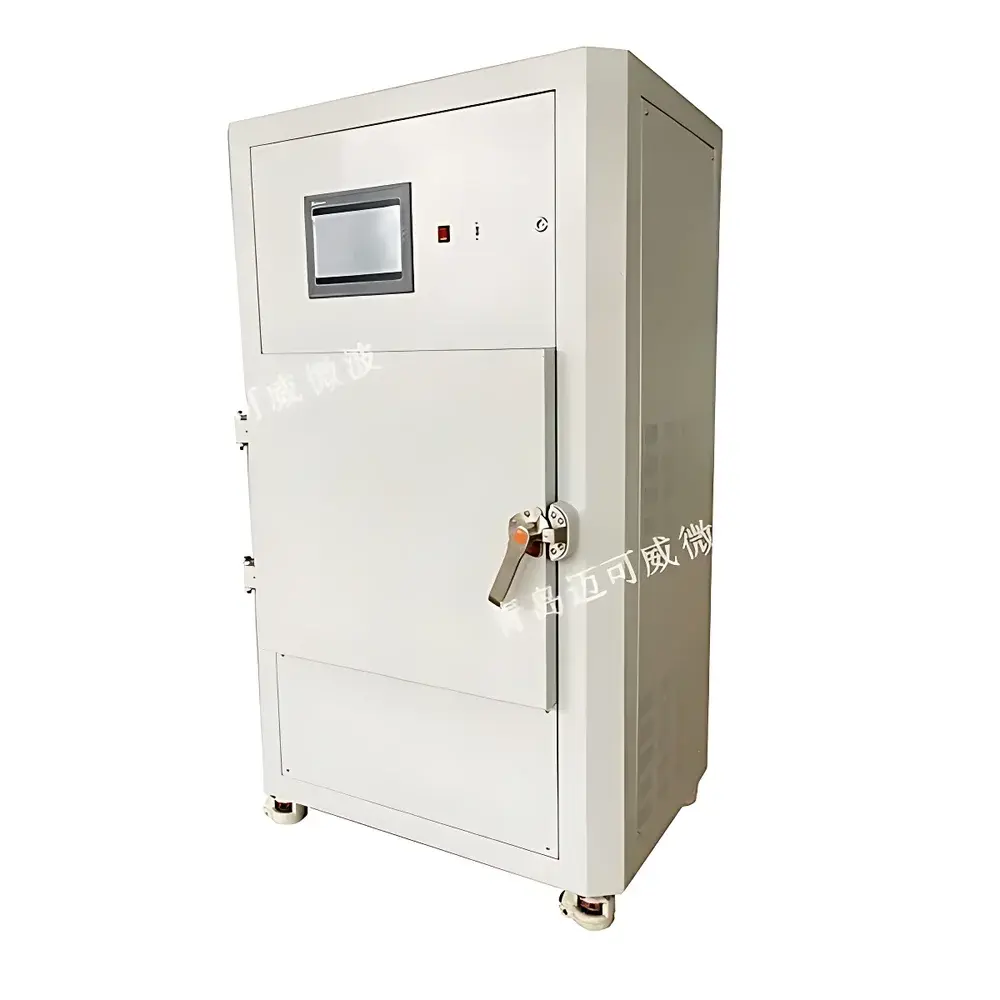
MakeWave HXH-L10 High-Capacity Microwave-Assisted Drying, Carbonization and Ashing System
| Brand | MakeWave |
|---|---|
| Origin | Shandong, China |
| Manufacturer Type | Direct Manufacturer |
| Product Category | Domestic |
| Model | HXH-L10 |
| Price Range | USD 14,000 – 42,000 |
| Microwave Power/Frequency | 0–3.2 kW adjustable / 2450 MHz |
| Cavity Volume | 56 L |
| Crucible Capacity | 10 L standard quartz crucible (optional 15 L) |
| Temperature Range | 0–1200 °C (thermocouple-based) |
| Cavity Material | Fully sealed, welded stainless steel with micro-positive pressure design |
| Insulation | Integrated high-efficiency thermal insulation |
| Atmosphere Control | Adjustable inlet for air or inert gas |
| Safety Compliance | GB 4706.21-2008, GB 5959.6-2008 |
| Radiation Leakage | <5 mW/cm² (per national standard) |
| External Dimensions (W×D×H) | 975 × 750 × 1680 mm |
Overview
The MakeWave HXH-L10 is an engineered high-capacity microwave-assisted system designed specifically for integrated drying, carbonization, and ashing of large-volume biological and environmental samples in nuclear, radiological, and public health laboratories. Unlike conventional sequential furnace-based workflows—requiring separate ovens for drying, muffle furnaces for carbonization, and dedicated ashing units—the HXH-L10 consolidates all three stages into a single, fully sealed process chamber. Its operation leverages dielectric heating principles: microwave energy at 2450 MHz penetrates sample matrices volumetrically, enabling rapid, uniform internal heating without reliance on conduction or convection. This results in significantly reduced processing time—e.g., meat samples requiring days under traditional protocols can be fully ashed within a single working day; leafy vegetables achieve complete mineralization in under six hours. The system is purpose-built for compliance-driven environments where sample integrity, isotopic retention, and operator safety are non-negotiable requirements.
Key Features
- Patented microwave ashing architecture (ZL201721881531.1), integrating drying, carbonization, and ashing in one closed-loop cycle to eliminate cross-contamination and manual transfer errors.
- 56-liter hermetically sealed stainless steel cavity with micro-positive pressure control, preventing ambient air ingress and minimizing volatile radionuclide loss during thermal decomposition.
- 10-liter high-purity fused quartz crucible (optionally 15 L) featuring ultra-low intrinsic radioactivity (“nuclear background”), ensuring minimal interference in gamma-spectrometric analysis of 137Cs, 90Sr, 238U, and other environmental radionuclides.
- Venturi-based centralized negative-pressure exhaust system with optional catalytic smoke purification module, achieving near-odorless operation and meeting occupational exposure limits for organic pyrolysis byproducts.
- PLC-controlled multi-segment thermal profiling with real-time thermocouple feedback (0–1200 °C), enabling precise temperature ramping and hold steps tailored to nuclide-specific volatility thresholds (e.g., avoiding sublimation of iodine-129 or cesium-134 above 600 °C).
- Comprehensive safety architecture: interlocked access door, surface temperature monitoring (<50 °C), microwave leakage detection (<5 mW/cm²), explosion-resistant chamber design, and corrosion-resistant internal surfaces.
Sample Compatibility & Compliance
The HXH-L10 is validated for heterogeneous biological matrices including cereals, leafy vegetables, aquatic tissues, animal muscle, and soil-adsorbed biomass—samples routinely analyzed under Chinese national standards GB 5749-2006 (drinking water), GB/T 14883.1-2016 (radioactive substance testing in food), and GB 16145-1995 (gamma spectrometry of biological samples). Its thermal profile reproducibility supports GLP-compliant data generation, while the closed quartz cavity minimizes isotopic fractionation and elemental volatilization—critical for accurate activity concentration determination per ISO/IEC 17025:2017 requirements. Structural conformity to GB 4706.21-2008 (microwave appliance safety) and GB 5959.6-2008 (industrial microwave equipment) ensures regulatory acceptance in government radiation monitoring networks and nuclear facility QA/QC labs.
Software & Data Management
The embedded PLC controller features a 7-inch color touchscreen interface with intuitive workflow navigation. Preloaded method libraries include standardized protocols aligned with GB/T 14883.1-2016 and user-defined multi-step programs (up to 20 segments). All runs log timestamped temperature curves, power modulation history, and chamber pressure status. Data export is supported via USB 2.0 in CSV format for traceable integration into LIMS platforms. Audit trail functionality records operator ID, parameter changes, and alarm events—supporting FDA 21 CFR Part 11 readiness when paired with network-authenticated user accounts and electronic signature modules (optional).
Applications
- Radiological emergency response: Rapid ashing of field-collected foodstuffs and environmental swabs during post-incident baseline surveys.
- Nuclear facility effluent monitoring: High-throughput preparation of bio-indicator species (e.g., lichens, mosses, fish tissue) for gamma spectrometry.
- Drinking water safety programs: Mineralization of suspended solids and organic-rich filter residues prior to alpha/beta counting.
- Research in radioecology: Controlled charring of plant biomass to isolate stable ash fractions for isotopic ratio mass spectrometry (IRMS).
- Regulatory compliance testing: Method validation studies supporting accreditation under CNAS-CL01 (equivalent to ISO/IEC 17025).
FAQ
Can the HXH-L10 handle samples with high moisture content, such as fresh fish or wet algae?
Yes. The system’s staged microwave power modulation allows gentle initial drying (≤150 °C) followed by progressive ramping to carbonization (300–600 °C) and final ashing (≥550 °C), preventing explosive steam release.
Is quartz crucible replacement required after each run?
No. Fused quartz exhibits excellent thermal shock resistance and chemical inertness. With proper cleaning (dilute nitric acid rinse), crucibles support ≥200 cycles without measurable background increase.
Does the system support inert atmosphere processing?
Yes. Optional nitrogen or argon gas inlet ports enable oxygen-free carbonization—critical for preserving redox-sensitive isotopes like 210Po or reducing nitrate interference in beta-counting applications.
How is calibration verified for temperature accuracy?
Each unit ships with NIST-traceable thermocouple verification report. In-field recalibration is performed using certified reference materials (e.g., SRM 720a alumina) following ASTM E2550 guidelines.
What maintenance intervals are recommended for the microwave magnetron and exhaust system?
Magnetron service life exceeds 5,000 operating hours; routine inspection every 500 h includes waveguide coupling alignment and cooling fan performance check. Catalytic smoke filters require replacement every 1,000 h under continuous operation.
Related Products



