
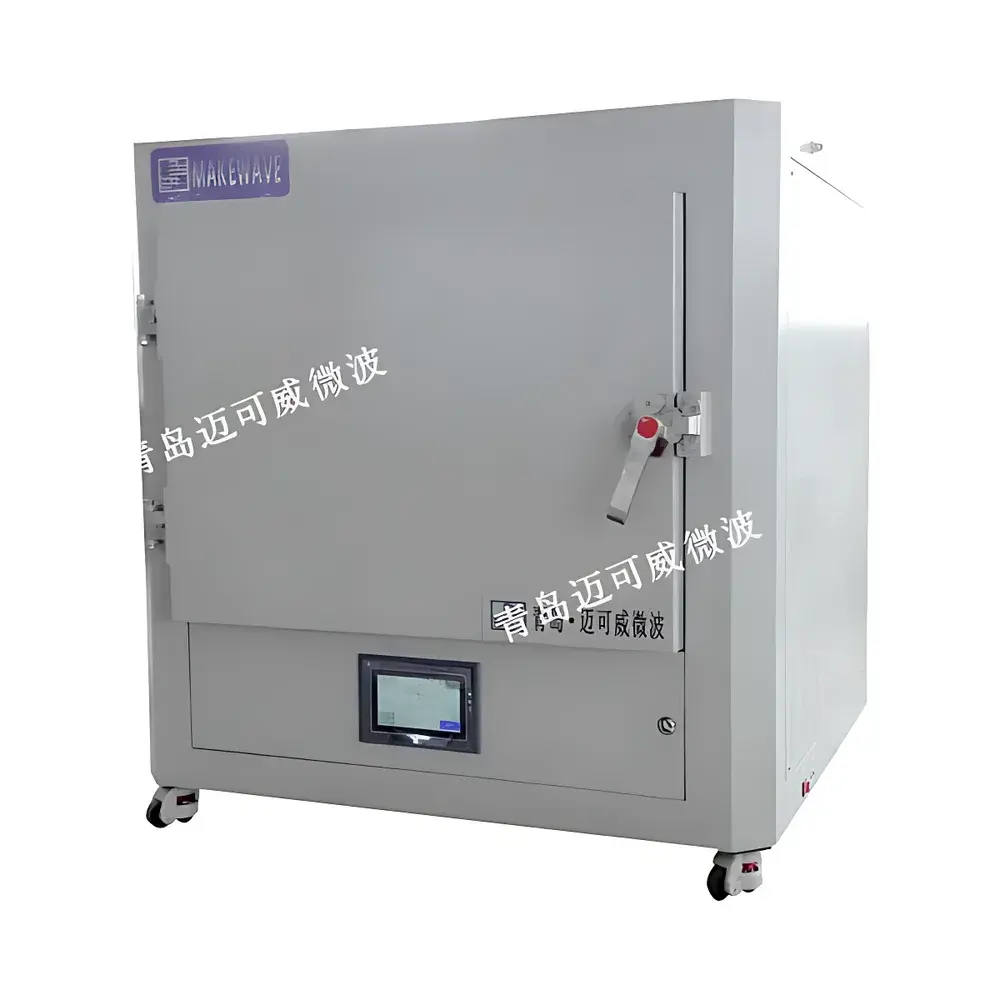
MakeWave MKX-R6HC High-Throughput Microwave Ashing Furnace
| Brand | MakeWave |
|---|---|
| Origin | Shandong, China |
| Manufacturer Type | Direct Manufacturer |
| Product Category | Domestic |
| Model | MKX-R6HC |
| Instrument Type | Box-Type Furnace |
| Maximum Temperature | 1000 °C |
| Temperature Control Accuracy | ±1 °C |
| Rated Power | 1600 W |
| Heating Method | Microwave Heating |
| Control System | PLC-Based Intelligent Control |
| Ramp Time to Max Temperature | ≤30 min |
| Effective Cavity Volume | 25 L |
| Parallel Sample Capacity | >100 crucibles (standard ceramic or quartz) |
| Atmosphere Options | Ambient air, inert gas (N₂), or controlled oxygen-deficient environment |
| Optional Accessory | Integrated exhaust gas scrubbing system |
Overview
The MakeWave MKX-R6HC High-Throughput Microwave Ashing Furnace is an engineered solution for rapid, reproducible sample preparation in analytical laboratories requiring high-volume ashing workflows. Unlike conventional resistive muffle furnaces, the MKX-R6HC employs monomode or multimode microwave energy coupling to achieve uniform volumetric heating within a 25 L insulated cavity—enabling simultaneous thermal decomposition of over 100 samples under precisely controlled atmospheric and thermal conditions. Its operation principle relies on dielectric heating of carbonaceous and organic matrices, accelerating oxidation kinetics while minimizing thermal gradients across the load. Designed for routine use in environmental testing labs, food safety QA/QC facilities, clinical research centers, and regulatory compliance environments, the furnace supports standardized ashing protocols per ASTM D5630, ISO 11885, USP , and EPA Method 3050B—particularly where throughput, repeatability, and trace-metal integrity are critical.
Key Features
- High-throughput capability: Supports parallel processing of >100 standard crucibles (e.g., 30 mL porcelain or quartz) within a single 25 L cavity, significantly reducing batch turnaround time compared to sequential resistive furnaces.
- Microstructure-preserving cavity design: Stainless steel-lined chamber with non-shedding refractory insulation ensures zero particulate contamination during ashing—critical for low-level elemental analysis by ICP-MS or AAS.
- Dual-mode atmosphere control: Programmable airflow management enables operation under ambient air (for oxidative ashing), nitrogen purge (for char retention or halogen-sensitive matrices), or staged oxygen-limited ramping (to prevent splattering of volatile organics).
- Closed-loop thermal regulation: PLC-based controller integrates real-time thermocouple feedback (Type K, Class 1) with adaptive microwave power modulation, maintaining ±1 °C stability at setpoints up to 1000 °C.
- Robust mechanical architecture: Floor-standing configuration with reinforced structural frame, heavy-duty door sealing, and integrated cooling ducts ensures long-term operational reliability under continuous shift usage.
- Modular exhaust integration: Optional catalytic scrubber module compliant with ISO 14644-1 Class 5 cleanroom requirements removes acidic vapors (e.g., HCl, HF) and particulates prior to venting—meeting local occupational exposure limits (OSHA PELs) and lab HVAC compatibility standards.
Sample Compatibility & Compliance
The MKX-R6HC accommodates diverse sample types including biological tissues, plant materials, soil/sediment composites, polymer residues, pharmaceutical excipients, and food matrices. Crucible compatibility extends to alumina, quartz, platinum, and high-purity graphite—validated for thermal shock resistance up to 1000 °C. The system conforms to electromagnetic compatibility (EMC) requirements per IEC 61000-6-3 and safety standards IEC 61010-1 for laboratory electrical equipment. All firmware logic adheres to GLP data integrity principles, supporting audit-ready event logging—including temperature profiles, power output history, door open/close timestamps, and alarm triggers—with optional USB or Ethernet export for LIMS integration.
Software & Data Management
The embedded PLC interface provides intuitive touch-screen navigation with preloaded method templates (e.g., “Soil Ashing – EPA 3050B”, “Food Residue – AOAC 971.18”). Each run generates a timestamped CSV log containing ramp rate, dwell duration, peak power %, and deviation from target temperature—all traceable to NIST-traceable calibration certificates. Optional software upgrade enables remote monitoring via secure HTTPS API, role-based user access control, and 21 CFR Part 11-compliant electronic signatures when paired with validated authentication modules.
Applications
- Routine ashing of environmental solid samples prior to heavy metal quantification (Cd, Pb, As, Hg) by atomic spectroscopy.
- Preparation of certified reference materials (CRMs) requiring strict mass loss consistency across replicate batches.
- Residue-on-ignition (ROI) determination in wastewater sludge per Standard Methods 2540F.
- Thermal pretreatment of catalyst supports and battery electrode powders for XRD or BET surface area analysis.
- Accelerated char yield assessment in biomass energy research under controlled pyrolysis atmospheres.
FAQ
Can the MKX-R6HC be used for sulfur-rich samples without corrosion concerns?
Yes—the cavity lining incorporates Hastelloy C-276 cladding in optional configurations, providing resistance to SO₂ and sulfate condensates during prolonged ashing cycles.
Is validation documentation available for GMP-regulated environments?
Yes—IQ/OQ protocols aligned with ASTM E2500 and Annex 15 are supplied; PQ support includes temperature mapping per ISO/IEC 17025 guidelines.
What crucible loading patterns maximize thermal uniformity?
We recommend hexagonal close-packing with ≥10 mm inter-crucible spacing and elevation on perforated ceramic trays—validated via infrared thermography across 9-point cavity mapping.
Does the system support programmable multi-step ramps with atmosphere switching?
Yes—up to 12 segmented programs, each permitting independent gas flow rate, microwave power %, and dwell time, with automatic valve sequencing between air/N₂ lines.
How is microwave leakage monitored during operation?
An integrated RF sensor continuously measures leakage at the door seal and viewport; values are logged and trigger audible/visual alerts if exceeding 1 mW/cm² (per IEEE C95.1-2019).



