
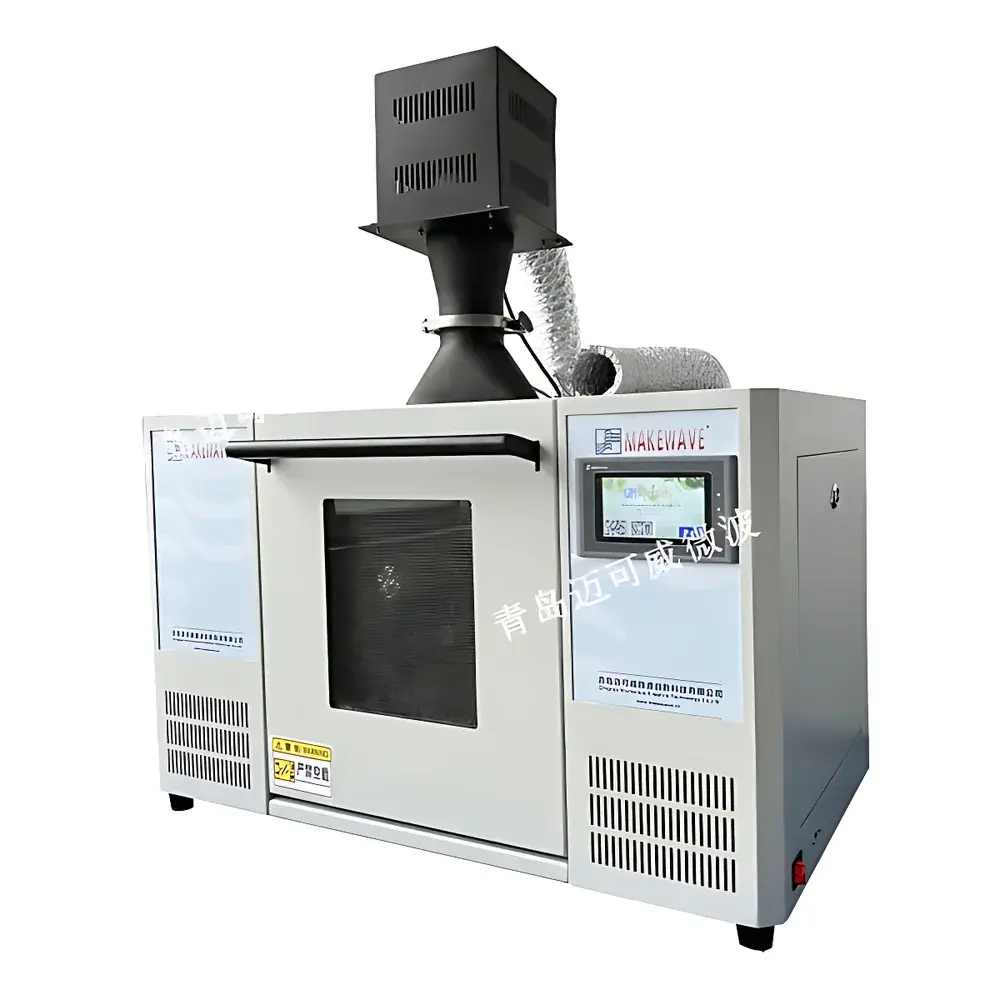
Makewave MKX-G1C1B Microwave-Assisted High-Temperature Drying Oven
| Brand | Makewave |
|---|---|
| Origin | Shandong, China |
| Manufacturer Type | Direct Manufacturer |
| Product Category | Domestic |
| Model | MKX-G1C1B |
| Instrument Type | High-Temperature Oven |
| Temperature Range | 0–300 °C |
| Temperature Uniformity | ±1 °C |
| External Dimensions | 782 × 800 × 450 mm (W × H × D) |
| Internal Chamber Dimensions | 250 × 285 × 275 mm (W × H × D) |
| Internal Cavity Material | 304 Stainless Steel with Multi-Layer PTFE Coating |
| Heating Method | Continuous Non-Pulsed Microwave at 2450 MHz |
| Rated Microwave Power | 800 W |
| Microwave Leakage | <5 mW/cm² |
| Power Supply | 220 V AC / 50 Hz |
| Total Power Consumption | 1300 W |
| Net Weight | 65 kg |
Overview
The Makewave MKX-G1C1B is a purpose-engineered microwave-assisted high-temperature drying oven designed for precision thermal processing in research laboratories and quality control environments. Unlike conventional convection or resistive ovens, the MKX-G1C1B employs continuous non-pulsed 2450 MHz microwave energy to induce volumetric heating within samples—enabling rapid, uniform, and energy-efficient drying, dehydration, and thermal stabilization of heat-sensitive or heterogeneous materials. Its operational temperature range spans from ambient to 300 °C, supported by infrared-based real-time temperature monitoring and closed-loop power modulation. The system integrates vacuum-compatible exhaust pathways and rotational sample handling to mitigate thermal gradients and moisture stratification—making it particularly suitable for applications where conventional drying induces surface hardening, oxidation, or compositional segregation.
Key Features
- Continuous-wave 800 W microwave generator operating at 2450 MHz, delivering stable, non-pulsed output without duty-cycle artifacts
- 20-L sealed cavity constructed from fully welded 304 stainless steel, internally coated with multi-layer PTFE for corrosion resistance against acidic, alkaline, and high-temperature vapors
- Φ200 mm rotating turntable with 360° continuous rotation, ensuring homogeneous field exposure across diverse vessel geometries (including crucibles, Petri dishes, and custom containers)
- Infrared pyrometric temperature sensing with direct line-of-sight access to sample surface—enabling non-contact measurement without thermocouple interference
- Integrated negative-pressure exhaust system with adjustable airflow rate, facilitating controlled removal of volatile byproducts and humidity-laden vapor during drying cycles
- PLC-based control architecture with 7-inch industrial touchscreen HMI; supports programmable ramp-soak profiles, real-time graphing of temperature/power/time, and data logging to internal memory or USB export
- Dual safety interlock system: mechanical door latch with λ/4 choke structure suppresses microwave leakage to <5 mW/cm² (exceeding IEC 61000-3-2 and GB 4706.21 requirements), while automatic power cutoff occurs upon door actuation
Sample Compatibility & Compliance
The MKX-G1C1B accommodates standard laboratory vessels up to 200 mm in diameter and 275 mm in depth, including quartz, borosilicate glass, ceramic, and PTFE-lined containers. Its PTFE-coated chamber and inert gas compatibility (via optional inlet port) support processing of hygroscopic, oxidizable, or chemically reactive materials—including pharmaceutical intermediates, battery cathode precursors, catalyst supports, and botanical extracts. The system complies with ISO 9001:2015 quality management standards and meets electromagnetic emission limits per CISPR 11 Group 2 Class A. While not intrinsically rated for hazardous area use, its design facilitates integration into GLP-compliant workflows when paired with external audit-trail-capable data acquisition systems.
Software & Data Management
The embedded PLC controller records timestamped process variables—including setpoint temperature, measured IR temperature, microwave power level, chamber humidity (via optional sensor input), and elapsed time—at user-configurable intervals (1–60 s). All datasets are stored in CSV format on internal flash memory and exportable via USB 2.0 interface. Up to 20 independent drying protocols can be saved, edited, duplicated, or deleted through the touch interface. Although native software does not provide FDA 21 CFR Part 11-compliant electronic signatures or audit trails, raw log files are compatible with third-party LIMS or ELN platforms for traceable data archival and reporting.
Applications
- Rapid moisture content determination in polymers, ceramics, and food powders per ASTM D4442 (moisture in wood) and ISO 712 (cereals and cereal products)
- Thermal conditioning of electrode slurries prior to roll-pressing in lithium-ion battery R&D
- Controlled solvent removal from nanomaterial dispersions without agglomeration
- Pre-treatment of chromatographic stationary phases and solid-phase extraction cartridges
- Accelerated aging studies of packaging films under defined humidity-temperature stress conditions
- Low-oxygen drying of oxygen-sensitive APIs in conjunction with nitrogen purge accessories
FAQ
Does the MKX-G1C1B support inert atmosphere operation?
Yes—optional gas inlet/outlet ports allow connection to regulated N₂ or Ar supply lines for low-oxygen or inert drying environments.
Can the infrared temperature sensor be calibrated traceably?
The built-in IR sensor is factory-calibrated against NIST-traceable blackbody sources; end-user calibration verification requires external reference instrumentation.
Is remote monitoring or Ethernet connectivity available?
Standard configuration includes only local HMI and USB data export; RS-485 Modbus RTU interface is available as an OEM add-on for SCADA integration.
What maintenance is required for the microwave magnetron?
Under normal usage (≤4 hrs/day), the magnetron requires no scheduled replacement; cooling fan filters should be inspected quarterly and cleaned as needed.
Are validation documents (IQ/OQ/PQ) provided?
Factory-issued installation and operational qualification templates are included; performance qualification must be conducted in situ using user-defined acceptance criteria and metrology-grade reference standards.



