
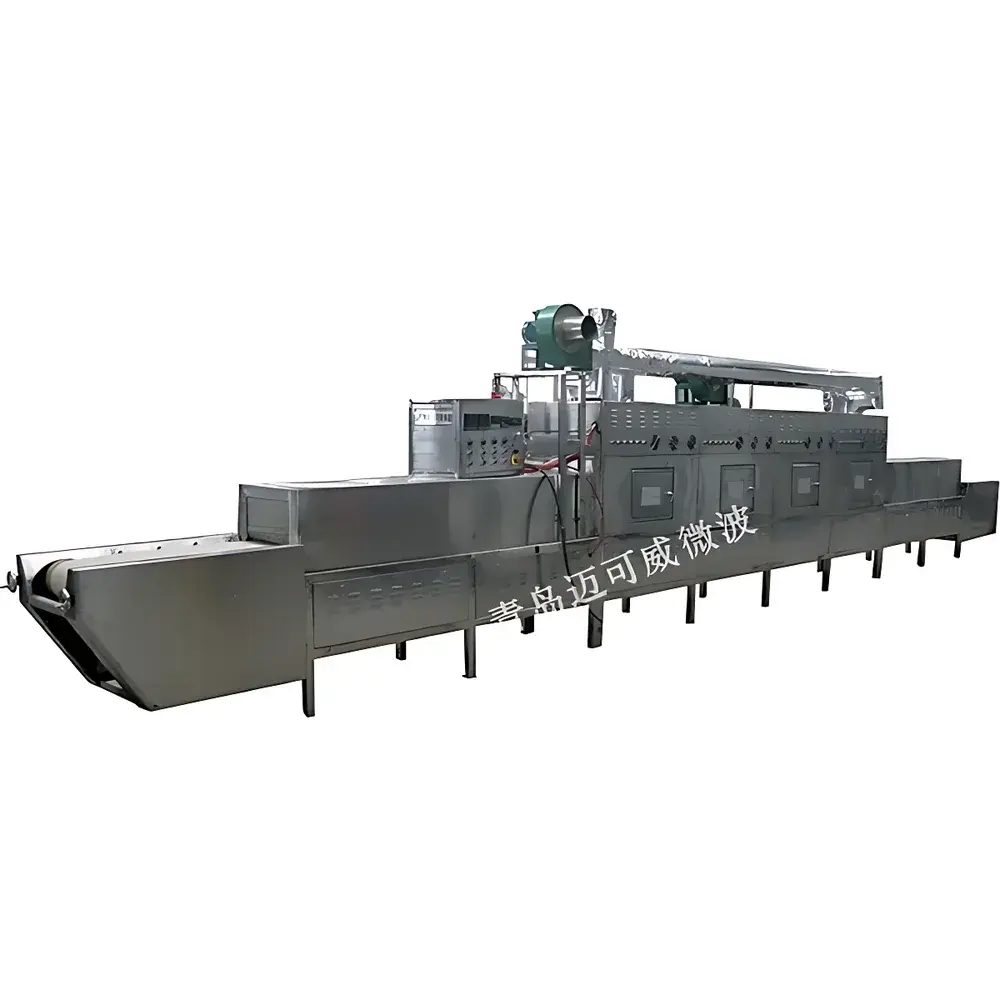
Tunnel-Type Food Sterilization System – Makewave MGS-G Series
| Brand | Makewave |
|---|---|
| Origin | Shandong, China |
| Manufacturer Type | Direct Manufacturer |
| Country of Origin | China |
| Model | MGS-G Series |
| Pricing | Upon Request |
Overview
The Makewave MGS-G Series Tunnel-Type Food Sterilization System is an industrial-scale, continuous-flow microwave processing platform engineered for thermal stabilization, pasteurization, and microbial reduction in food products. It operates on the principle of volumetric dielectric heating via 2450 MHz microwave energy, synergistically coupled with precisely controlled steam injection within a semi-enclosed cavity environment. This dual-mode (microwave + saturated steam) approach enables rapid, uniform temperature rise while maintaining product integrity—particularly critical for heat-sensitive items such as ready-to-eat meals, baked goods, dried fruits, and pre-packaged snacks. Unlike conventional hot-air or steam-tunnel systems, this design eliminates thermal lag and surface overheating by enabling simultaneous internal and external energy delivery. The system complies with GB 5959.6–2008 for industrial microwave equipment safety and integrates structural features protected under Chinese Utility Model Patent ZL201220045253.7—specifically its multi-environment cavity architecture, which supports not only sterilization but also optional defrosting (microwave + refrigeration) and rapid ambient heating (microwave + forced convection).
Key Features
- Continuous tunnel configuration with modular cavity assembly—each segment 1.1 m long, constructed from fully welded 304 stainless steel for corrosion resistance and structural rigidity
- Multi-source, multi-port broadband microwave feed system ensuring field homogeneity and reproducible energy distribution across the full conveyor width
- Semi-closed steam integration: Onboard steam generator with adjustable flow rate and recirculating fan system for precise humidity control during thermal treatment
- Food-grade PTFE-coated conveyor belt with dynamic feeding and electrically driven leveling mechanisms to accommodate variable load thicknesses—suitable for powders, granules, sliced solids, and sealed pouches
- Multi-point temperature monitoring using calibrated thermocouples or non-contact infrared sensors, with zone-wise PID control for segmented thermal profiling
- Integrated LED illumination and tempered borosilicate observation windows with λ/4 choke-backed microwave suppression—ensuring real-time visual process verification without radiation risk
- PLC-based control architecture with HMI touchscreen interface; parameters including power output (0–A kW), conveyor speed, dwell time, and setpoint temperature are fully programmable and logged
- Comprehensive safety subsystems: Microwave leakage <5 mW/cm² (measured per GB 5959.6–2008), interlocked access doors, remote emergency stop, and optional nitrogen inerting or water mist fire suppression
Sample Compatibility & Compliance
The MGS-G series accommodates a broad spectrum of food matrices—including viscous sauces, particulate-filled soups, frozen dough pieces, vacuum-sealed meats, and ambient-stable confectionery—without requiring pre-conditioning or unpacking. Its design adheres to ISO 9001:2015 quality management standards and meets mechanical and electrical safety requirements outlined in GB 5959.6–2008. While not certified to FDA 21 CFR Part 11 out-of-the-box, the system’s audit-trail-capable PLC controller and timestamped parameter logging support validation pathways for GMP/GLP environments. All wetted surfaces conform to FDA-compliant material specifications (304 SS, PTFE, food-grade elastomers), and steam generation uses softened water to prevent scaling in internal manifolds.
Software & Data Management
Control logic resides in an industrial-grade PLC with deterministic scan cycles and redundant I/O modules. The 10.1-inch resistive touchscreen HMI provides intuitive navigation through recipe selection, manual override, diagnostic menus, and real-time trend visualization. Process data—including actual vs. setpoint temperature profiles, microwave power modulation curves, conveyor velocity, and alarm history—is stored locally on SD card with CSV export capability. Optional Ethernet/IP or Modbus TCP connectivity enables integration into factory SCADA systems. Remote monitoring via secure web interface (HTTPS/TLS) is available as an add-on, supporting role-based user access and encrypted data transmission—facilitating centralized QA oversight across multiple production lines.
Applications
This system serves validated thermal processes across multiple food categories: microbial load reduction in RTE salads and deli meats (targeting >5-log reduction of Listeria monocytogenes); enzymatic deactivation in fruit purees; shelf-life extension of low-moisture snacks via moisture equilibration and pathogen control; and post-baking pasteurization of cereal bars. It has been successfully deployed in co-packing facilities handling USDA-inspected poultry products and EU-registered organic snack lines. The modularity allows scalability from pilot-scale R&D tunnels (10 m) to full-line integration (up to 30 m), with throughput capacities ranging from 100 kg/h to 2,500 kg/h depending on product density and dwell time requirements.
FAQ
What is the maximum allowable operating temperature inside the cavity?
The system is rated for sustained operation between 0 °C and 100 °C, with thermal control stability ±1.5 °C across all zones under steady-state conditions.
Can the system be validated for regulatory submissions (e.g., FDA, EFSA)?
Yes—the architecture supports IQ/OQ/PQ protocol execution. Documentation packages include FAT/SAT reports, traceable calibration records, and raw data archives compliant with ALCOA+ principles.
Is nitrogen blanketing supported as a standard feature?
Nitrogen purging is available as a factory-installed option, including pressure-regulated inlet manifold, O₂ sensor feedback loop, and interlock with microwave enable circuitry.
How is maintenance access designed for cleaning-in-place (CIP) procedures?
All cavity interior surfaces are accessible via hinged side panels and removable top covers; the conveyor drive mechanism is isolated behind service doors with IP54-rated enclosures.
Does the system meet electromagnetic compatibility (EMC) requirements for industrial environments?
It conforms to GB/T 17626 series (IEC 61000-4) for electrostatic discharge, radiated immunity, and conducted emissions—verified via third-party EMC testing report.



