
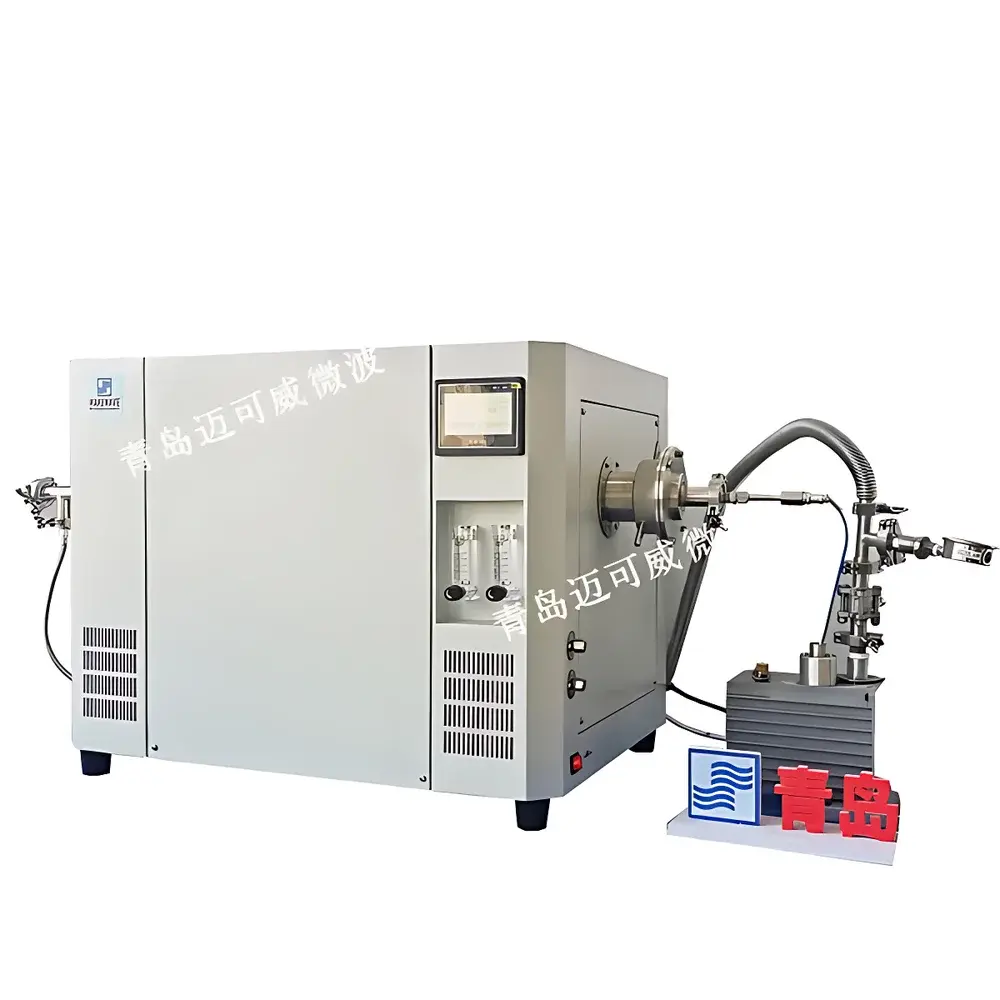
Makewave MKG-M4HD 1400°C Microwave-Heated Tube Furnace
| Brand | Makewave |
|---|---|
| Origin | Shandong, China |
| Manufacturer Type | Direct Manufacturer |
| Product Category | Domestic |
| Model | MKG-M4HD |
| Instrument Type | Tube Furnace |
| Maximum Temperature | 1400°C |
| Temperature Control Accuracy | ±3°C |
| Rated Power | 2400 W |
| Heating Time to Max Temp | 40 min |
| Heating Method | Microwave Energy |
| External Dimensions (W×H×D) | 1500 × 800 × 650 mm |
| Microwave Frequency | 2450 MHz |
| Microwave Power Output | 3200 W (continuous, non-pulsed, water-cooled magnetron) |
| Tube Diameter Compatibility | Φ100 mm |
| Vacuum Capability | 0 to –0.099 MPa |
| Cooling System | Air-cooled (water-cooling optional) |
| Weight | 90 kg |
| Compliance | ISO 9001 certified |
Overview
The Makewave MKG-M4HD is a high-temperature microwave-heated tube furnace engineered for advanced materials synthesis, thermal processing, and controlled-atmosphere reaction studies under precise thermodynamic conditions. Unlike conventional resistance-heated tube furnaces, the MKG-M4HD utilizes 2450 MHz continuous-wave microwave energy to directly couple with dielectric and conductive materials—enabling rapid, volumetric, and selective heating within a sealed Φ100 mm quartz or alumina tube. This hybrid architecture integrates the kinetic advantages of microwave heating (e.g., reduced thermal lag, enhanced reaction kinetics, and energy efficiency) with the environmental control rigor of a vacuum- and gas-compatible tubular system. The furnace operates across a functional temperature range of 500–1400°C (with short-term capability up to 1600°C), making it suitable for ceramic sintering, catalyst activation, precursor decomposition, carbonization, and solid-state reaction screening in academic labs, R&D centers, and quality control environments compliant with ISO/IEC 17025 workflows.
Key Features
- Integrated 3200 W water-cooled magnetron delivering non-pulsed, continuously adjustable microwave power for stable thermal profiles and reproducible heating cycles.
- Hermetically sealed 304 stainless steel microwave cavity with multi-layer embedded insulation: low-εr ceramic fiber modules (thermal conductivity ≈ 0.226 W/m·K) minimize radial heat loss and support sustained operation at 1400°C.
- Φ100 mm high-purity alumina tube (standard), compatible with alternative tube materials (e.g., quartz, silicon carbide) and customizable crucible systems (50–200 mL boat-type, multiple refractory compositions).
- Real-time infrared pyrometry for direct surface temperature measurement—bypassing thermocouple drift and positional uncertainty inherent in conventional furnace monitoring.
- PLC-based control architecture with 7-inch HMI touchscreen interface; supports multi-step programmable ramps, holds, and cooling profiles with simultaneous logging of time, temperature, and microwave power.
- Comprehensive safety engineering: conductive flange sealing, <5 mW/cm² microwave leakage (per GB 10436 and IEC 62233), dual-stage thermal shielding, and interlocked vacuum/gas manifold valves.
Sample Compatibility & Compliance
The MKG-M4HD accommodates powder, pellet, fiber, and thin-film specimens within its Φ100 mm cylindrical process zone. Its modular atmosphere management supports inert (N₂, Ar), reducing (H₂/N₂), oxidizing (O₂, air), and vacuum environments (down to –0.099 MPa). Vacuum compatibility enables oxide suppression during high-temperature annealing; gas-mixing ports (standardized VCR fittings) allow precise partial-pressure control for CVD-related processes. All structural and electrical components comply with ISO 9001:2015 manufacturing protocols. While not pre-certified for FDA 21 CFR Part 11, the data logging system supports audit-trail-ready CSV export—facilitating integration into GLP/GMP-aligned documentation frameworks. CE marking is available upon configuration-specific conformity assessment.
Software & Data Management
The embedded PLC controller records timestamped temperature, power, and vacuum/gas pressure data at user-defined intervals (1–60 s resolution). Historical profiles are stored internally (≥100 programs) and exportable via USB to CSV format for post-processing in MATLAB, Origin, or Excel. No proprietary software installation is required. Optional Ethernet or RS485 interfaces enable remote monitoring and SCADA-level integration in centralized lab automation systems. All parameter changes are logged with operator ID (if enabled) and timestamp—supporting traceability requirements under ISO/IEC 17025 Clause 7.7.
Applications
- Sintering of advanced ceramics (e.g., SiC, AlN, ZrO₂) with minimized grain growth and improved density uniformity.
- Thermal decomposition of metal-organic frameworks (MOFs) and precursors for battery cathode materials (e.g., LiCoO₂, NMC).
- In-situ reduction of metal oxides under H₂/N₂ to produce nanostructured catalysts with high surface area and phase purity.
- Graphitization and heteroatom doping of carbon nanomaterials under controlled CH₄/NH₃ atmospheres.
- Rapid thermal annealing (RTA) of semiconductor thin films (e.g., perovskites, chalcogenides) where conventional heating induces interdiffusion or decomposition.
- High-temperature calibration reference studies requiring fast thermal transients and minimal thermal mass interference.
FAQ
What tube materials are compatible with the MKG-M4HD?
Standard configuration includes a high-purity α-alumina tube (Φ100 mm × 600 mm). Quartz, silicon carbide, and molybdenum disilicide (MoSi₂) tubes can be integrated upon request—subject to microwave coupling behavior and maximum service temperature limits.
Can the furnace operate under dynamic gas flow conditions?
Yes. The system features dual mass-flow-controlled inlet lines and a regulated exhaust port, enabling steady-state flowing-atmosphere experiments up to 500 sccm total flow rate.
Is infrared temperature measurement validated against standard reference materials?
Emissivity compensation is user-adjustable (0.1–0.99); validation using NIST-traceable blackbody sources or calibrated thermocouples in auxiliary test fixtures is recommended for critical metrology applications.
What electrical infrastructure is required for installation?
380 V AC, 3-phase, 50 Hz supply with dedicated 32 A circuit breaker and proper grounding per IEC 60364. A minimum 1.5 m clearance around the unit is advised for ventilation and service access.
Does the system support automated vacuum ramping and gas purging sequences?
Yes. Vacuum hold-and-purge cycles (e.g., 3× evacuation-refill) can be programmed as part of multi-step thermal profiles via the HMI interface.



