
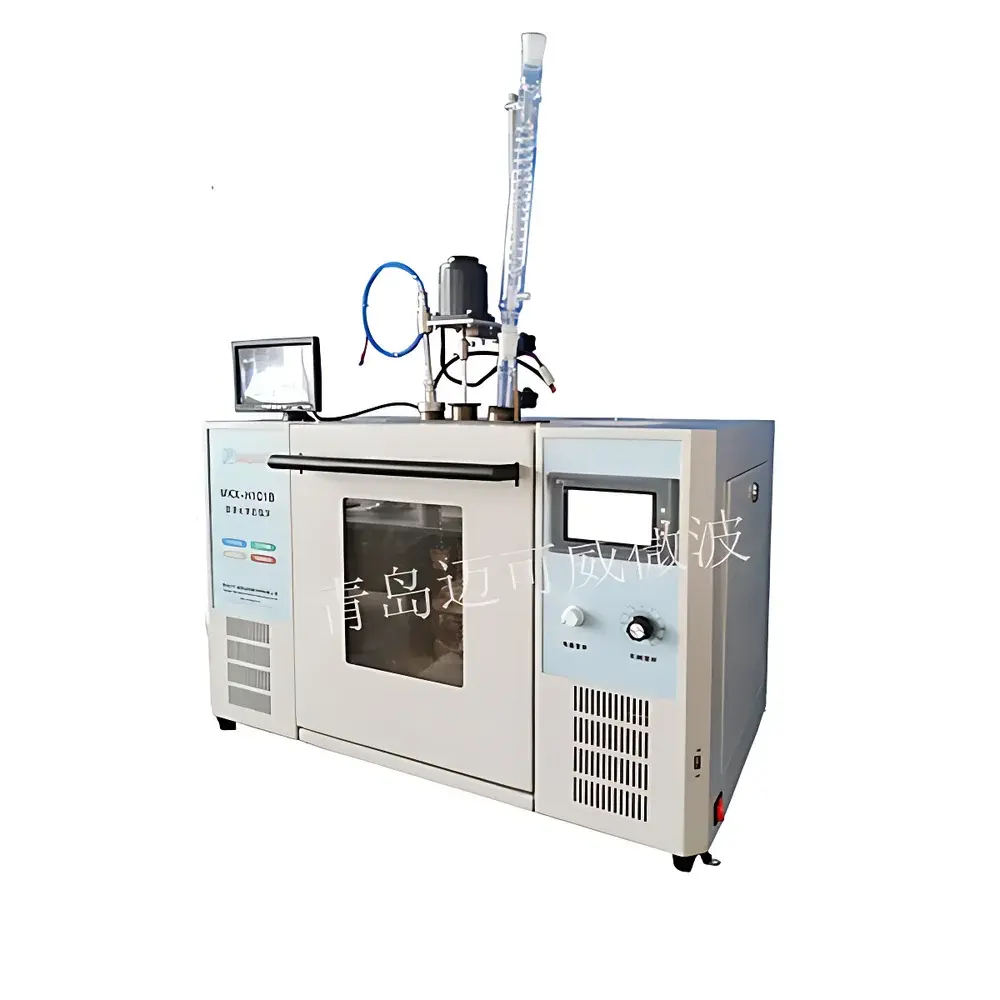
MakeWave MKX-H1C1B Open-Mode Atmospheric Microwave Synthesizer
| Brand | MakeWave |
|---|---|
| Origin | Shandong, China |
| Manufacturer Type | Direct Manufacturer |
| Model | MKX-H1C1B |
| Temperature Range | 0–300 °C |
| Pressure Mode | Atmospheric (Open-Vessel) |
| Microwave Power | 800 W (Continuous, Non-pulsed) |
| Frequency | 2450 MHz |
| Stirring Modes | Mechanical + Magnetic Stirring |
| Reaction Volume | 500 mL |
| Cavity Volume | ~20 L |
| Power Supply | 220 V AC / 50 Hz |
| Total Power Consumption | 1300 W |
| Net Weight | 50 kg |
| Safety Leakage | <5 mW/cm² (IEC 61000-4-3 compliant) |
Overview
The MakeWave MKX-H1C1B is an open-mode atmospheric microwave synthesizer engineered for reproducible, controllable, and scalable chemical synthesis under ambient pressure conditions. Unlike sealed-vessel high-pressure systems, this platform leverages continuous 2450 MHz microwave irradiation to selectively couple with polar molecules and ionic species—enabling rapid volumetric heating of reaction mixtures without thermal lag. Its design targets laboratories requiring robust, non-pressurized microwave-assisted synthesis across organic, inorganic, medicinal, and materials chemistry workflows. The instrument integrates a thermocouple-based real-time temperature feedback loop with closed-loop microwave power modulation, ensuring precise thermal management during exothermic or endothermic transformations. With a maximum operational temperature of 300 °C and compatibility with standard 500 mL three-neck glass reactors, the MKX-H1C1B bridges the gap between conventional oil-bath heating and high-pressure microwave reactors—offering enhanced reaction kinetics, improved selectivity, and reduced side-product formation in solvent-mediated and solvent-free protocols.
Key Features
- Atmospheric open-vessel architecture with integrated reflux condensation capability—enabling volatile solvent retention and extended reaction durations without pressurization.
- 20 L stainless-steel cavity (304 grade), fully welded and internally coated with multi-layer PTFE for corrosion resistance against acids, bases, and oxidants at elevated temperatures.
- Dual stirring system: PTFE-coated anchor-type mechanical stirrer (variable-speed DC motor) and magnetic stir bar (PTFE-encapsulated), supporting heterogeneous catalysis and viscous media handling.
- Real-time process monitoring via high-intensity LED illumination and optional color video feed through a λ/4 choke-sealed observation window—facilitating visual assessment of phase separation, precipitation, or reflux dynamics.
- PLC-based control architecture with 7-inch resistive touchscreen interface; supports up to 10 programmable methods with independent time–temperature–power profiles.
- Comprehensive safety suite: interlocked door mechanism (instant microwave cutoff on opening), elastic translational pressure-release latch, and EMI-suppressed waveguide choke structure meeting IEC 61000-4-3 emission limits.
Sample Compatibility & Compliance
The MKX-H1C1B accommodates standard borosilicate glassware—including 500 mL three-neck flasks equipped with thermometer ports, reflux condensers, and inert gas inlets—making it compatible with ASTM E2877-22 (microwave-assisted sample preparation) and ISO 21729:2020 (laboratory microwave equipment safety). Its open-system configuration avoids vessel rupture risks associated with sealed high-pressure protocols while maintaining compliance with GLP documentation requirements through audit-trail-capable data logging. All electrical and RF safety certifications align with GB 4706.21 (China) and IEC 61010-1:2010 for laboratory equipment. The unit is ISO 9001:2015 certified for manufacturing quality control.
Software & Data Management
Operational parameters—including real-time temperature, applied microwave power, elapsed time, and user-defined setpoints—are continuously recorded and plotted as synchronized curves on the HMI display. Data export is supported via USB 2.0 to CSV format for post-acquisition analysis in MATLAB, OriginLab, or Excel. The PLC controller retains historical run logs with timestamps and operator IDs, satisfying basic 21 CFR Part 11 traceability prerequisites when deployed in regulated QC/QA environments. No proprietary software installation is required; all configuration and diagnostics occur locally via the embedded interface.
Applications
This synthesizer is routinely employed in academic and industrial labs for: microwave-accelerated Suzuki and Heck cross-couplings; nanoparticle synthesis (e.g., metal oxides, perovskites); polymerization initiations (RAFT, ATRP); natural product extraction (polyphenols, alkaloids); catalyst screening under air or nitrogen; and solid-state reactions involving metal–organic frameworks (MOFs). Its atmospheric operation supports in situ FTIR sampling via dedicated ports and enables direct coupling with online GC or HPLC systems for kinetic profiling. Users in food safety, agrochemical R&D, and environmental testing leverage its reproducibility for EPA Method 3546-compliant extractions.
FAQ
Is the MKX-H1C1B suitable for reactions requiring inert atmosphere?
Yes—standard three-neck flasks allow N₂ or Ar purging via inlet/outlet adapters.
Can the system accommodate larger reaction volumes?
While optimized for 500 mL, custom mounting brackets support 1000 mL vessels as an optional upgrade.
What type of temperature sensor is used, and where is it positioned?
A calibrated K-type thermocouple is inserted directly into the reaction mixture via the central neck of the flask.
Does the unit meet international electromagnetic compatibility standards?
Yes—it complies with IEC 61000-4-3 (radiated immunity) and IEC 61000-6-3 (emission limits for industrial environments).
Is remote monitoring or network connectivity available?
Not natively; however, analog output signals (4–20 mA) for temperature and power are accessible via terminal block for integration with external SCADA systems.



