
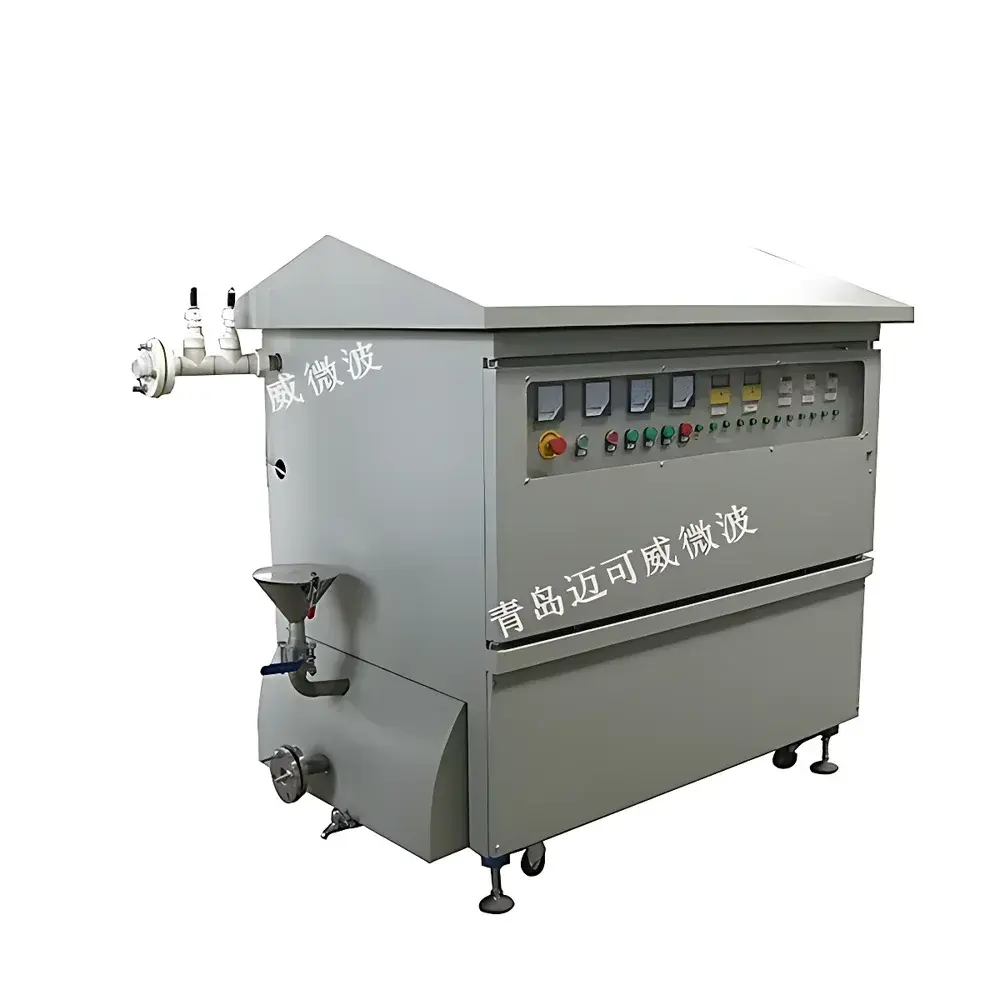
Makewave MGG-J Series In-Line Continuous Microwave Heating System
| Brand | Makewave |
|---|---|
| Origin | Shandong, China |
| Manufacturer Type | OEM Manufacturer |
| Country of Origin | China |
| Model | MGG-J Series |
| Pricing | Upon Request |
| Microwave Frequency | 2450 MHz |
| Max Operating Temperature | 100 °C |
| Temperature Control Range | 0–100 °C |
| Microwave Leakage | <5 mW/cm² |
| Compliance | GB 5959.6–2008 |
| Safety Certification | ISO 9001 Certified |
| Power Supply | 380 V AC / 50 Hz |
| Cavity Material | AISI 304 Stainless Steel |
| Feed System | Automated Liquid Inlet/Outlet with Flow Control |
| Control Interface | PLC + Touchscreen HMI |
| Optional Features | Remote Monitoring, N₂ Purge, Water Mist Fire Suppression |
Overview
The Makewave MGG-J Series In-Line Continuous Microwave Heating System is an engineered solution for precise, uniform, and scalable thermal processing of flowing liquid and slurry-phase materials in industrial pipelines. Unlike conventional conductive or convective heating methods, this system employs 2450 MHz microwave energy to induce volumetric dielectric heating directly within the material stream—enabling rapid, selective, and energy-efficient temperature elevation without significant thermal lag or wall fouling. Designed specifically for continuous-flow operation, it integrates seamlessly into existing process lines in food processing, chemical synthesis, wastewater treatment, and bio-based product manufacturing. The system operates under controlled micro-positive pressure conditions and supports dynamic flow rates across a wide viscosity range, making it suitable for Newtonian and non-Newtonian fluids as well as heterogeneous suspensions.
Key Features
- Industrial-grade continuous-wave microwave generation using frequency-stabilized magnetron power supplies, rated for uninterrupted duty cycles in 24/7 production environments.
- Multi-source, multi-port broadband microwave coupling architecture ensures homogeneous field distribution across the entire cross-section of the 304 stainless steel heating cavity—minimizing hot/cold spots and maximizing thermal reproducibility.
- Integrated horizontal serpentine coil configuration (engineered from chemically resistant engineering plastics) provides extended residence time while maintaining laminar-to-transitional flow profiles for consistent exposure to microwave energy.
- Closed-loop temperature control via calibrated thermocouples (Type K or Pt100, configurable), synchronized with real-time microwave power modulation to maintain setpoint accuracy within ±1.5 °C across the 0–100 °C operational range.
- Programmable logic controller (PLC)-based automation platform with industrial touchscreen HMI enables intuitive setup of multi-stage heating protocols, including ramp-hold-cool sequences, flow rate ramping, and interlocked safety shutdowns.
- λ/4 choke-based microwave suppression at all flanged interfaces meets and exceeds GB 5959.6–2008 requirements, with verified leakage levels consistently below 5 mW/cm² at 5 cm distance—ensuring operator safety and regulatory compliance.
Sample Compatibility & Compliance
The MGG-J series accommodates aqueous solutions, organic solvents, emulsions, enzyme-containing broths, and particulate-laden slurries with solids content up to 30 wt% (subject to particle size and dielectric loss factor). It is compatible with sanitary tri-clamp, DIN 11851, and ANSI B16.5 piping standards. All wetted components comply with FDA 21 CFR §177.2400 (food-contact polymers) and EU Regulation (EC) No. 1935/2004. Electrical safety adheres to IEC 61000-6-2/6-4 for industrial electromagnetic compatibility. The system is certified to ISO 9001:2015 for design, manufacturing, and after-sales service processes—and may be validated per ASTM E2888 (Standard Guide for Microwave Processing of Materials) upon customer request.
Software & Data Management
The embedded control firmware supports data logging of temperature, flow rate, forward/reflected microwave power, and system status flags at user-defined intervals (100 ms to 60 s resolution). Logged datasets are timestamped, stored locally on SD card or internal flash memory, and exportable in CSV format. Optional Ethernet/IP or Modbus TCP connectivity allows integration into MES/SCADA platforms for centralized monitoring and batch record generation. Audit trail functionality—including user login history, parameter change logs, and alarm event timestamps—supports GLP/GMP-aligned documentation requirements. Remote access capability (via secure VPN or TLS-encrypted web interface) enables off-site diagnostics and preventive maintenance scheduling.
Applications
- Continuous pasteurization of dairy, juice, and plant-based beverages without thermal degradation of heat-sensitive nutrients or flavor compounds.
- In-line preheating of reaction feedstocks prior to catalytic hydrogenation or enzymatic transesterification in fine chemical and biodiesel production.
- Thermal conditioning of anaerobic digestate streams to enhance biogas yield and pathogen reduction in municipal wastewater treatment plants.
- Rapid solvent removal and concentration of pharmaceutical intermediates in continuous manufacturing workflows compliant with ICH Q5C and Q8(R2).
- Controlled thermal activation of polymer dispersions and nanocomposite precursors in advanced materials R&D laboratories.
FAQ
What types of fluids can be processed in the MGG-J system?
It is validated for low-to-medium viscosity liquids (0.5–5000 cP), water-based emulsions, and stable suspensions containing particles ≤200 µm. Highly conductive brines or metal-rich slurries require prior dielectric characterization.
Is the system compatible with clean-in-place (CIP) procedures?
Yes—the fully drainable serpentine coil path and smooth-welded 304 SS cavity support standard alkaline-acid CIP cycles; gasket materials are selected per FDA-compliant elastomer specifications.
Can the system be integrated into an existing PLC-controlled plant network?
Absolutely. Native Modbus RTU/TCP and optional Profibus DP gateways enable bidirectional communication with DCS systems, including real-time setpoint synchronization and alarm forwarding.
Does the equipment meet international export standards for microwave emission?
Yes—microwave shielding performance has been independently verified against IEC 61000-3-2 (harmonics) and CISPR 11 Group 2 Class A limits, in addition to domestic GB 5959.6–2008 compliance.
What validation documentation is provided with the system?
Factory acceptance test (FAT) reports, traceable calibration certificates for all sensors, electrical safety test records, and a comprehensive IQ/OQ protocol template aligned with ASTM E2500-13 are included in the delivery package.



