
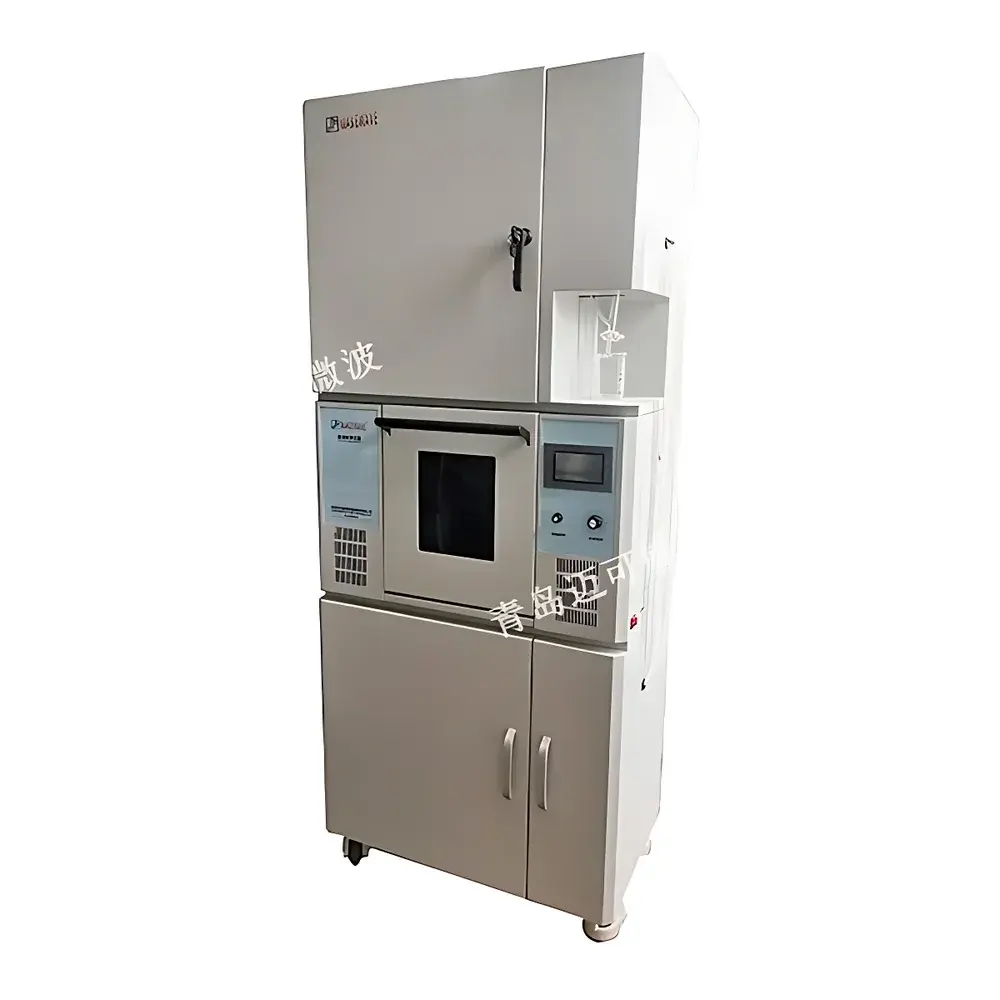
Makewave MSX-E1A Commercial Microwave-Assisted Plant Extraction System
| Brand | Makewave |
|---|---|
| Origin | Shandong, China |
| Manufacturer Type | Direct Manufacturer |
| Model | MSX-E1A |
| Microwave Power | 800 W (continuous, non-pulsed) |
| Microwave Frequency | 2450 MHz |
| Temperature Control Range | 0–100 °C (up to 150 °C peak) |
| Temperature Accuracy | ±1% of setpoint |
| Cavity Material | Seamless 304 stainless steel with multi-layer PTFE coating |
| Cavity Volume | ~20 L |
| Extraction Vessel Capacity | 2 L (open-system, reflux-compatible) |
| Safety Leakage | <5 mW/cm² |
| Power Supply | 220 VAC, 50 Hz |
| Total Power Consumption | 3000 W |
| Dimensions (W×H×D) | 782 × 1700 × 450 mm |
| Weight | 85 kg |
| Certification | ISO 9001 compliant |
Overview
The Makewave MSX-E1A is a purpose-engineered commercial microwave-assisted extraction (MAE) system designed for reproducible, scalable phytochemical isolation in laboratory and pilot-scale production environments. Unlike conventional domestic or research-grade microwave reactors, the MSX-E1A integrates industrial-grade thermal management, closed-loop process control, and modular reaction architecture to support validated botanical extraction workflows—including essential oil recovery, hydrosol generation, and polar/non-polar compound isolation from plant matrices. Its core operation relies on controlled 2450 MHz microwave energy absorption by solvent–matrix systems, enabling rapid, volumetric heating that enhances mass transfer kinetics while minimizing thermal degradation of thermolabile compounds. The system complies with fundamental principles outlined in AOAC Official Method 2006.02 and ASTM D7675-15 for microwave-assisted sample preparation, and its robust mechanical design supports GLP-aligned operational documentation when integrated with compliant data management protocols.
Key Features
- Continuous-wave 800 W microwave source operating at 2450 MHz, delivering stable, non-pulsed energy output for uniform dielectric heating across heterogeneous plant–solvent mixtures.
- 20 L reaction cavity constructed from seamless 304 stainless steel with multi-layer PTFE interior coating—resistant to organic solvents, mineral acids, and alkaline media up to 150 °C; facilitates easy cleaning and long-term corrosion resistance.
- Integrated 2 L open-type extraction vessel with dynamic feed, liquid addition, and condensate reflux capability—enabling sequential or continuous-mode extractions under temperature- and pressure-monitored conditions.
- Real-time infrared temperature monitoring via side-wall measurement on the extraction vessel, coupled with PID-controlled power modulation to maintain ±1% setpoint accuracy across 0–100 °C (extended range up to 150 °C).
- Optional ultrasonic probe integration (via external port) and built-in mechanical stirring mechanism—supporting synergistic MAE–ultrasound or MAE–mechanical dispersion protocols for recalcitrant biomass.
- PLC-based control architecture with 7-inch capacitive touchscreen interface, supporting multi-step program storage, real-time graphical display of time–temperature–power profiles, and USB-exportable CSV data logs.
Sample Compatibility & Compliance
The MSX-E1A accommodates diverse botanical feedstocks—including dried herbs, fresh leaves, seeds, and flower petals—in both aqueous and organic solvent systems (e.g., water, ethanol, hexane, ethyl acetate). Its open-vessel configuration permits direct handling of particulate-laden slurries without clogging risk. All wetted surfaces meet USP Class VI and FDA-compliant material standards where applicable. The system satisfies electromagnetic safety requirements per GB 4706.21 (China) and exceeds IEC 61000-3-2 harmonic emission limits. Microwave leakage remains below 5 mW/cm² at 5 cm distance (measured per IEEE Std 1528), ensuring operator safety during extended operation. ISO 9001:2015 quality management certification confirms consistent manufacturing traceability and documented calibration procedures for critical subsystems.
Software & Data Management
The embedded HMI runs deterministic ladder-logic firmware with non-volatile memory for ≥100 user-defined extraction protocols. Each run generates timestamped datasets containing temperature history, cumulative energy input (kJ), real-time power draw (% of 800 W), and elapsed time—exportable via USB to standard spreadsheet formats. Audit trails are preserved locally for 30 days; optional RS-485 Modbus RTU interface enables integration with centralized LIMS or SCADA platforms. While not natively 21 CFR Part 11 compliant, the system supports third-party electronic signature add-ons and manual SOP alignment for regulated QC/QA laboratories conducting method validation per ICH Q2(R2).
Applications
- Essential oil and hydrosol production from citrus peels, lavender, eucalyptus, and mint via steam-distillation-coupled MAE.
- Rapid polyphenol and flavonoid extraction from green tea, grape pomace, and rosemary for nutraceutical R&D.
- Accelerated alkaloid isolation (e.g., caffeine, berberine) from plant roots and barks using acidified methanol/water systems.
- Development of green extraction protocols compliant with ISO 14040 life cycle assessment frameworks—reducing solvent volume and energy consumption versus Soxhlet or maceration.
- Pilot-scale feasibility studies prior to industrial-scale continuous-flow MAE reactor deployment.
FAQ
What types of solvents are compatible with the MSX-E1A?
Polar solvents (water, methanol, ethanol, acetone) and moderately polar solvents (ethyl acetate, dichloromethane) are fully supported. Non-polar solvents (hexane, toluene) require careful vapor pressure management and are recommended only with active condensate reflux and ventilation.
Can the system operate unattended for extended periods?
Yes—programmable multi-stage sequences with automatic shutdown upon completion or thermal fault detection allow overnight operation. However, initial method development should include supervised runs to verify reflux stability and pressure equilibrium.
Is the 2 L vessel pressurized during operation?
No—the MSX-E1A uses an atmospheric open-vessel design. Reflux is achieved through active condensation and gravity return; no sealed high-pressure containment is employed.
Does the system support GLP-compliant data archiving?
Raw data export is provided in machine-readable format. For full GLP compliance, users must implement external validation of the HMI’s clock synchronization, define data retention policies, and apply procedural controls for electronic record integrity per ALCOA+ principles.
What maintenance is required for sustained performance?
Monthly inspection of door seal integrity, quarterly verification of IR sensor calibration against NIST-traceable reference sources, and annual replacement of PTFE cavity coating if abrasion or discoloration is observed.



