
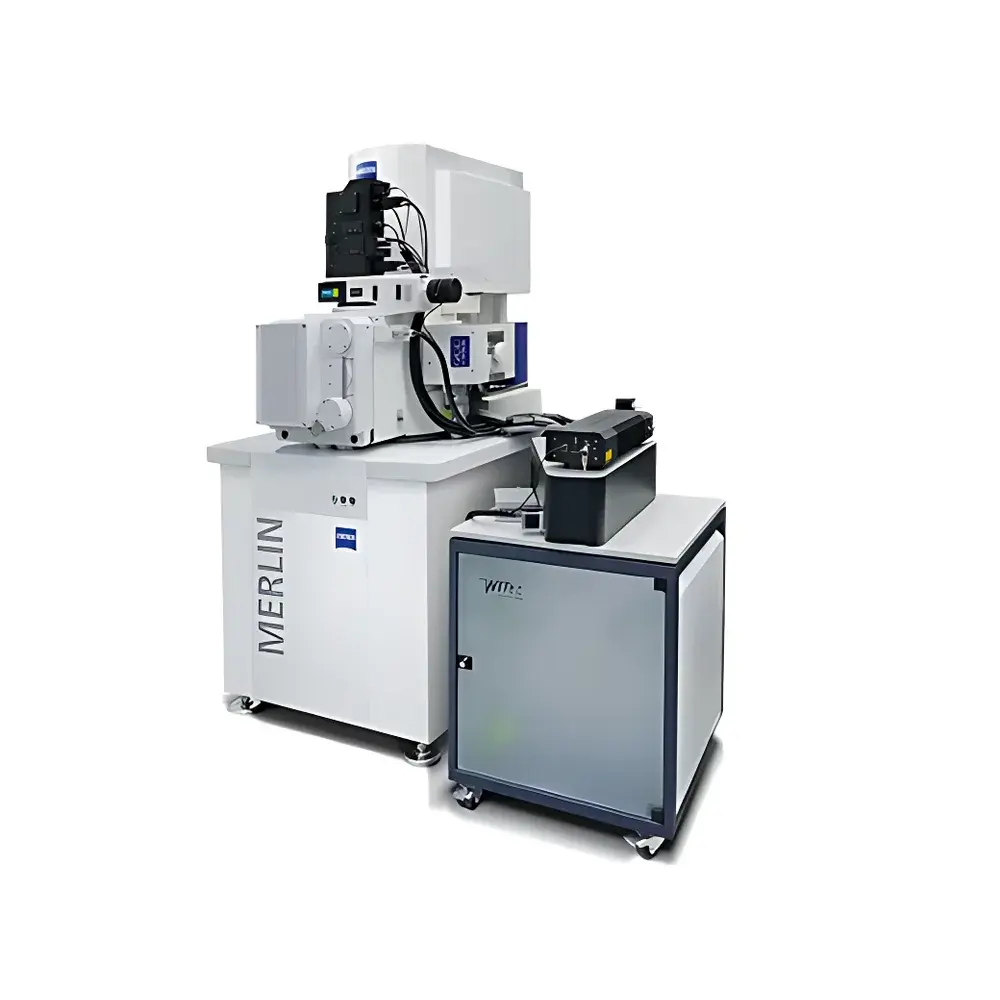
WITec RISE Microscope – Integrated Raman Imaging and Scanning Electron Microscope
| Brand | WITec |
|---|---|
| Origin | Germany |
| Model | RISE |
| Instrument Type | Confocal Raman Imaging Microscope coupled with SEM |
| Spectral Range | 90–9000 cm⁻¹ |
| Spectral Resolution | ≤1 cm⁻¹ |
| Spatial Resolution | Lateral 360 nm, Axial 900 nm |
| Minimum Wavenumber | 10 cm⁻¹ |
| Spectral Reproducibility | ≤±0.02 cm⁻¹ |
Overview
The WITec RISE Microscope is the world’s first fully integrated Raman Imaging and Scanning Electron Microscope (RISE), co-engineered with TESCAN and ZEISS electron microscope platforms. It merges high-resolution scanning electron microscopy (SEM) with confocal Raman spectroscopic imaging in a single vacuum-compatible instrument architecture. Unlike add-on or post-acquisition correlation systems, RISE enables true in situ, real-time correlation of topographic, morphological, and elemental data (from SEM and optional EDX) with molecular fingerprinting at sub-micrometer spatial resolution. The system operates on the principle of confocal Raman scattering—where monochromatic laser excitation (typically 532 nm) induces inelastic photon scattering from vibrational modes of chemical bonds—and integrates optical path alignment, stage coordination, and vacuum-compatible sample handling to ensure seamless transition between imaging modalities without breaking vacuum or repositioning the sample manually.
Key Features
- Fully synchronized, vacuum-integrated dual-modality platform: simultaneous SEM imaging and confocal Raman mapping within the same chamber
- Automated stage navigation enabling precise, repeatable relocation of regions-of-interest (ROIs) between SEM survey imaging and Raman hyperspectral acquisition
- High-throughput Raman imaging: up to 90,000 spectra per map (e.g., 300 × 300 pixels), with acquisition times as low as 0.76 ms per spectrum using the Ultrafast Raman Imaging option
- Confocal optical design delivering lateral resolution of 360 nm and axial resolution of 900 nm under 532 nm excitation
- High-throughput lens-based spectrometer with optimized light collection efficiency, supporting spectral resolution ≤1 cm⁻¹ and reproducibility ≤±0.02 cm⁻¹ across the full 10–9000 cm⁻¹ range
- True 3D Raman tomography capability via automated Z-stack acquisition, enabling depth-resolved molecular distribution profiling
- Non-destructive, label-free analysis—no staining, coating, or sectioning required for most solid-state samples
- Unified software interface (WITec Project PLUS) for instrument control, spectral processing, multivariate analysis (PCA, cluster analysis), and overlay rendering of SEM, EDX, and Raman data
Sample Compatibility & Compliance
The RISE Microscope accommodates a broad range of solid, heterogeneous, and beam-sensitive specimens—including geological thin sections, polymer blends, semiconductor wafers, biological tissue cryosections, pharmaceutical tablets, and nanocomposites—without requiring conductive coating when operated in low-vacuum or beam-brightening mode. Its vacuum-compatible optical path supports integration with standard SEM detectors (ETD, BSE, STEM-in-SEM) and energy-dispersive X-ray spectroscopy (EDX) modules. Data acquisition and storage comply with GLP/GMP-aligned workflows: Project PLUS software supports audit trails, user access control, electronic signatures, and metadata-rich HDF5 file export, meeting requirements for regulatory submissions under FDA 21 CFR Part 11 where applicable. All spectral calibrations are traceable to NIST-certified standards; spectral stability is verified daily via silicon reference peaks.
Software & Data Management
WITec Project PLUS serves as the central operating environment, providing unified control over both SEM and Raman subsystems. It enables synchronized acquisition scripting, real-time spectral preview during mapping, and pixel-wise spectral fitting using Voigt deconvolution or multivariate curve resolution (MCR). Hyperspectral datasets are stored in open-format HDF5 containers, preserving raw intensity, wavelength calibration, stage coordinates, and acquisition parameters. Batch processing supports automated baseline correction, cosmic ray removal, normalization, and PCA-driven segmentation. Overlay functionality allows quantitative registration of Raman-derived chemical maps (e.g., PMMA vs PS phase distribution) onto SEM topography or EDX elemental maps—with sub-pixel spatial alignment validated via fiducial markers or cross-correlation algorithms. Export options include TIFF, CSV, and industry-standard JCAMP-DX for spectral exchange.
Applications
The RISE platform delivers unique correlative insights across multiple domains. In materials science, it resolves phase segregation in GaAs heterostructures and identifies residual contaminants at grain boundaries. In polymer science, it quantifies domain size, interfacial thickness, and crystallinity gradients in PMMA-PS blends without staining. Geological applications include mineral identification (e.g., distinguishing epidote, quartz, and albite in metamorphic rocks) alongside EDX-derived cation ratios—enabling petrogenetic interpretation at micron scale. In life sciences, RISE has been used to map lipid-protein distributions in unstained brain tissue sections (white vs gray matter differentiation via CH₂/CH₃ band ratios), preserving native biochemistry. Pharmaceutical development benefits from tablet coating uniformity assessment, API polymorph mapping, and excipient-drug interaction studies—all performed non-destructively and in ambient or controlled atmosphere conditions.
FAQ
Can RISE operate without breaking vacuum when switching between SEM and Raman modes?
Yes. The RISE system maintains high vacuum (<10⁻⁵ mbar) throughout multimodal acquisition. Optical components are sealed and aligned for vacuum compatibility; no venting or mechanical reconfiguration is required.
Is RISE compatible with third-party SEM platforms beyond TESCAN and ZEISS?
Integration is currently certified for TESCAN MIRA and ZEISS SIGMA series SEMs. Custom integration with other field-emission SEMs is possible subject to vacuum interface, stage communication protocol (e.g., RS-232, TCP/IP), and chamber port availability.
What laser wavelengths are supported?
Standard configuration uses 532 nm excitation. Optional modules support 488 nm, 633 nm, and 785 nm lasers—selected based on sample fluorescence, absorption, and required spatial resolution.
Does RISE support time-resolved or stimulated Raman measurements?
No. RISE is designed for steady-state confocal Raman imaging. Time-resolved or SRS capabilities require external ultrafast laser systems and are outside its architectural scope.
How is spectral calibration maintained during long-duration mapping sessions?
An internal Si reference is measured automatically before and after each map; drift compensation is applied in post-processing using peak centering algorithms embedded in Project PLUS.
Related Products




