
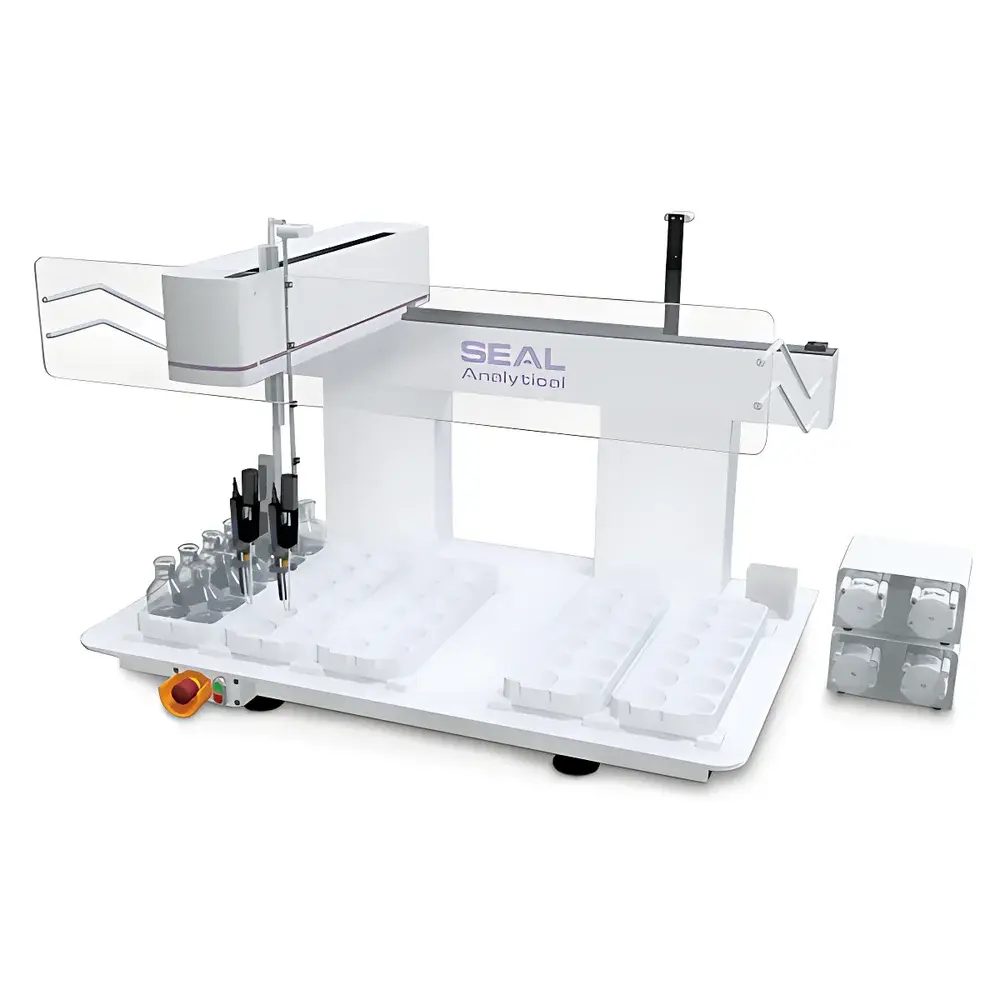
SEAL Minilab 1200 BOD Analyzer
| Brand | SEAL |
|---|---|
| Origin | Netherlands |
| Manufacturer Type | Authorized Distributor |
| Origin Category | Imported |
| Model | Minilab 1200 BOD |
| Pricing | Available Upon Request |
Overview
The SEAL Minilab 1200 BOD Analyzer is a fully automated benchtop system engineered for precise, reproducible, and compliant biochemical oxygen demand (BOD) measurement in environmental, municipal, and industrial wastewater laboratories. It implements the dilution method—per ASTM D5210, ISO 5815-1, EN 1899-1/2, EPA Method 405.1, Standard Methods 5210 B, and DIN 38409—by precisely controlling sample handling, dilution, pH adjustment, nitrification inhibition, aeration, and dissolved oxygen (DO) monitoring over standard 5-day incubation periods. Unlike manual or semi-automated approaches, the Minilab 1200 eliminates operator variability through programmable liquid handling, integrated barcode recognition for sample traceability, and closed-vessel DO measurement using Clark-type or optical DO sensors. Its modular architecture supports sequential or parallel analysis of up to 12 samples per run, with optional integration into larger laboratory automation workflows via LIMS-compatible communication protocols.
Key Features
- Fully automated sample processing: aspiration, pre-dilution, cap sealing/unsealing, pH measurement and adjustment (via integrated pH electrode), addition of diluent and nitrification inhibitor (allylthiourea, ATU), controlled aeration, and homogenization.
- Multi-parameter compatibility: interchangeable sensor modules enable concurrent or standalone measurement of pH, conductivity, alkalinity, turbidity, and color—reducing instrument footprint and cross-method validation overhead.
- Regulatory-grade compliance: built-in method templates for EPA 405.1, ISO 5815-1, EN 1899-1/2, and Standard Methods 5210 B; full audit trail generation aligned with GLP and GMP requirements.
- Robust sample identification: integrated barcode scanner validates sample ID at intake, ensuring chain-of-custody integrity and preventing misassignment during batch processing.
- Intelligent quality control: real-time DO drift compensation, automatic blank correction, and result validation against acceptance criteria (e.g., DO depletion ≥2.0 mg/L and residual DO ≥1.0 mg/L per ISO 5815-1).
Sample Compatibility & Compliance
The Minilab 1200 accepts standard 300 mL BOD bottles (glass or PET) and accommodates raw wastewater, treated effluent, surface water, and industrial process streams. Sample turbidity up to 1000 NTU and suspended solids ≤1000 mg/L are supported without filtration—provided representative subsampling is performed per ISO 5667-3. All operational parameters—including incubation temperature (20.0 ± 0.5 °C), mixing frequency, DO sensor calibration intervals, and dilution factor selection—are configurable and logged with timestamped metadata. The system complies with data integrity requirements under FDA 21 CFR Part 11 when deployed with electronic signature-enabled software, including user-level access control, immutable audit trails, and electronic record retention for ≥15 years.
Software & Data Management
Control and data acquisition are managed via SEAL’s proprietary Minilab Control Software, a Windows-based application supporting method configuration, real-time monitoring, and automated report generation in PDF or CSV format. Raw sensor outputs (mV, µS/cm, NTU, etc.), calculated BOD values (mg O₂/L), intermediate metrics (initial/final DO, pH shift, dilution ratio), and QC flags are stored in a relational database with SQL export capability. The software includes built-in validation tools for linearity checks, spike recovery assessment, and inter-bottle precision evaluation (RSD ≤5% for replicate analyses). Data export formats meet LIMS ingestion requirements (ASTM E1467, HL7) and support direct integration with enterprise systems via OPC UA or RESTful API endpoints.
Applications
- Wastewater treatment plant (WWTP) compliance monitoring per national discharge permits (e.g., EU Urban Wastewater Treatment Directive, US Clean Water Act NPDES).
- Environmental impact assessments for industrial effluents prior to discharge licensing.
- Research and development of biodegradability profiles for new chemical formulations (OECD 301 series alignment).
- Validation of tertiary treatment efficiency in membrane bioreactors (MBRs) and constructed wetlands.
- Academic teaching labs requiring standardized, repeatable BOD methodology with minimal hands-on intervention.
FAQ
Does the Minilab 1200 support unattended overnight operation?
Yes—the system is designed for continuous 5-day incubation cycles with automated start/stop sequencing, power-failure recovery, and temperature-stable incubator integration.
Can it analyze samples with high chlorine residuals?
Chlorine interference is mitigated by default sodium thiosulfate quenching during dilution; optional post-quench pH stabilization ensures accurate DO kinetics.
Is method validation documentation provided?
SEAL supplies IQ/OQ documentation packages, including performance qualification protocols, sensor calibration certificates, and reference material traceability statements (NIST-traceable standards).
What maintenance is required for long-term reliability?
Scheduled maintenance includes quarterly DO sensor membrane replacement, annual pH electrode recalibration, and biannual fluidic path inspection—documented in the onboard service log.
How does it handle low-BOD samples (<5 mg/L)?
The system employs high-resolution optical DO sensors (detection limit: 0.02 mg/L) and adaptive dilution algorithms to maintain measurement uncertainty within ±0.5 mg/L across the 0–50 mg/L range.
Related Products




