
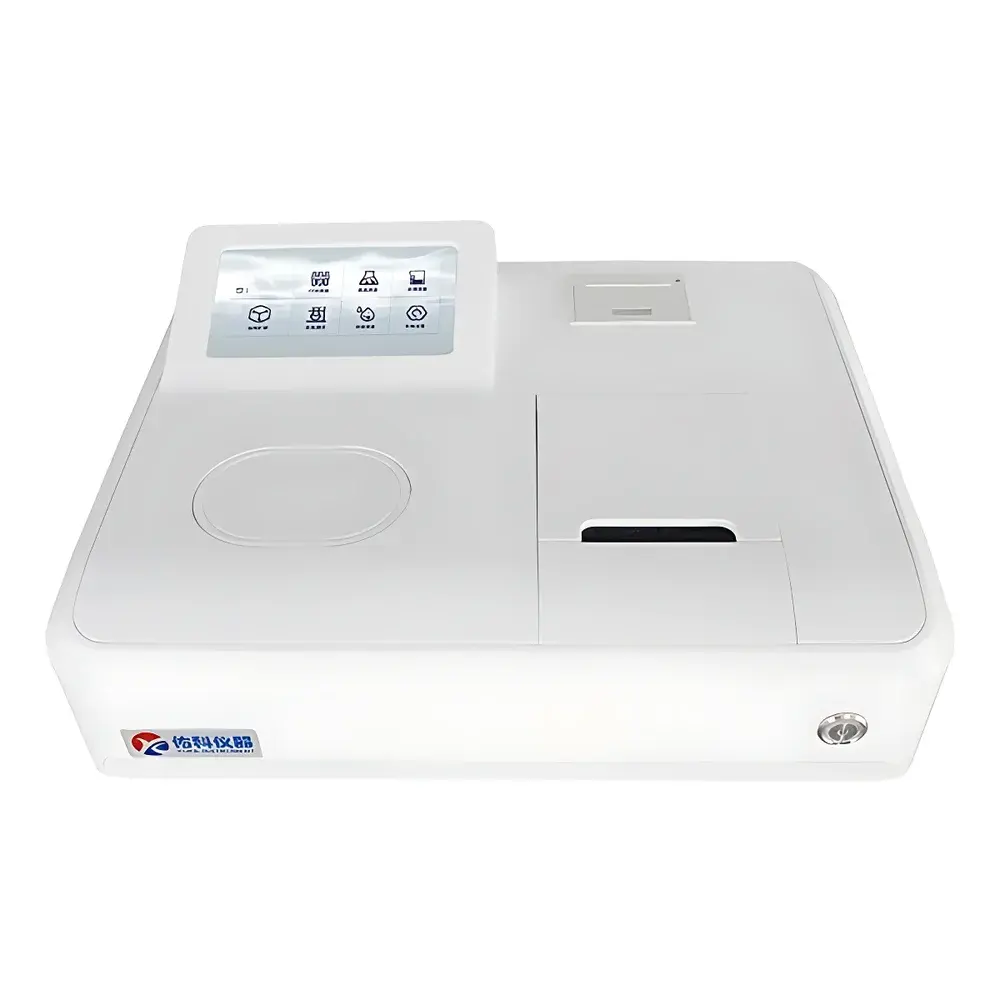
Yoke ITS2001 Multi-Parameter Water Quality Analyzer
| Brand | Yoke |
|---|---|
| Origin | Shanghai, China |
| Manufacturer Type | Direct Manufacturer |
| Product Category | Domestic (China-Made) |
| Model | ITS2001 |
| Price Range | USD 280–1,400 (FOB Shanghai) |
| Instrument Type | Benchtop Laboratory Water Quality Analyzer |
| Measurable Parameters | 65 parameters (excluding Total Nitrogen), selectable one at a time |
| Wavelength Accuracy | ±0.5 nm |
| Display | 5.6-inch color capacitive touchscreen |
| Data Interfaces | USB 2.0, RS-232 serial port |
| Built-in Printer | Thermal printer with direct data/print queue support |
| Light Source | Cold LED source with narrow-band interference filters |
| Processor | ARM9 core with 512 MB onboard memory |
| Calibration Curves | 5 factory-loaded standard curves + 195 user-expandable curves |
| Data Storage Capacity | ≥5,000 measurement records |
| Custom Curve Support | Yes, with adjustable segmental calibration coefficients (K-factors) |
| Reagent Compatibility | Lab-YY pre-formulated reagent kits (ASTM D1253, ISO 6060, HJ 399–2007, HJ 535–2009 compliant) |
| Measurement Principles | UV-Vis spectrophotometry (single-beam, fixed-wavelength or dual-wavelength modes), turbidimetry, nephelometry, and colorimetry per parameter-specific method |
Overview
The Yoke ITS2001 Multi-Parameter Water Quality Analyzer is a benchtop spectrophotometric platform engineered for precise, standardized analysis of physicochemical and contaminant parameters in drinking water, wastewater, surface water, and industrial effluents. It operates on the principle of absorbance-based photometry—employing narrow-band interference filters and cold LED light sources to deliver stable, drift-free optical performance across defined wavelength channels (e.g., 420 nm for ammonia, 620 nm for total phosphorus, 850 nm for turbidity). Each measurement follows internationally harmonized analytical protocols—including ASTM D1253 (COD), ISO 7150-1 (ammonia), ISO 6878 (total phosphorus), and Chinese EPA standards (HJ series)—ensuring traceability and regulatory alignment for laboratories operating under GLP or ISO/IEC 17025 frameworks.
Key Features
- 5.6-inch high-resolution color touchscreen with intuitive GUI navigation—designed for rapid method selection, real-time graphing, and multi-level user access control (operator, supervisor, administrator).
- Dual-mode optical architecture: fixed-wavelength photometry for routine compliance testing and programmable dual-wavelength correction for matrix interference compensation (e.g., turbidity correction in colorimetric ammonia assays).
- Onboard thermal printer supporting immediate hardcopy output of current results, historical datasets, and calibration reports—fully traceable with timestamp, operator ID, and method version stamp.
- ARM9-based embedded system with 512 MB flash memory and real-time OS—enabling simultaneous data logging, curve interpolation, and USB mass-storage mode without host PC dependency.
- Optical stability maintained via temperature-compensated LED drivers and precision interference filters (±0.5 nm bandwidth tolerance), minimizing recalibration frequency and improving inter-day reproducibility (RSD < 2.5% at mid-range concentrations).
- Expandable calibration framework: supports up to 195 user-defined calibration curves with segmented K-coefficients—critical for nonlinear ranges (e.g., COD 10–100 mg/L vs. 100–1000 mg/L) and matrix-matched standards.
Sample Compatibility & Compliance
The ITS2001 accepts standard 10 mm, 25 mm, and 50 mm rectangular cuvettes (quartz or optical-grade plastic), accommodating both liquid-phase samples and digested reagent mixtures. All listed parameters—including COD, ammonia nitrogen, total phosphorus, turbidity (NTU), residual chlorine, heavy metals (Cr⁶⁺, Pb²⁺, Cd²⁺, Ni²⁺, Cu²⁺), and organic contaminants (formaldehyde, phenol, cyanide)—are validated per national and international reference methods. The instrument’s measurement workflows comply with HJ 399–2007 (COD), HJ 535–2009 (NH₃-N), HJ 671–2013 (TP), and ISO 7027-1:2016 (turbidity by nephelometry). Data integrity meets FDA 21 CFR Part 11 requirements when used with audit-trail-enabled software extensions (optional LabLink Suite).
Software & Data Management
Data acquisition, storage, and export are managed through the embedded firmware interface—no external PC required for daily operation. All measurements are automatically timestamped and tagged with operator ID, method name, calibration status, and cuvette pathlength. The internal database stores ≥5,000 records with full metadata (sample ID, date/time, QC flags, curve ID). USB export supports CSV and PDF report generation compatible with LIMS integration. Optional LabLink Suite (Windows-based) enables remote instrument control, advanced statistical reporting (ANOVA, trend analysis), electronic signature workflows, and automated backup to network drives—fully aligned with ISO/IEC 17025 clause 7.7 (result reporting) and GLP Principle 5 (data retention).
Applications
The ITS2001 serves environmental monitoring labs, municipal water treatment facilities, university research centers, and industrial QA/QC departments requiring rapid, standardized analysis across diverse matrices. Typical use cases include: routine compliance monitoring of drinking water per GB 5749–2022; wastewater discharge verification against GB 8978–1996; nutrient loading assessment in eutrophication studies; heavy metal screening in electroplating effluents; and method validation for accredited testing per CNAS-CL01:2018. Its modular parameter selection allows dedicated deployment in field labs—e.g., configuring only COD/NH₃-N/TP for WWTP influent/effluent tracking—or full-spectrum analysis in central reference labs.
FAQ
Does the ITS2001 support automatic wavelength selection?
No—it uses fixed-wavelength optical modules optimized per parameter; users manually select the appropriate method, and the instrument engages the corresponding filter/LED pair.
Can calibration curves be exported or backed up externally?
Yes—via USB drive in .csv format; curve metadata (date, operator, R², range) is preserved for audit purposes.
Is the thermal printer compatible with continuous label stock?
It accepts standard 57 mm thermal paper rolls only; custom label formats require external printing via LabLink Suite.
What is the recommended maintenance interval for optical alignment?
No routine optical alignment is required; the cold LED and interference filter assembly is factory-aligned and sealed—only annual verification using NIST-traceable neutral density filters is advised.
Are Lab-YY reagents certified for ISO/IEC 17025 testing?
Lab-YY reagent kits carry batch-specific CoA documents referencing HJ and ISO method equivalency; full accreditation requires lab-specific validation per ISO/IEC 17025 clause 7.2.2.
Related Products







