
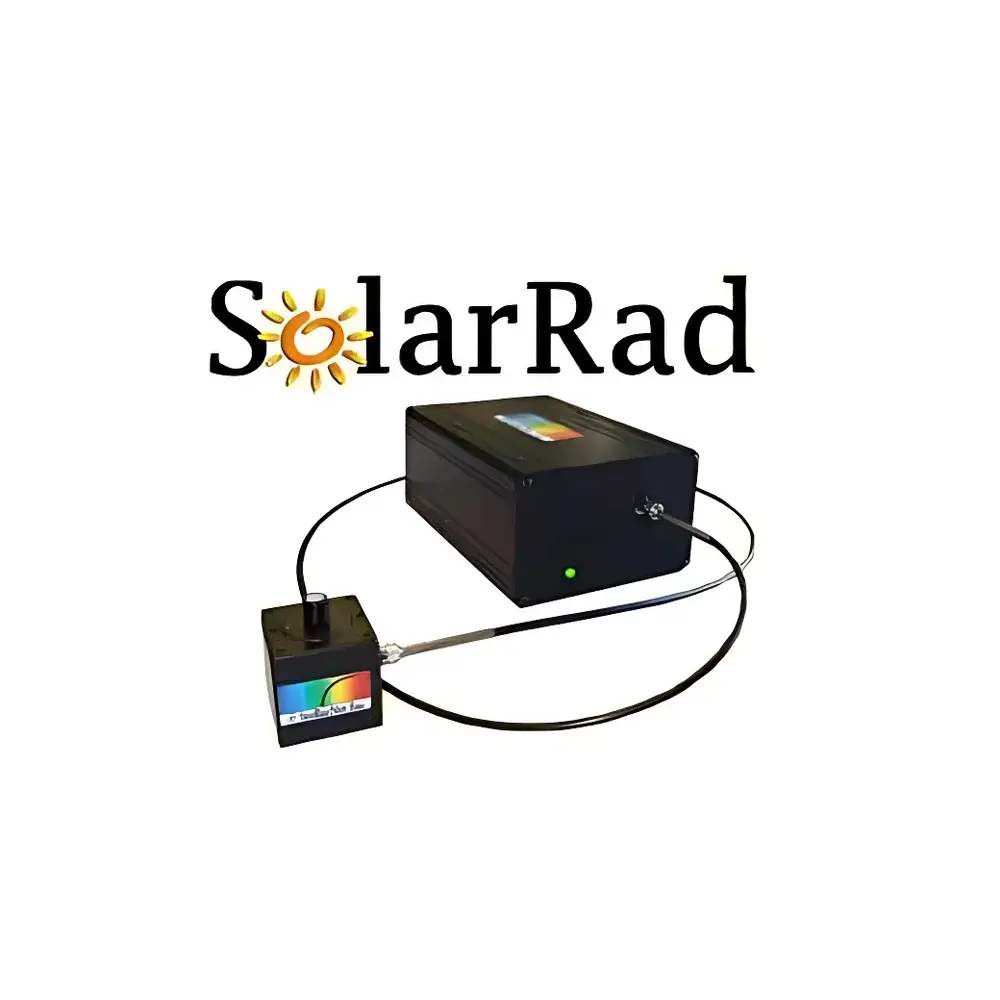
StellarNet SolarRad Solar Spectral Radiometer
| Brand | StellarNet |
|---|---|
| Origin | USA |
| Model | SolarRad |
| Spectral Range | 220–1100 nm (SolarRad), 200–1700 nm (SolarRad-DSR) |
| NIST-Traceable Irradiance Calibration | 300–1100 nm (UV-extended option available) |
| Spectral Resolution | <1.5 nm (VIS), <3 nm (NIR for DSR) |
| Detector | 2048-pixel CCD (SolarRad), 2048-pixel CCD / 512-pixel InGaAs PDA (SolarRad-DSR) |
| Cosine Receiver | CR2 with optional right-angle adapter |
| Wavelength Accuracy | <0.25 nm |
| Irradiance Accuracy | ±5% |
| Interface | USB 2.0 |
| Software | SpectraWiz® Suite, LabVIEW drivers, SDK for C/VB/VBA |
Overview
The StellarNet SolarRad Solar Spectral Radiometer is a laboratory-grade, NIST-traceable instrument engineered for absolute spectral irradiance measurement across the solar spectrum. It operates on the principle of dispersive spectroscopy using a high-efficiency BLACK-Comet concave holographic grating spectrometer—optimized for UV-enhanced response and low stray light. The system captures spectral power distribution (SPD) from 220 nm to 1100 nm (standard) or extends to 1700 nm in the SolarRad-DSR configuration, covering ultraviolet-A/B/C, visible, near-infrared (NIR), and short-wave infrared (SWIR) bands critical for photobiological, photovoltaic, and lighting applications. Designed for direct irradiance quantification in W/m²/nm, the SolarRad integrates a calibrated CR2 cosine-corrected optical receiver to ensure angular response compliance with CIE 69 and ISO/CIE 13822 standards for hemispherical irradiance measurement. Its USB-powered architecture enables plug-and-play operation without external power supplies or cooling units—making it suitable for field deployment, lab-based calibration, and integration into automated test benches.
Key Features
- NIST-traceable absolute irradiance calibration across 300–1100 nm (UV-extended calibration available); full traceability documentation provided with each unit
- High-fidelity BLACK-Comet spectrometer with UV-enhanced coating and <1.5 nm spectral resolution (VIS), enabling precise discrimination of narrowband solar simulator emissions
- Dual-detector option (SolarRad-DSR): 2048-pixel Si CCD + 512-pixel InGaAs PDA for seamless 200–1700 nm coverage with optimized signal-to-noise ratio in both UV-VIS and NIR regions
- CR2 cosine receptor compliant with IEC 60904-9 and ASTM E2758 for accurate angular response under diffuse and direct irradiance conditions
- Real-time calculation of PAR (Photosynthetically Active Radiation, 400–700 nm), YPF (Yield Photon Flux, 360–760 nm), and PPFD (Photosynthetic Photon Flux Density)
- Integrated UV-A/B/C dose monitoring with time-stamped exposure logging and cumulative irradiance tracking per band
Sample Compatibility & Compliance
The SolarRad is compatible with continuous and pulsed broadband sources including xenon arc lamps, metal halide, LED-based solar simulators, natural sunlight (via tripod-mounted cosine receptor), and industrial UV curing systems. It meets key international compliance requirements for spectral characterization: IEC 60904-9 (Class A–D solar simulator classification), JIS C 8912, ASTM E927-22, and ISO 9060:2018 (spectroradiometer classification). All irradiance calibrations are performed in accordance with NIST SP 250-95 and ISO/IEC 17025-accredited procedures. The system supports GLP-compliant data acquisition through audit-trail-enabled SpectraWiz® software, with timestamped metadata, user authentication logs, and exportable reports adhering to FDA 21 CFR Part 11 electronic record requirements.
Software & Data Management
SpectraWiz® Suite provides a modular, application-specific interface for solar spectral analysis. Core modules include Solar Match™—a dedicated algorithm that compares measured spectra against IEC/JIS/ASTM reference curves across eight wavelength bands (400–500 nm through 1000–1100 nm) and generates pass/fail classification reports for solar simulator Class A–D verification. Additional modules support CIELAB color space analysis (CIE 1931/1976), luminous flux calculation (lm/m²), UV dose accumulation (J/m²), time-series irradiance trending, and PSD (Power Spectral Density) analysis. Raw spectral data is stored in vendor-neutral .csv and .spc formats; API access via LabVIEW, C, VB, and VBA enables integration into custom QA/QC workflows and LIMS environments.
Applications
- Photovoltaic R&D: Spectral mismatch correction for cell efficiency testing under non-standard illumination
- Plant science & horticultural lighting: Quantification of PAR, YPF, and phytochrome-weighted irradiance for growth chamber validation
- Solar simulator qualification: Full-spectrum classification per IEC 60904-9 Annex D and ASTM E927-22
- Environmental photometry: Long-term solar spectral monitoring for climate studies and UV index modeling
- UV curing process control: Real-time radiometric feedback for dosage-critical polymerization and inkjet printing
- Material degradation testing: Accelerated aging correlation using spectrally resolved UV exposure metrics
FAQ
What spectral range is factory-calibrated for absolute irradiance?
The standard SolarRad is calibrated from 300–1100 nm. UV extension down to 220 nm and NIR extension up to 1700 nm (SolarRad-DSR) are available with full NIST-traceable calibration certificates.
Can the SolarRad be used outdoors for direct sunlight measurements?
Yes—when mounted with the CR2 cosine receptor on a stable platform and leveled using its integrated bubble level, the system complies with ISO 9060:2018 secondary standard requirements for global horizontal irradiance (GHI) measurement.
Does the system support automated compliance reporting for solar simulator Class A–D certification?
Yes—Solar Match™ generates IEC-compliant comparison tables and deviation plots, including weighted spectral mismatch factor (MMF) calculations required by IEC 60904-9.
Is firmware or calibration update support included post-purchase?
StellarNet provides lifetime firmware updates and optional recalibration services traceable to NIST SRM 2271 and 2272, with documented uncertainty budgets per ISO/IEC 17025.
How is detector linearity verified across the dynamic range?
Each unit undergoes multi-point linearity verification using neutral density filter stacks and calibrated tungsten-halogen sources, with results documented in the calibration report.





