
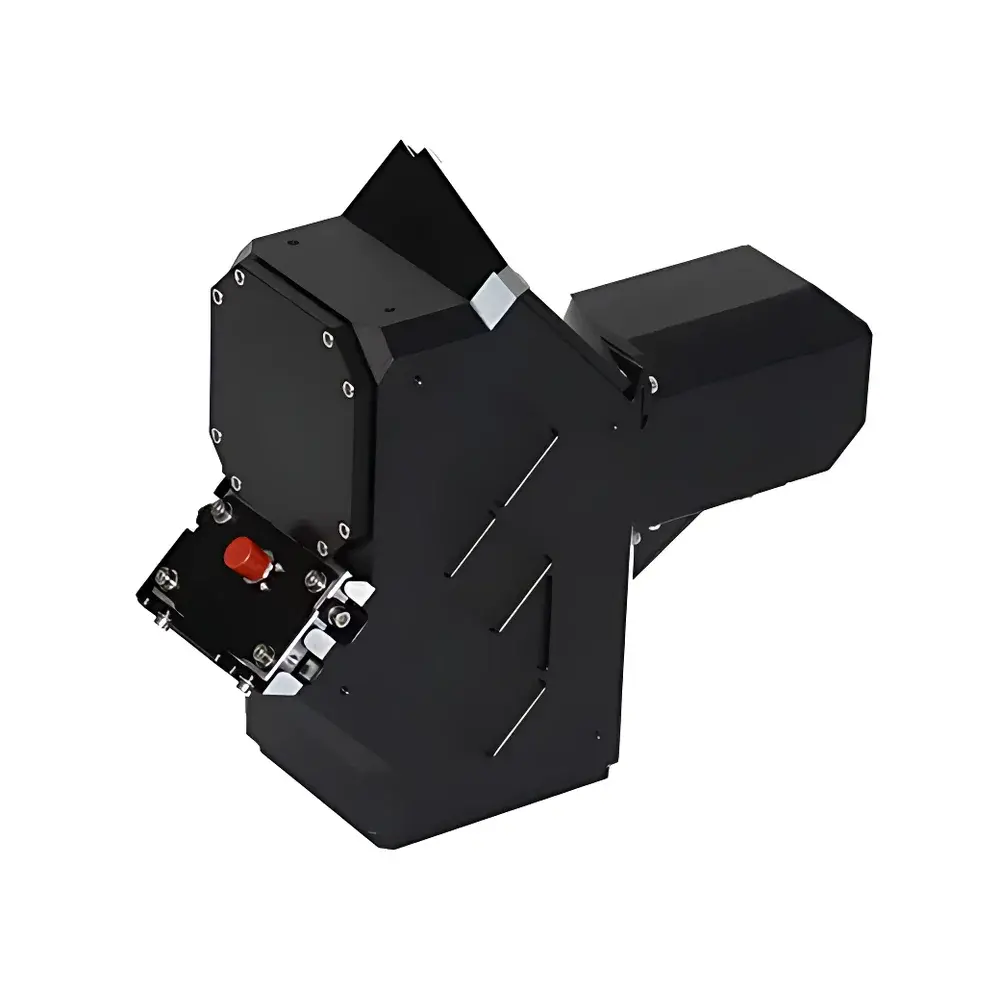
Spectral Industries IRIS Echelle Spectrometer
| Origin | Netherlands |
|---|---|
| Manufacturer Type | Authorized Distributor |
| Origin Category | Imported |
| Model | IRIS |
| Pricing | USD 27,500 (FOB) |
| Application System | Universal |
| Grating Configuration | Dual Echelle Gratings |
| Spectral Resolution | 0.1–0.45 nm (with 25 µm × 100 µm slit) |
| Dispersion | Echelle + Cross-Disperser Architecture |
| Wavelength Range | 180–800 nm |
| F-number | f/2 |
| Wavelength Accuracy | ±0.1–0.45 nm |
| Stray Light Rejection | < 1×10⁻⁵ (typical, per ISO 14644-1 cleanroom-aligned optical alignment) |
Overview
The Spectral Industries IRIS Echelle Spectrometer is a high-performance, compact dispersive spectrometer engineered for demanding elemental analysis applications—including Laser-Induced Breakdown Spectroscopy (LIBS), plasma diagnostics, astrophysical calibration, and time-resolved emission spectroscopy. Its optical architecture implements a true echelle grating configuration coupled with a prism or grating cross-disperser, enabling simultaneous full-spectrum acquisition across the vacuum ultraviolet to near-visible range (180–800 nm) without mechanical scanning. Derived from flight-proven optical designs developed for the ESA/Roscosmos ExoMars mission, the IRIS platform integrates heritage-grade thermal and mechanical stability with modern CMOS-based detection. The f/2 input optics deliver exceptional light throughput—among the highest in commercial echelle systems—while maintaining diffraction-limited performance across its entire spectral range. Designed for both laboratory benchtop use and embedded OEM integration, the IRIS operates as a stand-alone spectral engine or as a core module within automated analytical platforms.
Key Features
- f/2 Optical Throughput: Maximizes signal collection efficiency for low-light and transient emission sources—critical for LIBS, spark ablation, and pulsed plasma diagnostics.
- Dual-Echelle Grating Design: Combines high angular dispersion with broad spectral coverage; eliminates need for grating rotation or wavelength scanning.
- UV-Optimized CMOS Detector: Back-illuminated, deep-depletion sensor with enhanced quantum efficiency below 200 nm and on-chip binning capability.
- Precision Timing Engine: Hardware-level trigger synchronization with 100 ns delay resolution, ±10 ns jitter, and minimum shutter duration of 28 µs—enabling gated spectral acquisition synchronized to laser pulses.
- Thermal & Mechanical Stability: Monolithic aluminum housing with passive thermal management; wavelength drift < 5 ppm/K over operational temperature range (15–30 °C).
- Compact Form Factor: Dimensions 220 mm × 195 mm × 80 mm; total mass 3.0 kg including integrated detector—optimized for field-deployable and mobile LIBS systems.
- Ethernet Interface (GigE Vision compliant): Enables deterministic data streaming at up to 20 full-frame spectra per second (1024 × 1024 pixels), with metadata timestamping traceable to IEEE 1588 PTP.
Sample Compatibility & Compliance
The IRIS spectrometer is compatible with a wide range of excitation sources—including Q-switched Nd:YAG lasers (266 nm, 532 nm, 1064 nm), microwave-induced plasmas, glow discharges, and arc/spark sources. Its 180 nm lower cutoff supports direct detection of key elemental lines such as Al I (186.27 nm), Mg II (189.19 nm), and C I (193.03 nm). All optical surfaces are coated for UV durability and resistance to ozone exposure. The system complies with IEC 61326-1 (EMC for laboratory equipment) and meets mechanical shock/vibration requirements per MIL-STD-810G Method 516.6. For regulated environments, raw spectral data logs support audit trails compliant with FDA 21 CFR Part 11 when used with validated software configurations (e.g., SpectralControl Suite v4.2+).
Software & Data Management
Spectral Industries provides the IRIS Control & Analysis Suite—a modular, cross-platform application built on Qt and HDF5. Core capabilities include real-time spectrum visualization, pixel-to-wavelength calibration (using Hg/Ne/Ar lamp libraries), intensity normalization, background subtraction, peak identification (NIST Atomic Spectra Database v2023), and quantitative chemometric modeling (PLS-R, PCA). Data export supports ASCII, CSV, and self-describing HDF5 formats with embedded metadata (exposure time, trigger delay, ambient temperature, grating position). Remote operation is supported via RESTful API and Python SDK (PyIRIS), enabling integration into LabVIEW, MATLAB, or custom LIMS workflows. Firmware updates are delivered over Ethernet with SHA-256 signature verification and rollback protection.
Applications
- Laser-Induced Breakdown Spectroscopy (LIBS) for rapid, multi-elemental analysis of metals, soils, polymers, and geological samples.
- In-line process monitoring in metallurgy and additive manufacturing, where real-time alloy composition tracking is required.
- Plasma characterization in fusion research (e.g., edge-localized mode studies) and industrial plasma etching.
- Astrophysical instrument calibration using traceable line sources and solar spectrum reference libraries.
- Environmental monitoring of atmospheric trace gases via differential optical absorption spectroscopy (DOAS) in open-path configurations.
- OEM integration into portable handheld analyzers, UAV-mounted sensors, and robotic sampling platforms.
FAQ
What spectral calibration standards are supported?
The IRIS supports NIST-traceable calibration using Hg, Ne, Ar, and Xe emission lamps. Automated multi-line fitting routines correct for non-linear dispersion and pixel response variations.
Is vacuum purging or nitrogen purging required for operation below 190 nm?
Operation down to 180 nm is achievable under dry air purge (dew point < −40 °C) or continuous N₂ flow; no vacuum enclosure is needed.
Can the IRIS be synchronized with third-party lasers or detectors?
Yes—via TTL-compatible trigger I/O (5 V CMOS), SMA-sync ports, and programmable delay generators. Full timing register access is exposed through the API.
What is the typical spectral pixel resolution and how is it validated?
Pixel resolution is 0.005–0.015 nm/pixel depending on order overlap and slit geometry. Validation follows ISO 14212-2 using well-isolated Fe/Ar lines and Gaussian deconvolution of instrumental line profiles.
Does the system support GMP/GLP-compliant data handling?
When deployed with SpectralControl Suite in “Audit Mode”, all user actions, parameter changes, and raw acquisitions are logged with digital signatures, timestamps, and operator IDs—fully aligned with ALCOA+ principles.





