
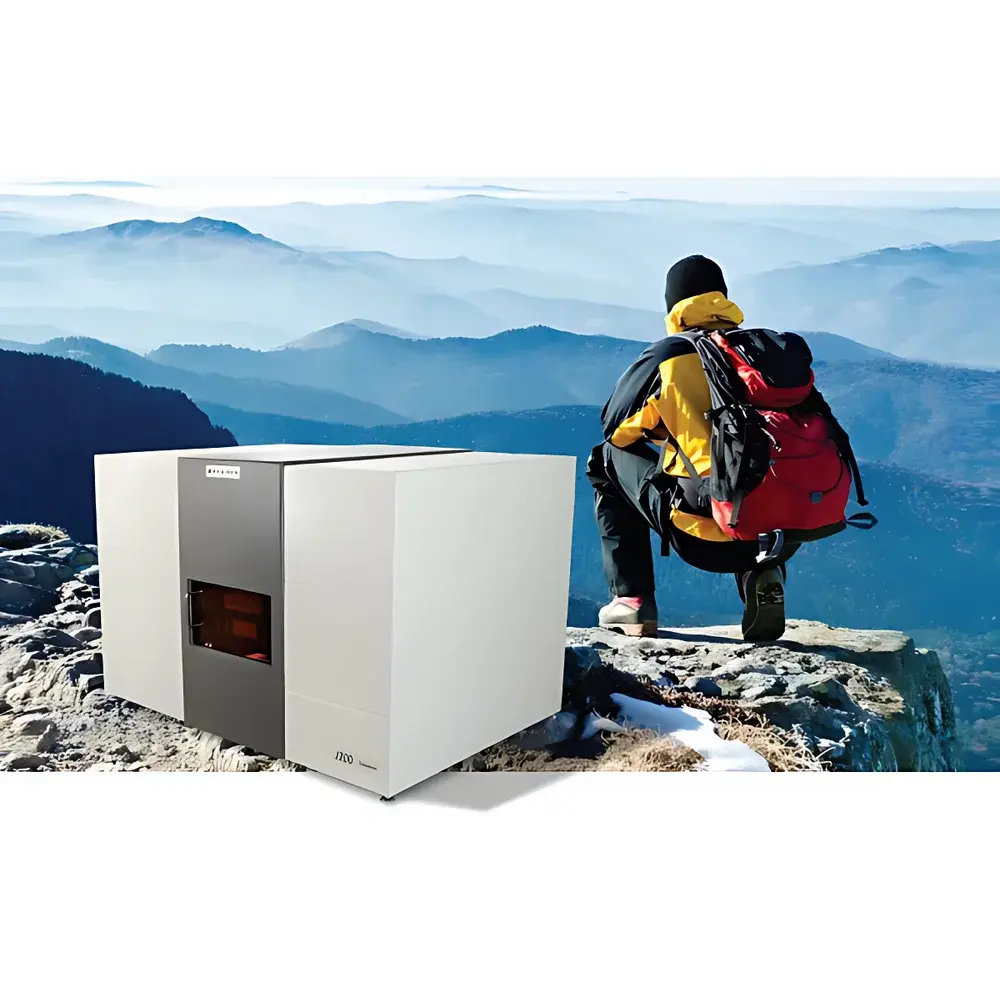
TEO LIBS Integrated Online Laser-Induced Breakdown Spectroscopy System
| Brand | TEO |
|---|---|
| Origin | Beijing, China |
| Manufacturer Type | Authorized Distributor |
| Product Origin | Domestic (China) |
| Model | Integrated Online LIBS System |
| Price Range | USD 210,000 – 280,000 |
| Instrument Type | Online |
| Integration Level | Fully Integrated |
| Core Components | Q-switched Nd:YAG Laser Source, Echelle or Czerny–Turner Spectrometer, ICCD Detector, Synchronization Controller, LIBS-Specific Acquisition & Analysis Software |
Overview
The TEO Integrated Online LIBS System is an engineered solution for real-time, in-situ elemental analysis based on Laser-Induced Breakdown Spectroscopy (LIBS) principles. It employs a high-stability, nanosecond-pulsed Nd:YAG laser to ablate micro-volumes of solid, liquid, or aerosol samples, generating transient plasma at temperatures exceeding 10,000 K. The emitted atomic and ionic line spectra—spanning the deep UV to near-IR (e.g., 120–1090 nm)—are collected and resolved by a high-throughput spectrometer and detected with sub-nanosecond temporal gating. Unlike conventional laboratory-based techniques requiring sample digestion or vacuum environments, this system delivers direct, matrix-tolerant, multi-element detection without calibration standards for qualitative screening, and supports quantitative analysis when coupled with certified reference materials and robust chemometric modeling. Its online deployment architecture enables continuous monitoring in industrial process streams, conveyor-belt sorting, scrap metal verification, and hazardous environment surveillance—meeting operational requirements for minimal downtime, low maintenance, and long-term signal reproducibility.
Key Features
- Fully integrated hardware platform: Co-aligned laser source, collection optics, spectrometer, and gated ICCD detector housed within a single thermally stabilized enclosure.
- Modular laser options: Includes lamp-pumped Ultra/CFR series (1064/532/355/266 nm) and diode-pumped Viron/Q-SMART series (up to 1 J @ 1064 nm, 1–20 Hz repetition rate), all qualified for 7×24 operation under temperature cycling (−10°C to +50°C) and mechanical vibration per MIL-STD-810G.
- Time-resolved spectral acquisition: iStar ICCD detectors provide optical gate widths down to 2 ns, 10⁸ UV extinction ratio via IntelliGate™ MCP–photocathode synchronization.
- Echelle spectroscopy option: Andor Mechelle 5000 delivers constant resolving power (R = 6000), full spectral coverage (200–975 nm) in a single exposure, zero moving parts, and dual-prism dispersion to suppress inter-order overlap.
- Czerny–Turner configuration: Available with focal lengths of 193 mm, 328 mm, 500 mm, or 750 mm; compatible with UV–Vis–NIR optimized ICCDs for application-specific resolution/sensitivity trade-offs.
- Precision timing control: Stanford Research DG645 digital delay generator provides four independent TTL channels, <25 ps RMS jitter, 5 ps delay resolution, and up to 10 MHz trigger frequency for plasma evolution studies and LA-LIBS synchronization.
Sample Compatibility & Compliance
The system accommodates heterogeneous solids (metals, ores, polymers, soils), liquids (slurries, electrolytes), and particulate-laden gases without preprocessing. It complies with ISO/IEC 17025:2017 general requirements for competence of testing and calibration laboratories, and supports audit-ready data integrity through time-stamped, immutable acquisition logs. When deployed in regulated environments (e.g., metallurgical QA/QC or recycling compliance), it meets traceability requirements per ASTM E2926–22 (Standard Test Method for Determination of Elemental Composition by LIBS) and aligns with GLP documentation workflows. Optional integration with Tadem LA-LIBS modules enables hybrid ablation–spectroscopy coupling for spatially resolved depth profiling and ICP-MS correlation studies.
Software & Data Management
Acquisition and analysis are managed via a Windows-based platform supporting real-time spectral visualization, background subtraction, peak identification (NIST Atomic Spectra Database v2023), and multivariate regression (PLS, PCA). All raw spectra, metadata (laser energy, gate delay, ambient conditions), and processing parameters are stored in HDF5 format with SHA-256 checksums. The software includes FDA 21 CFR Part 11-compliant user access control, electronic signatures, and audit trail functionality—including operator actions, parameter changes, and report generation timestamps. Export formats include CSV, ASCII, and .spc for third-party chemometric tools (e.g., Unscrambler®, MATLAB®).
Applications
- Industrial process control: Real-time alloy grade verification on hot-rolling lines, slag composition feedback in steelmaking, and contaminant detection in battery cathode recycling streams.
- Geoscience & mining: Field-deployable rock/mineral classification using handheld StellarCASE variants; lab-based ore assay validation with echelle-ICCD configurations.
- Environmental monitoring: In-situ heavy metal screening in soil cores, airborne particulate analysis (PM₂.₅/PM₁₀), and nuclear decommissioning surface contamination mapping.
- Research & development: Plasma kinetics studies via time-resolved spectral imaging, calibration-free LIBS (CF-LIBS) method development, and LA-LIBS correlative analysis for microstructure–composition relationships.
- Forensics & cultural heritage: Non-contact pigment analysis in paintings, counterfeit coin authentication, and glass fragment provenance determination.
FAQ
What is the typical detection limit for major elements (e.g., Fe, Al, Si) in steel using this system?
Detection limits vary with matrix, laser fluence, and integration time; typical values range from 10–100 ppm for major alloying elements under optimized online measurement conditions.
Can the system operate in explosive or dusty industrial atmospheres?
Yes—optional ATEX Zone 2 / IECEx-certified enclosures and purged optical paths are available for hazardous area deployment.
Is spectral calibration traceable to NIST standards?
Yes—wavelength calibration uses Hg/Ne/Ar hollow-cathode lamps with NIST-traceable emission lines; intensity calibration is supported via calibrated photodiode monitoring of laser pulse energy.
Does the software support automated pass/fail decision logic for production QA?
Yes—customizable rule-based triggers can initiate alarms, reject signals, or log deviations based on pre-defined elemental thresholds or spectral similarity metrics.
What maintenance intervals are recommended for continuous 24/7 operation?
Laser flashlamps require replacement after ≥10⁸ shots (typically 12–18 months); spectrometer alignment is factory-locked and requires no field adjustment; ICCD gain calibration is performed automatically at startup.



